When most people picture wedding vows, they hear the same rhythm: for better, for worse, for richer, for poorer. Those traditional wedding vows are almost 500 years old, and they are still the words couples choose most, in churches, in registry offices, and on beaches with a celebrant who has never set foot in a church.
They are only one tradition, though. A Catholic couple answers three questions before they say anything like them. A Hindu couple makes seven promises in seven steps. At a Nikah, the vows are an offer and an acceptance. At a Greek Orthodox wedding, the couple doesn't speak vows at all.
This guide gives you the full traditional vows word for word, explains what each line means and where it came from, shows how vows differ across faiths and cultures, and sets out the words the law actually requires in the US, UK, Europe, Australia and beyond. It's written for couples choosing their words, and for anyone planning a wedding that brings two traditions or two countries together, which is where Wonderland Concierge spends much of its time.
Traditional wedding vows are fixed promises that a faith community or legal system has used, largely unchanged, for generations. Three things make a vow traditional rather than personal:
The words are fixed. You say an established text rather than writing your own.
A community stands behind them. A church, a religious law, or a marriage statute set the words, not the couple.
They have a long history. Couples have said the same words for centuries, so your promise joins theirs.
That is different from personal vows, which you write yourselves, and from "classic" vows, a loose term for any vow with a formal, old-fashioned tone. Many couples now do both: they say the traditional vow and add a few personal lines, which we cover further down.
In English-speaking countries, "traditional wedding vows" almost always means one text: the vow from the Book of Common Prayer.
The best-known version comes from the Church of England's Book of Common Prayer. Archbishop Thomas Cranmer compiled it in 1549, drawing on older Latin marriage rites used in medieval England, and it was revised in 1662. The 1662 text is the source of almost every "traditional" vow you've heard.
I, [name], take thee, [name], to my wedded wife, to have and to hold from this day forward, for better for worse, for richer for poorer, in sickness and in health, to love and to cherish, till death us do part, according to God's holy ordinance; and thereto I plight thee my troth.
Source: The Form of Solemnization of Matrimony, Book of Common Prayer (1662)
I, [name], take thee, [name], to my wedded husband, to have and to hold from this day forward, for better for worse, for richer for poorer, in sickness and in health, to love, cherish, and to obey, till death us do part, according to God's holy ordinance; and thereto I give thee my troth.
Source: The Form of Solemnization of Matrimony, Book of Common Prayer (1662)
Notice the two differences. Only the bride promises to "obey", and the groom "plights" his troth (pledges his faithfulness) while the bride "gives" hers.
Most churches and celebrants now use updated wording, where "thee" becomes "you" and both people make the same promise. This is the Church of England's current version:
I, [name], take you, [name], to be my wife/husband, to have and to hold from this day forward; for better, for worse, for richer, for poorer, in sickness and in health, to love and to cherish, till death us do part, according to God's holy law. In the presence of God I make this vow.
Source: Church of England, Common Worship marriage service (in use since 2000)
For a civil ceremony, drop the religious closing line. If "wife" or "husband" doesn't fit, use "spouse" or "partner", which most marriage laws now allow (see the legal section below):
I, [name], take you, [name], to be my spouse, to have and to hold from this day forward, for better, for worse, for richer, for poorer, in sickness and in health, to love and to cherish, for as long as we both shall live.
The 1662 ring words are among the most quoted lines in English:
With this Ring I thee wed, with my body I thee worship, and with all my worldly goods I thee endow.
Source: Book of Common Prayer (1662)
"Worship" here meant honor in 1662, not religious worship. Most modern services simplify it to something like "I give you this ring as a sign of our marriage."
Each phrase in the traditional vow was chosen on purpose. Here is what the words meant when they were written, and what they promise now.

This is the heart of the vow: a free choice, made out loud. In Christian, Jewish and civil law alike, a marriage depends on both people consenting freely, which is why so many ceremonies ask "Do you take...?" before anything else. By saying "I take you", you are declaring that nobody else is making this decision for you. Everything after this line describes what the choice commits you to.
"To have and to hold" is older than the wedding service. It comes from English property law, where a deed granted land "to have and to hold", meaning to own and keep. Cranmer borrowed the formula, but in the vow it describes belonging together, not ownership. "To hold" also carries its older sense of keeping safe and caring for. "From this day forward" marks the moment the promise takes effect: today, not someday.
This is the most honest line in the vow. It admits that marriage will include bad seasons, and it promises that those seasons won't end the commitment. It's also the reason couples often say the traditional vows feel more serious than personal ones: they plan for hard times rather than only celebrating good ones.
Money is one of the most common causes of conflict in a marriage, and the vow names it directly. You're promising that a lost job, a debt or a windfall doesn't change the terms. In 1549, when marriage was also an economic arrangement, this was a serious legal promise as well as a personal one.
This is a promise to care for each other through illness, injury and ageing. Couples who have nursed a partner through serious illness often say this is the line that meant the most, years later.
Love is the commitment. To cherish is to treat your spouse as precious and to keep showing it. In the 1662 text, this is where the bride's vow added "and to obey".
This is the lifelong promise: the marriage ends only with death. The word order sounds odd to modern ears. The original was "till death us depart", where depart meant "separate". As depart changed meaning, the phrase became "till death us do part", and it has stayed that way ever since. Many modern versions say "as long as we both shall live" instead.
The closing words place the promise in a religious setting. Troth is an old word for truth or faithfulness (it shares a root with "betrothed"), so "I plight thee my troth" means "I pledge you my faithfulness." Civil versions leave these lines out.
Only the bride promised to obey in 1662. The Church of England's proposed 1928 Prayer Book made the promise optional, and most couples today leave it out. Some churches still offer an alternative form where the bride can include it, or where both partners promise to serve each other. If "obey" matters to you, or if you want to be certain it isn't in your service, ask your minister which form they use.
Most Protestant churches use a version of the Book of Common Prayer vow, with small changes in wording. Here is how the main traditions differ.

These use the 1662 text or its modern revision (Common Worship in England, the Book of Common Prayer 1979 in the US Episcopal Church). The Church of England treats its official vows as fixed and says they can't be changed, so personal words go into readings, music or a separate moment in the service.
These traditions mostly keep the familiar structure (take, have and hold, better and worse, richer and poorer, sickness and health, love and cherish, as long as we both shall live) and adjust the phrasing. Baptist and non-denominational churches often give couples more room to add their own words. Your minister will have the exact text, and many are happy to show you two or three options.
In the Greek Orthodox tradition, the couple doesn't speak vows at all. Their consent is shown through the rite itself: the rings are exchanged three times during the betrothal, crowns (stefana) joined by a ribbon are placed on the couple's heads, they share a common cup, and they walk three times around the table in the "Dance of Isaiah". In the Russian and other Slavic Orthodox rites, the priest asks each person whether they come of their own free will and haven't promised themselves to anyone else. Crowning is also central in the Coptic Orthodox and Maronite churches of Egypt, Lebanon, Syria and the Middle Eastern diaspora.
If you're marrying into an Orthodox family and want spoken vows, talk to the priest early. Some parishes outside traditional Orthodox countries allow them; many don't.
Quaker weddings have no officiant. During a meeting for worship, the couple stand and make their declaration to each other:
Friends, I take this my friend, [name], to be my spouse, promising, through divine assistance, to be unto him/her a loving and faithful spouse, so long as we both on earth shall live.
Source: Quaker faith & practice, chapter 16 (Britain Yearly Meeting). "Spouse" may be replaced by wife, husband or partner in marriage, and "through divine assistance" by "with God's help".
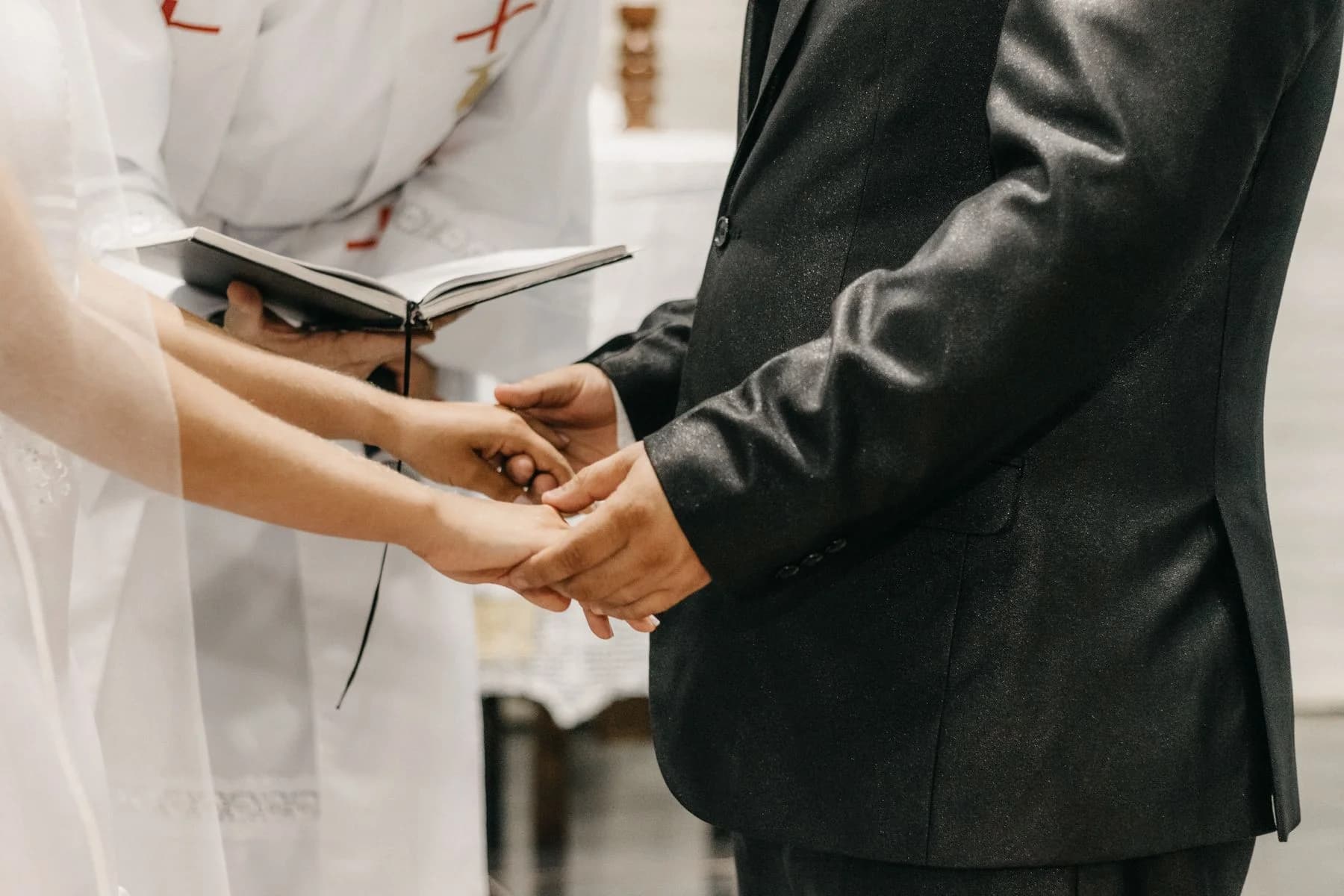
Catholic vows come from the Order of Celebrating Matrimony, the Church's official rite. Unlike most Protestant weddings, the words aren't open to editing: the couple must use one of the approved forms. The vows are also only one part of a three-step exchange.

The priest or deacon asks the couple three questions, and each person answers:
Have you come here to enter into marriage without coercion, freely and wholeheartedly? "I have."
Are you prepared, as you follow the path of marriage, to love and honor each other for as long as you both shall live? "I am."
Are you prepared to accept children lovingly from God and to bring them up according to the law of Christ and his Church? "I am." (This question may be left out, for example when the couple are older.)
The first form, used at most Catholic weddings in the US:
I, [name], take you, [name], to be my wife/husband. I promise to be faithful to you, in good times and in bad, in sickness and in health, to love you and to honor you all the days of my life.
Source: The Order of Celebrating Matrimony (English translation used in the US)
The rite also allows a version that will sound familiar:
I, [name], take you, [name], for my lawful wife/husband, to have and to hold, from this day forward, for better, for worse, for richer, for poorer, in sickness and in health, to love and to cherish until death do us part.
If you're nervous about remembering the words, there's a question form, where the priest asks, "[Name], do you take [name] to be your wife? Do you promise to be faithful to her in good times and in bad...?" and you answer, "I do."
When the rings are exchanged, each person says: "[Name], receive this ring as a sign of my love and fidelity. In the name of the Father, and of the Son, and of the Holy Spirit."
Many Catholic cultures add their own rituals here, and the US edition of the rite includes some of them:
Arras (coins): Common in Mexico, the Philippines and Spain. The couple exchange 13 coins, saying they are "a pledge of God's blessing and a sign of the good gifts we will share".
Lazo (lasso): In Mexican and Filipino weddings, sponsors drape a cord or a large rosary in a figure eight around the couple's shoulders.
Veil and cord: In Filipino weddings, sponsors (ninong and ninang) pin a veil over the bride's head and the groom's shoulders, then place the cord over it, as a sign of unity.
Outside Christianity, many traditions don't have "vows" in the English sense. The binding moment might be a spoken formula, a walk around a fire, an offer and an acceptance, or a shared cup. This table shows the key difference at a glance.
Tradition | Where it's common | Who speaks | What makes it binding | Key words or act |
|---|---|---|---|---|
Anglican / Protestant | UK, US, Commonwealth | Both partners | Spoken vows before witnesses | "I take you... till death us do part" |
Catholic | Worldwide | Both, after 3 questions | Exchange of consent | "I promise to be faithful to you..." |
Eastern Orthodox | Greece, Eastern Europe, Middle East | Priest (few or no words from the couple) | Crowning and blessing | Crowns, common cup, three circles |
Jewish | Worldwide | Groom (both in many egalitarian ceremonies) | Giving the ring with the formula, before witnesses | "Harei at mekudeshet li..." |
Hindu | India, Nepal, diaspora | Couple, led by the priest | Seven steps around the sacred fire | The seven promises (Saptapadi) |
Muslim | Middle East, South and Southeast Asia, diaspora | Bride (or her guardian) and groom | Offer and acceptance before witnesses | Ijab and qabul ("I accept") |
Sikh | Punjab, diaspora | Hymns sung by musicians | Four circles around the Guru Granth Sahib | The four laavan |
Buddhist | East and Southeast Asia | Varies | Usually civil registration; blessing by monks | Reflection on mutual duties |
Chinese | China, Singapore, Malaysia, diaspora | No spoken vows traditionally | Tea ceremony and the bows | Serving tea to parents and elders |
Japanese Shinto | Japan | Groom reads for both | Sake ritual and the pledge before the kami | San-san-kudo and the seishi |
The legal heart of a Jewish wedding is kiddushin (sanctification). Under the chuppah (wedding canopy), the groom places a ring on the bride's finger in front of two witnesses and says:
Harei at mekudeshet li b'taba'at zo k'dat Moshe v'Yisrael.
Behold, you are consecrated to me with this ring, according to the law of Moses and Israel.
In many Reform, Conservative and Reconstructionist ceremonies, the bride gives a ring and says a matching formula. Before the ceremony, the couple sign the ketubah, the marriage contract, which sets out the husband's obligations. After the ring, the sheva brachot (seven blessings) are recited, and the ceremony ends with the breaking of a glass. Couples who want English vows usually add them after the ring formula, not in place of it.
The binding moment in most Hindu weddings is the Saptapadi, "seven steps". With the sacred fire (agni) as witness, the couple take seven steps together, or walk around the fire, making one promise with each step. The Sanskrit wording varies by region and family, but the promises usually cover:
Nourishment, and providing for the household
Strength, in body, mind and spirit
Prosperity, earned together and shared
Happiness, and love and respect for each other's families
Children, and raising them well
Health, long life, and staying together through every season
Friendship, and lifelong companionship
In many North Indian weddings, the couple also circle the fire in the pheras (often four or seven circuits), and the groom then applies sindoor to the bride's hair parting and ties the mangalsutra. South Indian ceremonies emphasize tying the thaali. Your priest (pandit) will lead the Sanskrit, and many will explain each step in English or your family's language for guests.

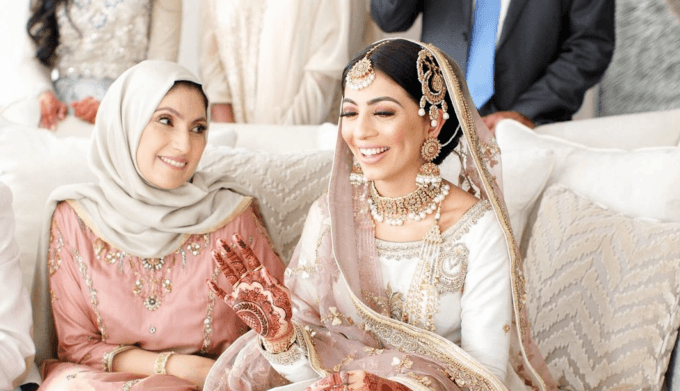
A Nikah is a contract rather than an exchange of vows. It is made through ijab (the offer), traditionally made by the bride or her guardian (wali), and qabul (the acceptance) by the groom, in front of two witnesses. The acceptance can be as short as "qabiltu", "I have accepted." The mahr, a gift the groom commits to the bride, is agreed and recorded, and a short sermon (khutbah) is usually given.
A point that many guides get wrong: the words "I accept" are often said three times, but that is a widespread custom, not a condition of a valid Nikah. Muslim wedding traditions vary between the Gulf, the Levant, South Asia and Southeast Asia, and between legal schools, so ask your imam what your ceremony will include. Many couples add personal English vows at a reception or separate ceremony.
In the Anand Karaj ("blissful union"), the couple circle the Guru Granth Sahib four times while the four laavan are sung. These hymns were written by Guru Ram Das, the fourth Sikh Guru, and appear on pages 773 to 774 of the scripture. Each circle marks a stage of married and spiritual life. The couple don't speak vows; their commitment is made through the laavan, with the congregation (sangat) as witness.
Buddhism doesn't have one marriage rite, because marriage has traditionally been treated as a civil matter. In Thailand, Sri Lanka and other Theravada countries, couples often register the marriage legally and then invite monks to chant blessings. Western Buddhist couples often write vows based on the Sigalovada Sutta, a teaching that lists five duties husband and wife owe each other, including respect, faithfulness and care for the household.
Traditional Chinese weddings don't include spoken vows. The key moments are the bows (to heaven and earth, to the parents, and to each other) and the tea ceremony, one of several Chinese wedding traditions still widely kept, where the couple kneel and serve tea to their parents and elders, who give red envelopes or jewelry in return. Many couples in China, Singapore, Malaysia and the diaspora now combine a tea ceremony with a Western-style ceremony and bilingual vows.

At a Shinto wedding (shinzen-shiki), the couple share sake from three cups of increasing size in the san-san-kudo ritual, then the groom reads the seishi, a written pledge, on behalf of both of them. It's usually a promise to respect and love each other and keep a harmonious home. The bride may add her name at the end.
In a Korean pyebaek, held after the main ceremony, the couple bow to the groom's family and receive blessings, and the parents throw dates and chestnuts for the bride to catch in her skirt. Across Southeast Asia, Vietnamese, Filipino, Thai and Malay traditions weave ancestor rites, blessings from elders and Catholic or Muslim rites together, so the "vows" depend on the family's faith.
This is the question most guides skip. In most countries, the law requires far fewer words than couples expect, and everything beyond them is your choice. This table shows what each country requires, based on each government's own rules.

Country | Words the law requires | What's optional |
|---|---|---|
United States | No set words. Couples must declare, in front of the officiant and witnesses, that they take each other as spouses (California Family Code s420). Rules vary by state. | Everything else: religious vows, personal vows, ring words. |
England and Wales | A declaration ("I declare that I know of no legal reason why I, [name], may not be joined in marriage to [name]") and contracting words ("I, [name], take you, [name], to be my wedded wife/husband"). Older forms with "thee" and "I call upon these persons here present to witness..." are also allowed. | Readings, personal words. Anglican weddings use the church's own service. |
Both declare there's no lawful impediment and that they accept each other as husband, wife or spouse. Three months' notice is required. | Personal vows, readings. | |
Canada | Set by each province. In Ontario, each person declares there's no lawful impediment and says, "I call upon these persons here present to witness that I, [name], do take you, [name], to be my lawful wedded wife/husband/partner/spouse." | Religious or personal vows around the legal words. |
A civil ceremony at the town hall is legally required, even if you also marry in church. The mayor reads articles 212 to 215 and 371-1 of the Civil Code (respect, fidelity, support, raising children) and each person answers "oui". | The religious ceremony has no legal effect on its own. | |
The registrar asks each person whether they want to marry the other; each says "ja", and the registrar pronounces them married (Civil Code, s1312). | A church wedding afterwards is optional. | |
The registrar or priest reads articles 143, 144 and 147 of the Civil Code (mutual rights and duties), then each person says "sì". A Catholic wedding can also count as the civil one. | Personal vows. | |
For non-Muslims since 2022: both give free consent before a court officer, with two witnesses (Abu Dhabi Law No. 14 of 2021). Muslim marriages follow Sharia court procedures. | Couples can add their own vows and exchange rings. | |
India | Under the Special Marriage Act (civil and interfaith marriages), each person says to the other, in any language they understand, "I, [name], take thee, [name], to be my lawful wife/husband," before the Marriage Officer and three witnesses. | Religious ceremonies under the Hindu, Muslim, Christian or Sikh marriage laws follow their own rites. |
Australia | "I call upon the persons here present to witness that I, [name], take thee (or you), [name], to be my lawful wedded wife (or husband, or spouse)." (Marriage Act 1961, s45(2)). Civil celebrants must also say the monitum: "Marriage, according to law in Australia, is the union of 2 people to the exclusion of all others, voluntarily entered into for life." | Everything else. Ministers of recognized religions can use their own rite. |
Two things follow from this. First, in almost every country you can say the traditional vows and meet the law, because the legal words either overlap with them or take ten seconds to add. Second, if you're planning a destination wedding, the law of the country where you marry applies, not the law of your home country. In France you must marry at the town hall before any church wedding, which is why many couples marrying abroad hold the legal ceremony at home and a symbolic ceremony at the destination. We cover this in more detail for Middle Eastern destination weddings and for making an overseas marriage legal in Australia.
This table is a guide, not legal advice. Your celebrant, officiant or local registry office will confirm the current rules.
It depends on who is marrying you.
Catholic and Church of England services: The vow wording is fixed. You choose between the approved forms; you can't rewrite them. Personal words go elsewhere in the service, such as a reading, a letter read aloud, or a moment before the blessing.
Most other Protestant churches: Usually flexible. Many ministers will let you modernize the language or add a line.
Civil celebrants and officiants: Very flexible, as long as the legal words are included (see the table above).
Jewish, Hindu, Muslim and Sikh ceremonies: The core ritual stays. Personal vows can usually be added before or after it.
Where you do have flexibility, these are the most common changes:
"You" instead of "thee". It sounds natural and loses none of the meaning.
"Spouse" or "partner" instead of "wife" or "husband". Allowed in the legal wording in England and Wales, Ireland, Ontario and Australia.
Leaving out "obey", or making the promise mutual: "to love, cherish and support each other".
"As long as we both shall live" instead of "till death us do part", for couples who find the older phrase too heavy.
The simplest rule: add, don't replace. Say the traditional vow as written, then add two or three sentences of your own. It keeps the weight of the old words and still sounds like you. If you need a starting point, look through the best wedding vows of all time or these poems and quotes to inspire your vows. For example:
I, Sam, take you, Priya, to be my wife... to love and to cherish, till death us do part. And I promise to keep making you laugh, to keep learning your family's recipes, and to be home for every Sunday dinner.
Interfaith weddings are common now, and there are two main ways to handle the vows.
Two ceremonies. Many Hindu-Christian (especially diaspora couples), Jewish-Christian and Muslim-Christian couples hold two ceremonies, often on consecutive days or in the morning and afternoon of the same day. Each tradition's rite is kept whole, and only one of them needs to be the legal ceremony.
One blended ceremony. A civil or interfaith celebrant builds one ceremony with elements from both traditions, such as the legal vow, a Saptapadi or a ring formula in Hebrew, a reading from each scripture, and a shared ritual like the tea ceremony. This works best when neither family's religious authority needs to perform the marriage itself.
A few things to settle early:
Ask each religious leader what they require. The Catholic Church, for example, has specific rules for marrying someone who isn't Catholic, and many Orthodox Jewish and Muslim authorities won't officiate at a mixed ceremony.
Decide which ceremony is legal. Only one needs to include the required words.
Explain the rituals to your guests. A short line in the program ("The seven steps are the heart of a Hindu wedding...") helps both families feel included.
For traditional vows, you don't need to memorize anything. In almost every religious and civil ceremony, the officiant says the vow a few words at a time and you repeat it. It's the norm, nobody in the room thinks less of you, and it lets you look at your partner rather than try to remember the next line.

A few tips from the celebrants we work with:
Rehearse it out loud, even once. "Till death us do part" is harder to say through tears than you'd think.
Keep a vow card for any personal lines you add, even if you've memorized them. Nerves make people forget.
Ask the officiant to break the vow into short phrases if you're anxious. There's no rule about how long each chunk is.
Say it to your partner, not the officiant. Repeat the words, then turn back to face each other.
The traditional vow takes about 30 to 45 seconds for each person to say. With the questions, the ring exchange and the pronouncement, the whole vow section of a ceremony usually runs 5 to 10 minutes.
The legal table above is where destination weddings usually get complicated. A symbolic ceremony in a French chateau still needs a legal marriage somewhere, a Nikah in Abu Dhabi needs the right court, and a blended Hindu and Catholic weekend in Italy needs two officiants who have never met to agree on a running order.
When you plan through Wonderland Concierge, a Wedded Advisor takes that on. Where a permit or an approval decides whether something can happen at all, we engage tourism boards and civil authorities directly, and heritage sites that don't normally host events can be opened for your ceremony. Your guests arrive as people the property is expecting, with breakfast included on every room we book. There is no fee for the first conversation.
Benefits vary by property and booking. Eligibility and availability conditions apply.
Traditional vows have lasted because they say the essential things plainly: I choose you, in good times and bad, for the rest of my life. Whether you say the 1662 words, walk seven steps around a fire, or answer "qabiltu", you're joining a promise millions of couples have made before you.
If you're planning a wedding that blends two cultures, or marrying in another country, speak with a Wedded Advisor about the legal side, the venue and your guests' travel. Already married? Our vow renewal ideas show you how to say the words again, and you can browse wedding destinations for where to do it.
Church of England, The Form of Solemnization of Matrimony, Book of Common Prayer (1662)
Church of England, Common Worship marriage service, and "Wedding vows" guidance
The Order of Celebrating Matrimony (Roman Ritual, English translation for the US)
Britain Yearly Meeting, Quaker faith & practice, chapter 16
California Family Code, section 420
Marriage Act 1949 (England and Wales), section 44
Citizens Information (Ireland), "Civil marriage ceremonies"
Marriage Act, RSO 1990 c M.3 (Ontario), section 24
French Civil Code, articles 75, 212 to 215 and 371-1
German Civil Code (BGB), section 1312
Abu Dhabi Law No. 14 of 2021 on Civil Marriage; Abu Dhabi Judicial Department
Special Marriage Act 1954 (India), section 12
Marriage Act 1961 (Australia), sections 45 and 46
Written by
Content and Creative Manager
Joseph Joshua is the SEO & Content Manager at Wedded Wonderland, bringing an editorial and search strategy perspective to the publication’s coverage of luxury weddings, destination celebrations and bridal lifestyle. His approach to content centres on helping readers move from inspiration to informed decisions, with attention to the design, craftsmanship and personal details that give a celebration its character.
Search real weddings, venues and vendors from around the world.
Search Wedded Wonderland