A wedding ceremony is the formal part of a wedding where two people exchange vows and are legally declared married, usually led by an officiant in front of witnesses. It typically runs 20 to 45 minutes. The reception is the separate celebration afterwards, with food, speeches and dancing.
While every wedding is different, most ceremonies follow a familiar sequence, from the processional and opening remarks to the vows, ring exchange, pronouncement, and recessional.
A wedding ceremony is the formal event where two people exchange vows, make their commitment official, and are declared married. It is led by an officiant and usually includes witnesses. The ceremony is the marriage itself, while the reception is the celebration that follows.
That last point trips up many people. The two events are often held on the same day, sometimes at the same venue. But they serve different purposes.
Wedding ceremony | Wedding reception | |
Purpose | You make your commitment and are declared married | You celebrate with your guests |
Legal status | Where the marriage becomes legal, once the paperwork is signed | No legal role |
Who leads it | An officiant or celebrant | Usually an MC, often a friend, the venue or the DJ |
Typical length | 20 to 45 minutes | Four to six hours |
What happens | Processional, readings, vows, rings, pronouncement, recessional | Drinks, dinner, speeches, cake cutting, first dance, dancing |
When it happens | First | Straight after, or after a short break for photos |
The typical order of a wedding ceremony is: processional, opening remarks, readings, exchange of vows, ring exchange, optional unity ritual, pronouncement and first kiss, and recessional. A civil ceremony can take 15 minutes, while religious ceremonies may take an hour or more.
Here is the same order as a quick list:
Guests are seated
Processional
Opening remarks
Readings (optional)
Address or homily
Declaration of intent
Exchange of vows
Exchange of rings
Unity ritual (optional)
Pronouncement and first kiss
Recessional
Now let's look at what each step involves.
Most weddings follow the same basic arc, whether they're civil, non-denominational, or lightly religious. The ceremony builds slowly, peaks at the vows and rings, and then ends on a joyful note. Understanding each step makes it easier to plan, or simply to enjoy, the day.
Let's walk through the order from the moment guests arrive.
Strictly speaking, this isn't part of the ceremony. But it sets the mood for everything that follows. Ushers or family members guide guests to their seats while soft music plays.
Traditionally, the groom's family sits on one side and the bride's on the other. Today, many couples skip this and let guests sit wherever they like. It keeps things relaxed and helps both sides of the family mingle.
This is also the best time to share any ground rules. For example, if you're having an "unplugged" ceremony with no phones or cameras, a small sign near the entrance or a quick reminder from an usher works well. It saves your officiant from having to say it later.
The processional is the formal entrance. It marks the moment the ceremony truly begins, and guests usually stand as the music changes.
Music plays an important role here. The wedding party often walks in to a softer instrumental piece. Then the music shifts to something more meaningful for the final entrance, which signals to everyone that something special is coming.
Here's a common order:
Officiant takes their place
Groom enters, with parents or alone
Groomsmen and bridesmaids, in pairs
Ring bearer and flower girl
Bride, escorted or alone
That said, this is a tradition, not a rule. Some couples walk in together. Others each walk with both parents. Small weddings may skip the wedding party altogether. What matters is that it feels right to you.

Once everyone is at the altar, the officiant welcomes the guests. They explain the purpose of the gathering and set the emotional tone, which might be warm, playful, or solemn.
A generic welcome can feel flat. A good officiant will say something personal about the couple. If yours hasn't asked you about your relationship, offer a few details in advance. Even a single short story can make the opening feel like it belongs to you.
Readings are optional, but many couples love them. A friend or family member steps up to read a poem, a passage of prose, or a religious text. It's a lovely way to involve someone close to you without giving them a big speaking role.
Religious couples often pair a scripture passage with a poem. Secular ceremonies may use well-known love poems or a favorite passage from a book.
There's one simple guideline: keep each reading to about two or three minutes. Anything longer risks losing the audience. If your ceremony is running long, readings are the first thing to trim.
Next, the officiant speaks directly about the couple and what marriage means. In a religious ceremony, this is called a homily, and it often draws on the scripture reading. In a civil or secular ceremony, it's usually more personal and conversational.
For guests, this is often the moment they learn something new. They might hear how the couple met, what makes them a good match, or what they hope for the future. It also gives everyone a calm pause before the emotional high point.
Before the vows, the officiant asks each partner a simple question: do you choose to marry this person? It's usually phrased as, "Do you take [name] to be your lawfully wedded spouse?" The answer is "I do."
It's short, but it carries weight. In many places, this is the legal backbone of the ceremony, because it shows both people are marrying freely. Requirements vary by location, so your officiant can confirm what applies to you.
This is the emotional heart of the ceremony. Couples typically choose one of two options:
Traditional vows: The officiant reads short lines, and each partner repeats them.
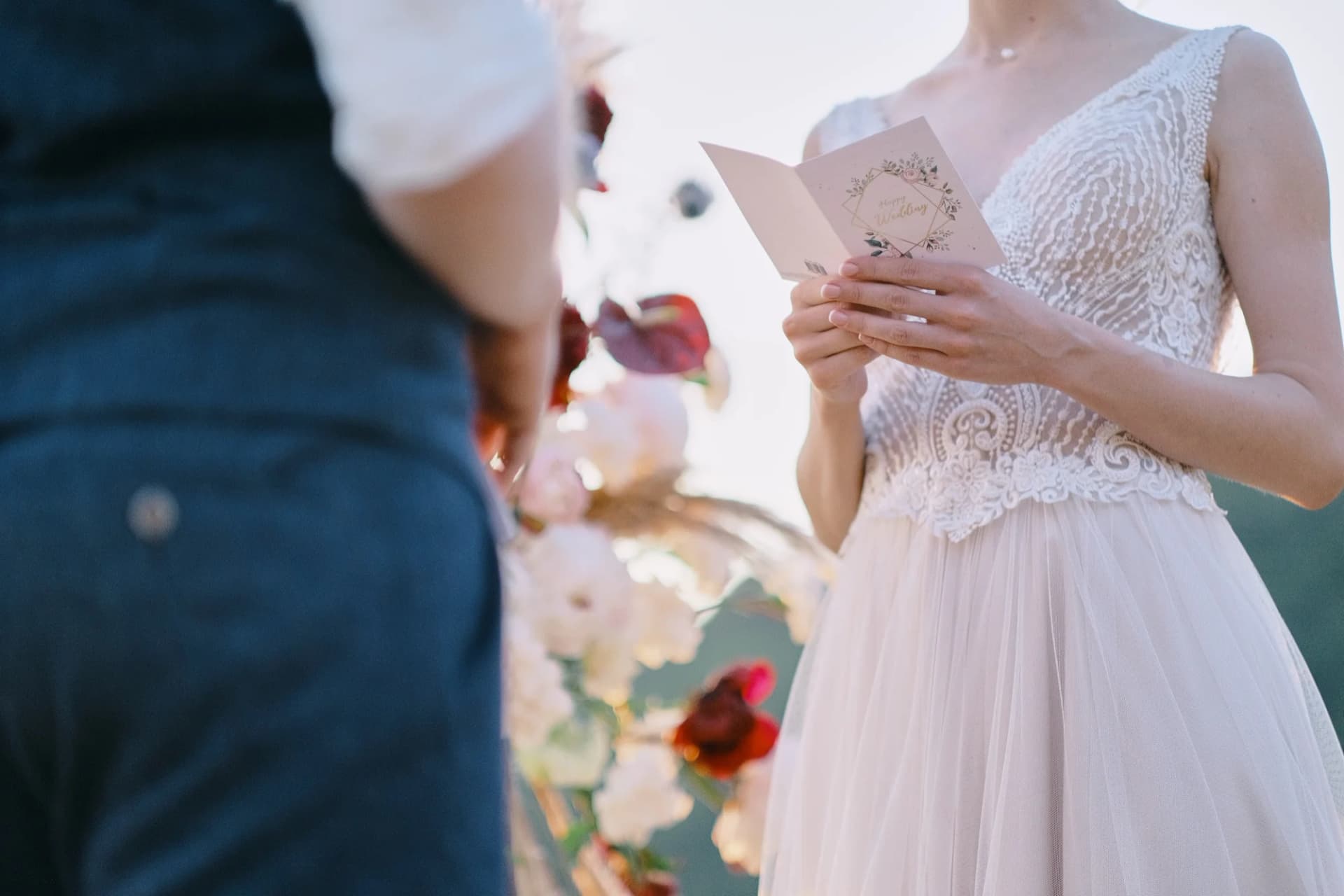
Personal vows: Each partner reads words they've written themselves.
Traditional vows are shorter and take the pressure off. Personal vows are more intimate and often more memorable.
Want the exact words? Here are the traditional wedding vows, word for word, with what each line means.
If you write your own vow, aim for roughly one to two minutes each. That's long enough to be meaningful and short enough to keep your composure. Our full guide on how to write your own wedding vows walks you through it.
Some couples mix both. They repeat the traditional promises and then add a short personal message.
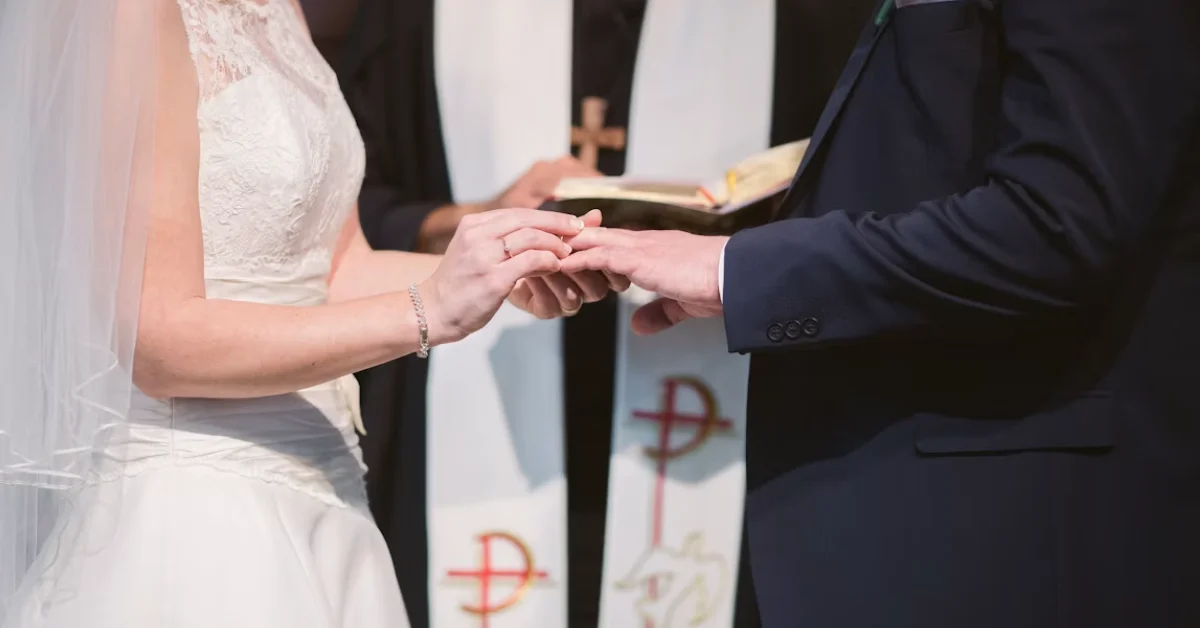
Right after the vows, the couple exchanges rings. The best man or ring bearer usually hands them over. Then each partner places the ring on the other's finger and says a short phrase. A classic choice is "With this ring, I thee wed," but many couples write their own.
The officiant may bless the rings first. Why do rings matter so much? A ring is a visible reminder of the promises just made. It's something the couple will see every day, long after the ceremony ends.

A unity ritual is a symbolic act that shows two lives joining as one. It's completely optional, and it works best when it means something to the couple rather than feeling like a box to tick.
Here are some popular choices:
Unity candle: Two individual candles light one central candle together.
Sand ceremony: Two colors of sand are poured into one container, creating a pattern that can't be separated.
Handfasting: The couple's hands are loosely tied with a ribbon or cord. This tradition is the origin of the phrase "tying the knot."
Wine or whiskey blending: Two bottles are combined into one, and the couple shares a glass.
Tree planting: Each partner adds soil to a shared planter, which can later be planted at home.
Ring warming: The rings are passed through every guest's hands to collect their good wishes before the exchange.
If you include a ritual that guests may not know, add a line about it in your wedding program. People connect more deeply with a moment when they understand what it means.
Now comes the moment everyone has been waiting for. The officiant formally declares the couple married and introduces them to the room for the first time as a married pair.
The wording can be traditional, such as "I now pronounce you husband and wife." It can also be modern, such as "You are now married!" Some couples simply have their names announced. Then comes the first kiss, and the guests usually cheer.
Finally, the newlyweds walk back down the aisle together, usually to lively, joyful music. The wedding party follows in reverse order, and ushers guide the guests out, often row by row.
The recessional signals that the ceremony is over and the celebration is about to begin. From here, guests typically head to the cocktail hour or reception while the couple takes photos.
In a traditional processional, the officiant takes their place first. Then come the groom, groomsmen and bridesmaids, maid of honor, ring bearer and flower girl, and finally the bride. Modern couples often change this order, and there is no single correct version.
Here is the classic sequence:
Officiant
Groom (with parents or alone)
Groomsmen and bridesmaids, in pairs
Maid of honor
Ring bearer and flower girl
Bride, with an escort or alone
Many couples today put their own spin on it. Some walk in together. Others each walk with their parents. Small weddings may skip the wedding party entirely and simply have the couple enter side by side. The best order is the one that feels right to you.
The basic pattern stays the same, but the details shift. Here is how the most common ceremony types differ.
Ceremony type | What to expect | Typical length |
Civil ceremony | Short and simple, usually including a declaration of intent, vows, and signing of the register or marriage license. | 15–25 minutes |
Non-denominational ceremony | Flexible and customizable, often including readings, personal vows, and unity rituals alongside the standard ceremony order. | 25–45 minutes |
Catholic ceremony | Follows a set liturgy with scripture readings, a homily, vows, and ring exchange. A ceremony with a full Mass generally takes longer than one without Mass. | 45–90 minutes with Mass |
Protestant ceremony | Often includes hymns, scripture readings, a sermon, vows, and prayers. Guests may also participate through spoken responses. | Varies |
Jewish ceremony | Usually takes place under a chuppah and may include blessings over wine, the ketubah, ring exchange, the Seven Blessings, and the breaking of a glass. | Varies |
Includes multiple rituals centered around a sacred fire, including the seven steps taken by the couple around the fire. | 1 hour to several hours | |
Elopement or micro-wedding | Small and personal, with a simplified ceremony that may include vows, rings, and a brief pronouncement. | 10–35 minutes |
Reported lengths vary between sources, because every officiant and family shapes the ceremony differently. Treat these numbers as rough guides, and confirm timing with your own officiant.
Written by
Content and Creative Manager
Joseph Joshua is the SEO & Content Manager at Wedded Wonderland, bringing an editorial and search strategy perspective to the publication’s coverage of luxury weddings, destination celebrations and bridal lifestyle. His approach to content centres on helping readers move from inspiration to informed decisions, with attention to the design, craftsmanship and personal details that give a celebration its character.
Search real weddings, venues and vendors from around the world.
Search Wedded Wonderland