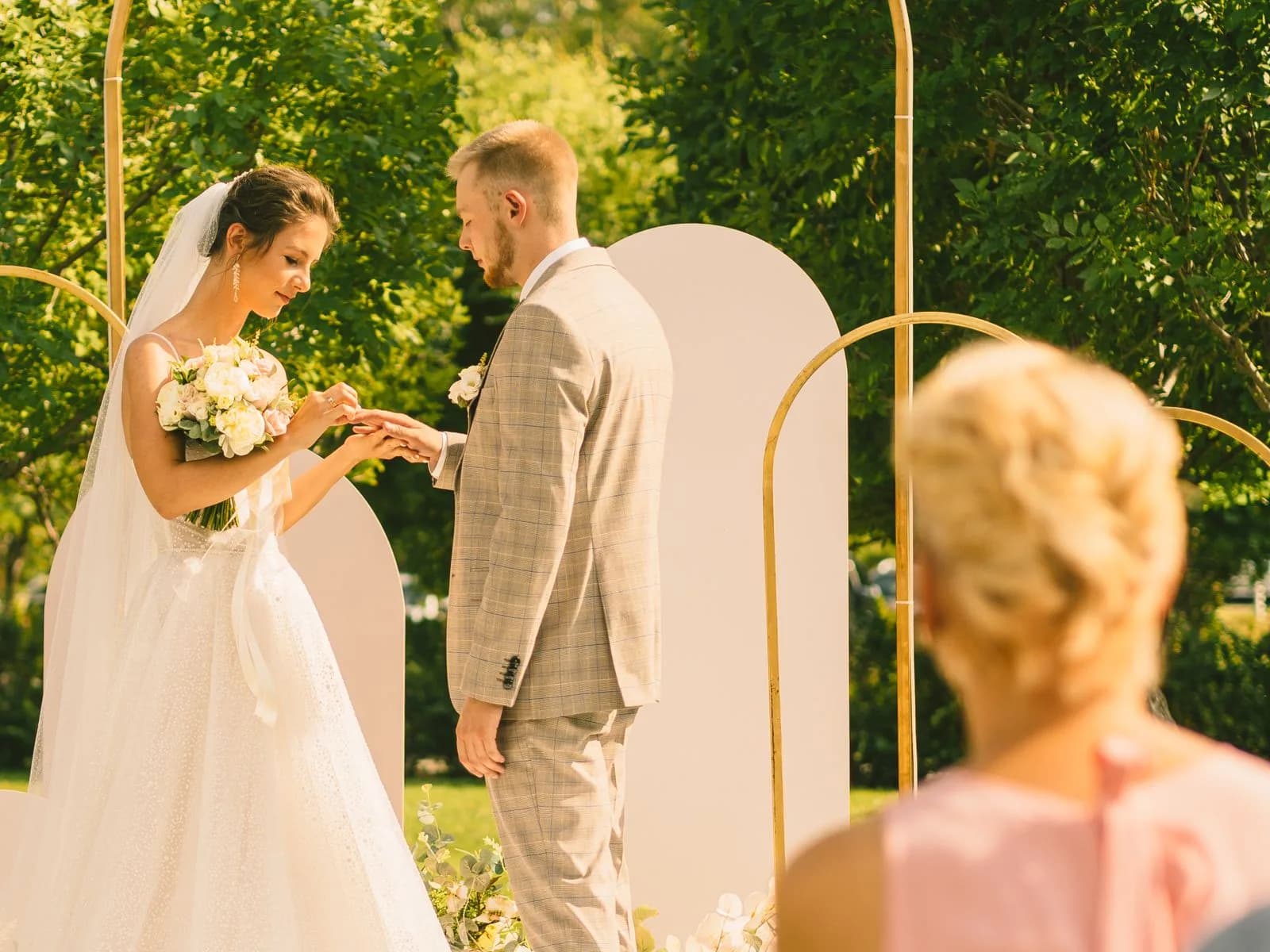
There is no single required ring exchange wording. This script takes under a minute, comes straight after your vows and suits a civil or symbolic ceremony.

Say it in this order:
Celebrant: May I have the rings, please? Sam, place the ring on Alex's finger and repeat after me.
Sam: Alex, I give you this ring as a sign of my love and of our marriage.
Alex: Sam, I give you this ring as a sign of my love and of our marriage.
Ring words are not a legal requirement in Australia, England and Wales or New York, so outside a religious rite they are yours to write. Wedded Wonderland's Wedded Concierge can manage the timeline around them.
The rings follow the vows and take 2 to 4 minutes of a ceremony lasting 20 to 45 minutes, as Wedded Wonderland's guide to what happens in a wedding ceremony sets out. For the whole ceremony around them, see our wedding ceremony script. If this is also your legal ceremony, the words the law requires come first. At a register office the registrar uses the office's own words, so this template is for a celebrant-led, symbolic or friend-led ceremony (item 7 has a friend's lead-in). Stage directions sit in brackets, and slashes mark where you breathe:
Celebrant: Sam and Alex have chosen rings as the sign of the promises they have just made. May I have the rings, please? [Takes the rings. Hands Alex's ring to Sam.]
Celebrant: Sam, place the ring on Alex's finger and repeat after me.
Sam: Alex, / I give you this ring / as a sign of our marriage / and of my love, / from this day on.
Celebrant: [Hands Sam's ring to Alex.] Alex, place the ring on Sam's finger and repeat after me.
Alex: Sam, / I give you this ring / as a sign of our marriage / and of my love, / from this day on.
Celebrant: May these rings remind you of what you promised here, long after today. [Moves to the pronouncement and the kiss.]
Past about 40 words, the ring line competes with your vows. Keep any humour to one dry line after the sincere part, never at your partner's expense. For two grooms or two brides, agree who goes first. Give whoever leads a copy in large type and a pause after each cue; if they lose their place, "Bear with me" is all they need to say.
Print the order of the day in your wedding order of service, and see which readings work at a wedding for the moment before the vows.
The line most people picture comes from the Church of England's Book of Common Prayer of 1662. The priest gives one ring to the man "to put it upon the fourth finger of the Woman's left hand", and the man says (more in Wedded Wonderland's guide to traditional wedding vows):
The 1662 words: With this ring I thee wed, with my body I thee worship, and with all my worldly goods I thee endow: In the Name of the Father, and of the Son, and of the Holy Ghost. Amen.

In England and Wales, keep it for a church service, since a civil ceremony must not include anything religious.
This adaptation drops "thee" and "worldly goods" and borrows a line from Common Worship, the Church of England's modern service, so label it as adapted if you print it:
Each partner: [Name], with this ring I marry you, and all that I have I share with you.

It keeps the rhythm of the church line without the old English, so it suits a couple with a religious family and a civil ceremony. If nerves are a worry, the officiant can say it in short phrases for each of you to repeat.
The plain civil classic leaves room for a closing clause of your own:
Each partner: [Name], I give you this ring as a sign of my love and of the promises I made to you today.

It has no religious words, so it fits any civil or celebrant-led ceremony. Keep your added clause to one short line after "today", such as "and of every day after it", so it is easy to repeat.
Births, Deaths and Marriages Victoria's standard marriage service script marks the ring ceremony optional and prints these words. Every celebrant, NSW included, works to the same federal Marriage Act 1961, so the words work in any state:
Celebrant (BDM Victoria): [Name] and [name] have chosen to exchange rings as an outward symbol of their commitment to each other. The band of the wedding ring represents everlasting love, the ring a never-ending circle with no beginning and no end.
Each partner (BDM Victoria): [Name], accept this ring with all my love.
A plainer lead-in, adapted: [Name] and [name] will now exchange rings as a sign of the vows they have just made.

The circle line is the celebrant's to offer and yours to drop.
At a UK register office, you repeat the office’s own ring words after the registrar. Peterborough's office says "you do not need to remember any wording"; offices vary, so ask yours what you can add. Examples from Peterborough, Clackmannanshire and Belfast:
Peterborough (England): I give you this ring as a symbol of my love and a token of our marriage.
Clackmannanshire (Scotland): With this ring I offer my hand, my heart and my love always.
Belfast (Northern Ireland): I give you this ring as a symbol of my love and affection now and always and of our marriage today.

Short lines suit a nervous speaker or a second language. Each follows the partner's name:
I give you this ring.
With this ring, I marry you.
This ring is my promise.

Say it after the celebrant in one go, with no pause in the middle.
If you marry legally at another time or place, a friend-led ceremony is a celebration and its ring words carry no legal weight. A lead-in and close that claim no authority:
Friend: Sam and Alex married earlier this week. Today they make their promises again, in front of you. May I have the rings?
Sam and Alex, together: We are married, and today we celebrate it with you.
Friend: Please join me in celebrating them.

Leave out "I now pronounce you" and "by the power vested in me" unless your friend may solemnise marriages where you marry, as an authorised celebrant can in Australia. In New York, a friend can become a one-day marriage officiant (see how to officiate a wedding). A family priest's or imam's blessing fits straight after the rings, so ask beforehand what they will say.
If only one of you wears a ring, use give and receive, as the Common Worship one-ring form does:
Sam, giving the ring: Alex, I give you this ring as a sign of our marriage.
Alex, receiving it: Sam, I receive this ring as a sign of our marriage, and I give you my word in return.

This suits a partner who can't or won't wear a ring for work. Both of you still speak, so the exchange stays a promise from each side, not a gift from one.
An heirloom ring needs one line in the lead-in: "This ring belonged to Sam's grandmother, [name], and today Sam gives it to Alex." With children, ask them first, and never ask a child to make a promise. Choose one of these:
Holding the rings: A younger child carries a stand-in pair while an adult keeps the real rings.
A promise from the adults: Straight after the rings, you both say, "Mia and Lily, we make these promises to you as well."

At a register office, ask before adding that promise.
For a second marriage, speak to the life you already share:
Sam: Alex, I give you this ring for the life we have already built, and for everything still ahead of us.
Alex: Sam, I give you this ring knowing exactly who you are, and choosing you.

Let the line face forward rather than back. If children from either marriage are there, add the promise from item 9.
GOV.UK confirms you can have a religious blessing after a civil ceremony, and a celebrant-led blessing has no fixed wording. Decide where the rings go before you book either. If you exchange them with the registrar, the blessing can speak to what they mean:
Celebrant: Sam and Alex exchanged rings this morning with the registrar. Now they say, in front of you, what those rings mean.
Each partner: [Name], I gave you this ring this morning, and here I promise to keep what it stands for.

Each of you can speak the same ring line in your own language. Have a native speaker of your family's dialect write the second line in its own script:
Sam, in English: Alex, I give you this ring as a sign of my love.
Alex, in their own language: [The same line, as that native speaker writes it.]

For a shorter ceremony, say only the ring lines aloud and print the translations in the order of service. Otherwise the celebrant gives each cue in both languages, and you alternate who speaks first.
In a church, the rite sets the words and the minister leads them. This formula appears as printed, gendered words included, so ask your minister which form they use for two grooms or two brides. In Common Worship, the minister prays over the rings, and each goes on the fourth finger of the left hand:
Minister: Heavenly Father, by your blessing let these rings be to N and N a symbol of unending love and faithfulness, to remind them of the vow and covenant which they have made this day through Jesus Christ our Lord. All: Amen.
Each partner, in turn: N, I give you this ring as a sign of our marriage. With my body I honour you, all that I am I give to you, and all that I have I share with you, within the love of God, Father, Son and Holy Spirit.

In an Australian Anglican or a US Episcopal church, ask your minister or priest which words they use.
The priest blesses the rings, then each partner gives one. The Order of Celebrating Matrimony, printed by the Liturgy Office of England and Wales, offers a choice of texts, and the Diocese of Columbus gives this short form as the current US words:
Priest: May the Lord bless these rings, which you will give to each other as a sign of love and fidelity. Amen.
Each partner, in turn: N., receive this ring as a sign of my love and fidelity. In the name of the Father, and of the Son, and of the Holy Spirit.

The England and Wales book also offers "N., I give you this ring as a sign of our marriage", and your priest chooses. Eastern Catholic and Orthodox churches use their own texts, so ask before printing anything. The full consent is in Catholic wedding vows word for word.
In a traditional Jewish wedding, the groom gives one ring and the rabbi leads. Chabad explains that two kosher witnesses beneath the chuppah must see him place it on the bride's right index finger and hear the words, and asks for a ring of "plain metal, preferably gold, and with no precious stones". The words:
Hebrew (Chabad): הֲרֵי אַתְּ מְקֻדֶּשֶׁת לִי בְּטַבַּעַת זוֹ כְּדַת משֶׁה וְיִשְׂרָאֵל
Transliteration (My Jewish Learning): harei at mekudeshet li b'taba'at zo k'da'at moshe v'yisrael
Translation: Behold, with this ring, you are consecrated to me according to the law of Moses and Israel.

My Jewish Learning gives the form for a male partner, "harei ata mekudesh li b'taba'at zo kda'at moshe v'yisrael", while Chabad suggests the groom's ring be given after the chuppah, in private. Your rabbi decides which applies, so two grooms or two brides should ask which form they use. For the wider day, see how to plan a Jewish wedding.
Ring words carry no legal weight in Australia, England and Wales or New York, so the law’s lines come first and your rings follow. In Australia that is the monitum and the legal vow, in England and Wales the registrar’s declaratory and contracting words, and in New York your declaration that you take each other as spouses. Our wedding ceremony script sets out each one word for word, and how to officiate a wedding covers a friend leading in New York.
Agree one calm line with your celebrant for each of these:
Stuck at the knuckle: "Take your time. Ease it to the knuckle and we'll finish it in a moment." Never force it.
Dropped: "No hurry. We'll have it back in a second." Then carry on.
Not ready: "Alex's ring is still being finished, so today this band stands in for it." Bring a plain spare band.
Blue Nile's ring size guide notes that "cold temperatures cause fingers to shrink and warm temperatures cause them to swell", so try your rings on at the time of day you marry. In heat, keep them with one named adult, not on a cushion in the sun. Outdoors, the celebrant holds a handheld microphone to each partner in turn.
Your celebrant leads the words, so read how to choose a wedding celebrant and choose the bands themselves with wedding rings that match your engagement ring. The Wedded Marketplace lists celebrants. Wedded Concierge manages the timeline and logistics of the wider day, and for a wedding abroad sources the venue, manages vendors across countries and arranges guest travel and accommodation. Once you have chosen your wording, read it aloud together once and send it to your celebrant.
Written by
Content and Creative Manager | Wonder Group
Joseph Joshua is the SEO & Content Manager at Wedded Wonderland, bringing an editorial and search strategy perspective to the publication’s coverage of luxury weddings, destination celebrations and bridal lifestyle. His approach to content centres on helping readers move from inspiration to informed decisions, with attention to the design, craftsmanship and personal details that give a celebration its character.
Search real weddings, venues and vendors from around the world.
Search Wedded Wonderland