A wedding ceremony script is every word spoken at your ceremony, from the welcome to the moment you are presented as married, with cues for the music, the movement and the signing. The law fixes only a few lines: the monitum and one vow line each in Australia, two passages led by the registrar in England and Wales, and a declaration that you take each other as spouses in New York and California. A symbolic ceremony has none. Everything else is yours, and a 20-minute ceremony holds about 1,300 spoken words, about 10 minutes at a calm 130 a minute, with music filling the rest.

Only the lines below are law. The "I do", the rings and the kiss are custom, explained in what happens in a wedding ceremony. Everything else in the script is yours to write.
The Marriage Act 1961 is federal, so the same lines apply in every state. It fixes two passages: the monitum in section 46(1), which a civil celebrant says before the witnesses, and the vow in section 45(2). Both end "or words to that effect", so ask your celebrant how closely they keep to the Act's wording.

The script below follows BDM Victoria's standard order, with the declaration before the monitum.
Under the GOV.UK ceremony rules, a registrar carries out or attends a civil ceremony at a register office or a council-approved venue such as a hotel, with at least 2 witnesses and nothing religious. Your register office sets the exact words; the script uses Islington's published wording, which offers only "wife or husband", so ask yours if you would rather say "spouse".
Islington's civil order runs: welcome, the declaratory words, the contracting words, optional vows and rings, the pronouncement and the signing, with up to three readings between. Whether your children may speak in the civil part beyond a reading is the registrar's call, so ask.
A humanist wedding in England and Wales needs a civil ceremony as well to be legally recognised, as Humanists UK explains, so the humanist part is a blessing with no legal words. Hold it after the registrar, in its own order: welcome, your story, the children's part, a reading, your vows and rings, the blessing, then presentation into drinks. The symbolic run of show below gives the words.
Each state sets its own rules. New York's section 12 says "No particular form or ceremony is required", but the couple "must solemnly declare" before the officiant and at least one other witness "that they take each other as spouses". California's section 420 asks the same "in the physical presence" of the officiant, and neither law mentions "the power vested in me".

New York's section 11 is silent on online ordination, so a friend is safer with a one-day officiant licence, which costs US$25 and covers only the two of you. How to officiate a wedding sets out how to apply.
The script's 1,300 spoken words take about 10 minutes at 130 a minute, inside the 100 to 150 that VirtualSpeech calls comfortable, and music brings the ceremony to 18 to 20. Give the welcome about 150 words, the story 300, a reading up to 150 and each set of vows about 100. For other formats, see how long is a wedding ceremony. For a ceremony of 10 to 15 minutes, use our simple wedding ceremony script.
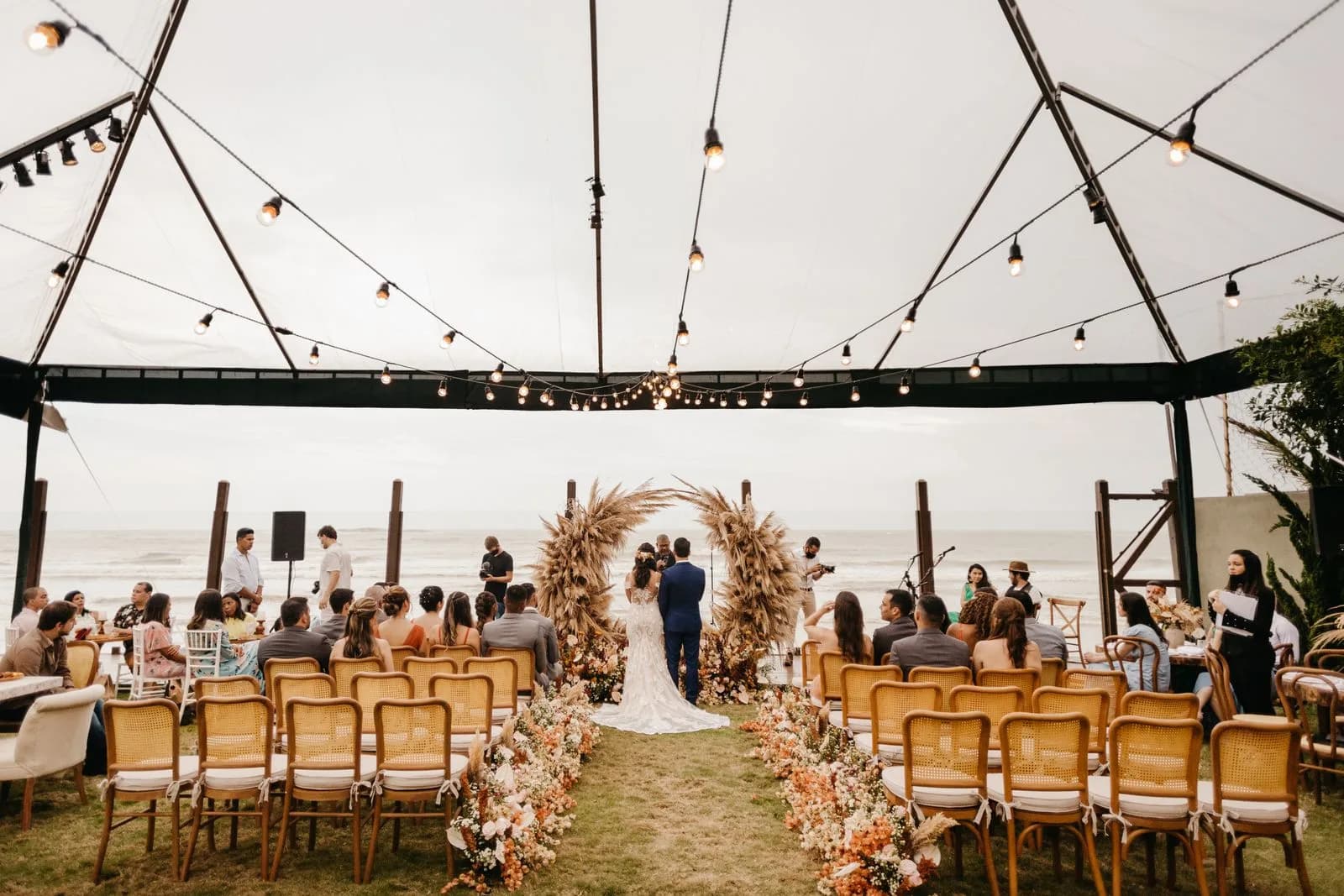
A large crowd outdoors needs a microphone for the person leading and one for your vows, and a pace nearer 100 words a minute than 150.
"Person leading" means your celebrant, officiant, registrar or friend. Each legal line carries a place label (Australia, England and Wales, US): keep yours and strike the rest. "Say exactly" marks law; lines credited to BDM Victoria come from its standard script and are custom, not law. A symbolic ceremony has its own run of show below.

*[Before any music, the person leading or an MC stands at the front.]*
Person leading: "Good afternoon, and welcome. [Partner A] and [Partner B] ask that phones stay away for the next twenty minutes; their photographer has the pictures. Please take your seats."
*[Music begins. You enter together, one after the other, or each with someone you choose.]*
*Note:* Nothing is spoken, and BDM Victoria's optional "who brings this person" question can go. Begin the welcome when the music finishes its phrase.
Person leading: "We're here for the marriage of [Partner A] and [Partner B]. To [Partner A]'s parents, [names], and [Partner B]'s parents, [names]: thank you. And to [name], who is missed today."
*[Skip if symbolic.]*
Celebrant (Australia, BDM Victoria's wording): "[Partner A] and [Partner B], do you declare before me and before your witnesses here present, that you come here voluntarily and without reservation and that you are free by law to be married to each other today?" Each of you: "Yes, I do."
Officiant (US): "[Partner A], do you come here freely to marry [Partner B]?" Answer: "I do."
Say exactly (England and Wales, each of you, after the registrar; your register office confirms it): "I declare that I know of no legal reason why I, [your name], may not be joined in marriage to [partner's name]."
*Note:* If you want an "I do", this is its place, because no legal vow needs one.
*[Australia only.]*
Say exactly (celebrant): "I am duly authorised by law to solemnise marriages according to law. Before you are joined in marriage in my presence and in the presence of these witnesses, I am to remind you of the solemn and binding nature of the relationship into which you are now about to enter. Marriage, according to law in Australia, is the union of 2 people to the exclusion of all others, voluntarily entered into for life."
*Note:* The witnesses must hear it, so they stand a step or two away, within range of the microphone.
Person leading: "[Partner A] and [Partner B] met [where and when]. [The detail that made one of them look twice.] [What their friends saw first.] [How the question was asked.] [Why here, with these people.]"
*Note:* Keep humour here, a joke or two at most, and none in the legal words. Cut anything either of you would rather a grandparent didn't hear.
Person leading: "[Name], [Partner A]'s [relationship], will read for us."
Reader: "[Under 150 words: a grandparent's letter, a passage from a book you love, or lines written for today.]"
Person leading: "[Partner A], when you're ready."
[Partner A]: "[Partner B], I promise to tell you the truth early, while it's still small, and to keep Sunday mornings ours. I'll be glad of whoever you become."
[Partner B]: "[Partner A], I promise to slow down when you ask, to argue fairly and to finish the argument. Whatever comes, I'd rather meet it with you."
These are samples; to write yours, see how to write your own wedding vows.
*Note:* Vows go on cards, not phones. Pause before the legal words so the witnesses hear a new beat.
*[Use the line for where you marry. Skip if symbolic.]*
Person leading: "[Partner A], please repeat after me."
Say exactly (Australia, each of you): "I call upon the persons here present to witness that I, [your full name], take you, [partner's full name], to be my lawful wedded [spouse, wife or husband]."
Optional, from BDM Victoria: "I promise to love you, to care for you and to respect you for all of my life."
Say exactly (England and Wales; your register office confirms it): "I, [your name], take you, [partner's name], to be my wedded [wife or husband]."
The declaration (New York and California): "I, [your name], take you, [partner's name], as my spouse."
For older forms, see traditional wedding vows.
*Note:* Feed the line in short phrases, and don't move on until each of you has said all of it. In the US, your officiant prompts each of you in turn, and your witness stands close enough to see and hear you both.
The ring exchange is optional in BDM Victoria's script.

Person leading: "[Name], the rings, please."
Each of you, in turn: "[Name], I give you this ring as a sign of the promises I have made today."
*Note:* If the rings go missing, carry on and exchange them at the signing table. For more wording, see ring exchange wording.
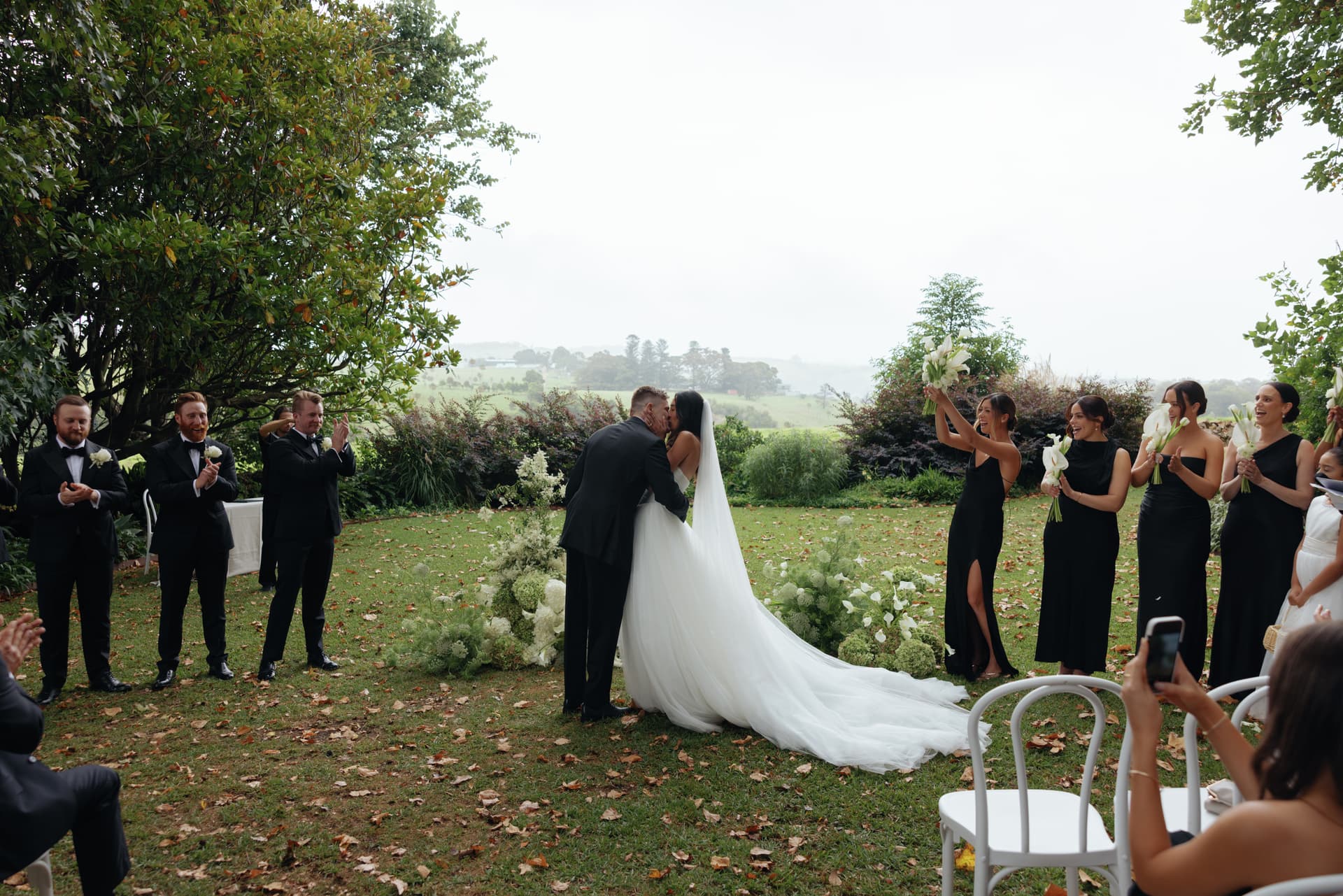
Celebrant (Australia): "It gives me great pleasure to pronounce you married. You may kiss."
Registrar (England and Wales, Islington's wording): "It therefore gives me great pleasure to pronounce you are now [husband and wife, wife and wife, or husband and husband]."
Officiant (US, legally authorised only): "By the authority granted to me by the State of [state], I pronounce you married. You may kiss."
*Note:* Step aside before the kiss, for the photographer.
In Australia you, your celebrant and two witnesses sign, and the NSW Government describes two official certificates plus a ceremonial one you keep on the day. In England and Wales you sign first, then your witnesses, then the registrars.

Person leading: "[Partner A] and [Partner B] will now sign their marriage certificates with [Witness 1] and [Witness 2]. Please stay seated while the music plays."
Person leading: "Everyone, please stand. It is my pleasure to present [Partner A] and [Partner B], married. Please follow them to [the terrace] for a drink."
*[Recessional music begins.]*
The authority where you signed has already made you married, so a friend leading needs no legal words or standing. Print this run of show on its own, for a blessing too:
*Note:* A friend leading a symbolic ceremony never claims an authority. Write the opening line out in full, and stand beside the two of you and slightly forward, never between you.
Plan the entrance as a pair, together or from opposite sides at the same moment, so neither of you is cast as the one who waits. Read the script aloud once for anything that assumes a bride, such as a giving away or "man and wife", and use the spouse option in the Australian vow or the US declaration.

Decide together whether the pronouncement says "married", "husbands" or "wives", and write it into the script.
Agree in advance which language leads each section, for example the welcome in the older generation's language first, the declaration in the other first, and the pronouncement in both. Speaking every line twice adds about ten minutes, so keep each language near 650 words, or let the programme carry the story and reading in translation. Say your vows in the language you think in. A fluent family member, never a machine, translates from your English, and the programme prints it in its own script, not transliteration alone.
One line on the past is enough, and it should face forward:
"[Partner A] and [Partner B] bring their histories with them, and [names] are part of this day."
"This marriage begins with a family already in it."
Promises run from the adults to the children: "[Names], we promise to listen to you and to make room for you." Teenagers can hold the rings, walk you in or read; ask each child early, and again a week before, and accept a no.
A grandmother or an uncle can give a minute's blessing after the pronouncement, in their own words and language. The person leading never adds "God bless this union" on their own.
Write these into the back of the folder:
Microphone fails during the legal words: Wait for the sound, then repeat the full line.
A name comes out wrong: Pause, then say it again in full.
The person leading freezes: Read the next legal line from the spare card, then pick up the script.
The reader freezes: "Let's take a breath together."
A child is in tears: Quietly, "Take your time. We're not going anywhere."
Two to four weeks out:
A script takes about ten minutes to read, but the ceremony around it depends on the venue, the music cues, the microphone and the photographer all being ready on time. Through Wedded Concierge, a Wedded Advisor handles venue sourcing, choosing and negotiating with suppliers, the timeline and event-week support, so the running order you wrote is the one that happens. If you would rather book the pieces yourself, Wedded Marketplace lists celebrants, musicians and other vendors you can contact directly.
Fix the legal lines for where you marry, fill the brackets with what only you know, and let the person leading shape the rest. Read the whole script aloud once with a timer, so you know it fits the slot the venue has given you. Send it at least a month ahead, which gives your celebrant time to check the legal wording and suggest changes before the rehearsal. To find a celebrant, see how to choose a wedding celebrant.
Written by
Content and Creative Manager | Wonder Group
Joseph Joshua is the SEO & Content Manager at Wedded Wonderland, bringing an editorial and search strategy perspective to the publication’s coverage of luxury weddings, destination celebrations and bridal lifestyle. His approach to content centres on helping readers move from inspiration to informed decisions, with attention to the design, craftsmanship and personal details that give a celebration its character.
Search real weddings, venues and vendors from around the world.
Search Wedded Wonderland