Wedding rings that sit well beside an engagement ring start with how high the stone sits, then its shape, then the metal and width. A high stone lets a straight band sit flush beneath it. A low stone, a halo or wide side stones need a contoured, curved or open band, or a deliberate, even gap.

Read the section for your own setting and pass over the rest. Makers, prices and hallmark rules for Australia, the UAE, the UK and the US sit near the end, each under its own name.
The height of the head above the shank decides most of what follows. At the first appointment, ask the maker to try a plain band in your size against your ring. If it rocks or lifts, you need one of the band shapes below.
A contoured band is made to follow the outline of one ring, so the two lock together. Krikawa offers a precise contour that hugs your ring "with no gaps", or a gentler one. A contour is the closest fit of all, but it is shaped for that one ring, so it rarely sits well beside a different engagement ring later.

Bring your engagement ring to the fitting, because the maker shapes the band against the ring itself, not a photograph. Ask how long the ring stays with them, since some makers keep it for the whole build.
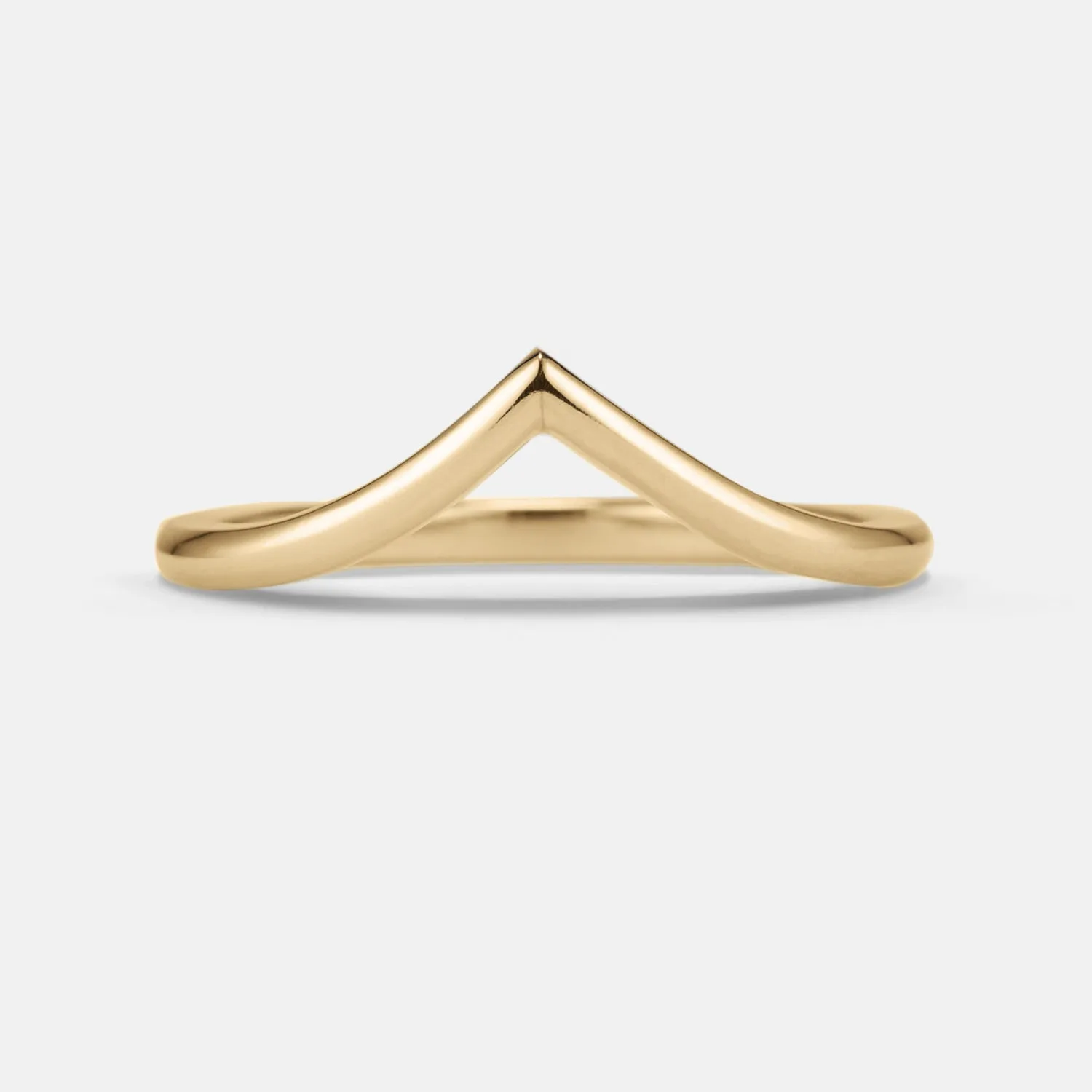
A curved band dips at the centre, a V-shaped band points there, and a notched band has a small cut-out where the stone sits. Austen and Blake suggests a subtle curve for a round or oval stone, and a deeper contour for a pear, a halo or an elevated setting. These shapes are often sold ready-made, so they cost less and arrive sooner than a fully contoured band. Try the band on your own ring before you buy, because the depth of the dip has to match the height of your setting, not just its shape.

An open band leaves the centre clear, and enhancers, wraps and guards frame the stone from both sides. A gap that stays the same width along both bands looks planned, in person and in close-up photographs, while a wedge that widens towards the stone looks like a band that doesn't fit. Makers rarely give the gap in millimetres, so judge it side-on, in daylight.

The setting, more than the stone, decides which band will sit beside your ring. Find yours below, then take the advice for it to your first appointment. If you're unsure what your setting is called, our 13 timeless engagement ring styles names each one.
A low stone leaves a gap under a straight band, and that gap can be part of the design. From closest fit to simplest, your choices are a band contoured to your ring, a ready-made curve tried on it, or a fine straight band with an even hairline gap. Only the contour sits flush.

Waldemar Jewellers says a poorly fitted band puts "all the wear and tear" on the centre stone's collet, and suggests laser tacking a straight band to the ring so the two can't rub. Tacking fixes the pair, though, so resizing either ring gets harder. On an old ring, ask first whether the laser's heat is safe for its stones.
Tapered baguettes leave a V-shaped space at the centre when a straight band sits beside them. You can close it with a contoured band, echo it with a V-shaped or notched band, or make it look intended with two fine stacked bands. Keep every band in a stack in the same metal, since a harder ring beside a softer one "can gradually scratch the surface", says Maya Magal, and try the whole stack on your ring.

Stacked bands touch along their whole length, and a high polish "makes fine surface wear more noticeable", says Whiteflash. Each polish also lifts away "a little metal and detail", warns Lebrusan Studio, so ask how often the maker will refresh the finish.
A hidden halo can lift the stone and widen the base. If a plain band won't sit under it without rocking, Frank Jewelers suggests a contoured band or one "notched to match your exact hidden halo".

For an heirloom, have the claws, halo and shank inspected before anything is measured, and add a month for any repair. Wild Fawn takes a 3D scan, while F.Hinds presses the ring into soft putty for an impression. Neither maker says how its method treats an antique setting, so ask, and get it in writing that the stones stay in.
Taylor and Hart says a straight band will "slot right next to" a three-stone ring only when the basket sits high enough. Ask to see a contour around the centre stone, one around all three and a straight band with a small, even gap. A plain band leaves the three stones to lead, a sapphire-set band repeats the side stones as a style call, and a heavily set band can crowd them. Taylor and Hart's Daisy half eternity band sets its sapphires in 18ct white gold, so for a platinum ring, ask whether it comes in platinum.

For a platinum ring, choose a platinum band. Michael Hill advises keeping "the same metal type and caratage", since a big difference in hardness "could cause extra wear". Same-metal rings still rub where they touch, so a contour or an even gap keeps the band off the setting. Have the claws checked every six months to a year, as Timothy Roe advises for rings worn daily, and ask the jeweller to look where the band meets the setting.

Mixing metals is a style choice with a care cost. Tacori says the metals "don't need to match in order to go well together", while Robinson's Jewelers warns that a platinum band can "wear down the softer gold" beside it, so a mixed pair needs closer checks.
Gold colour also varies by maker. Rose gold takes its pink from copper, and "every recipe uses its own amount", says Liori Diamonds, which advises matching the carat in yellow gold too if "a slight shade difference would bother you". Hold a new band beside your ring in daylight before anything is cast.
Start from your engagement ring's shank width, in millimetres. A band of the same width reads as a pair, and a finer one keeps the eye on the stone. Shaped bands that list a width run from 2mm to 2.7mm. Makers rarely give a width rule for a given stone shape, so try two widths on your ring.

Your partner's band needn't match yours, but the same metal and a related finish look considered. A brushed or matt band beside your polished one reads as a pair without copying it. Order both at the same appointment and try widths on both hands. Platinum "will hold a matte finish longer" than softer gold, says Robinson's Jewelers, which suggests professional upkeep every 12 to 18 months.

Posting a ring abroad means insuring it in transit and going without it, so first ask whether a local scan will do. These three makers reach all four countries:
Austen and Blake runs its own sites for Australia, the UAE, the UK and the US, and each offers a custom band made "around your engagement ring's exact shape".
Taylor and Hart makes the band from "a direct 3D scan of your engagement ring" in up to 30 days and ships worldwide, with complimentary annual care for life. Ask whether it fits rings from other jewellers. Its resizing covers UK and US customers only.
Krikawa contours its bands "to fit any engagement ring" in 6 to 10 weeks and ships by FedEx International. Ask whether you send the ring or an impression.
Count back from the date:
Six months out or earlier: Choose your maker and settle your partner's band. Have an heirloom setting inspected and repaired now.
Four months out: Resize the engagement ring if needed, then have it measured or scanned.
Three months out: Approve the design and order. The makers above quote about a month to 10 weeks, which leaves room for a remake.
While the band is made: Try a wax or resin model on your ring before it's cast.
One month out: Collect the band and try both rings together, with time for any adjustment.
Some makers scan the ring and hand it straight back. Taylor and Hart keeps it for the whole making time and calls sending it "the best way to achieve a fully-flush finish". If it must stay, ask who insures it and for a dated receipt that describes it.
Take the ring and these questions:
Measuring: Will you scan it, take an impression or measure it by hand, and does it stay with you?
Fit test: Can I try a wax or resin model before casting?
Later work: Who resizes or repairs the band, and does the fit survive it?
Paperwork: Will the metal, hallmark, engraving and lead time be confirmed in writing, and does hallmarking add time?
On the day, you can wear both rings, move the engagement ring to your right hand for the ceremony or wear only the band. On the morning, give both bands to one named person, whether the venue is a drive away or a flight.

Day to day, take both rings off before a pool. Robinson's Jewelers calls chlorine "public enemy number one for gold jewelry", advises putting rings on after sunscreen, and suggests cleaning them "with mild soap and water" after a hot day outdoors.
Flying to the wedding, keep the rings in your hand luggage, as TMC Fine Jewellers advises, and read the destination's customs rules first. Some travel policies cap valuables well below a ring's worth, warns Q Report, so carry a valuation and check your cover overseas. If a second ceremony follows in another country, ask whether the maker's resizing and warranty reach you there. For the trip itself, see our guides to planning a destination wedding, choosing the location and guest etiquette.
Prices below come from each maker's own page on 20 October 2026, in local currency.
Larsen Jewellery, in Sydney's Strand Arcade, measures your ring and makes curved bands in 6 to 8 weeks. Its contoured platinum bands start at AUD 2,710 plain and AUD 3,990 diamond-set, and its brushed 6.5mm Classical Matte for a partner is AUD 2,820.

Cushla Whiting, on King Street by booking only, can fit any curved or open band to your ring in 8 to 10 weeks. In Mosman, Grew and Co's Dot Plain Curved is a ready-made curve at AUD 1,150 in 18K yellow gold. None of the three says whether it keeps your ring, so ask.
Australia has no government-regulated hallmarking, Jeweller magazine notes, so ask for the metal on your receipt. Jewellers such as Simon Curwood, are on the Wedded Marketplace, and our Australia wedding magazine covers the destination. The Victorian marriage registry lists the ring ceremony as optional, so a late remake needn't hold up the day.
Austen and Blake UAE's ready-shaped 2.2mm Azalea is AED 4,801 in 18K yellow gold, delivered in 2 to 4 weeks. In Dubai, Emirates Diamonds handcrafts bands to match an existing ring, and Royal Star Jewellers says it fits bands to engagement rings, with 18K pieces from AED 2,500. Neither gives a lead time, so ask.

Bvlgari's B.zero1 is AED 7,950 in yellow gold and Tiffany's Harmony band starts at AED 5,500 in platinum, but neither offers to fit another house's ring.
Emirates Diamonds advises sizing for the heat, as "fingers swell in warmer temperatures". L'azurde calls 21K "the classic golden yellow" of the UAE, so beside family gold, ask for 21K or choose 18K on purpose. UAE law bars selling jewellery without an official or recognised foreign hallmark, and ICP requires you to declare precious metals and stones over AED 60,000. For the city itself, read our Dubai wedding magazine.
In Hatton Garden, Queensmith at number 98 works with engagement rings bought there "or elsewhere". Its plain platinum or 18ct bands start at around £350 and diamond-set bands at around £1,350, typically in 4 weeks, so ask whether a fitted band takes longer. Rennie and Co, at number 105, hand-makes contoured bands for "a beautiful flush fit".

Taylor and Hart, at 69 to 71 Monmouth Street in London and in Manchester, makes curved platinum bands, so ask for a UK price.
Queensmith sends every ring to the London Assay Office for hallmarking. Under UK hallmarking law, platinum under 0.5 gram is exempt, so on a very slim band, ask for the mark anyway. The royal household records that the Queen Mother's, the late Queen's and Diana's wedding rings came from one nugget of Welsh gold.
In Manhattan, start with two makers that work from your own ring. Nekta New York, at 74 West 47th Street, treats "the engagement ring as the blueprint", and Martin Busch Jewelers, at 85 John Street, lists custom contour bands and heirloom redesign. Neither page gives a price or lead time, so ask both.

Erstwhile's Étoile, at USD 4,500 in about 4 to 6 weeks, is designed for Edwardian and Art Deco rings rather than fitted to yours, so try it against your own first. In Brooklyn, Bario Neal's custom diamond curved cluster band is USD 4,000 to 5,000, made in 8 weeks plus shipping.
Under the FTC's Jewelry Guides, a band sold as plain "platinum" should be 950 parts per thousand pure. Before an overseas wedding, register foreign-made pieces with CBP or carry a dated appraisal, so you can show you owned them before you left.
A fitted band can take weeks to make, and a contour or an heirloom inspection adds more, so start six months out to leave room for a second fitting. Wedded Wonderland doesn't make or sell rings, so the jeweller is yours to choose. Take your engagement ring and the four questions above to the first appointment, find jewellers on the Wedded Marketplace, and leave the rest of the plan to Wedded Concierge. Collect the finished bands at least a month before the wedding, so there is time to resize or polish them.
Written by
Content and Creative Manager
Joseph Joshua is the SEO & Content Manager at Wedded Wonderland, bringing an editorial and search strategy perspective to the publication’s coverage of luxury weddings, destination celebrations and bridal lifestyle. His approach to content centres on helping readers move from inspiration to informed decisions, with attention to the design, craftsmanship and personal details that give a celebration its character.
Search real weddings, venues and vendors from around the world.
Search Wedded Wonderland