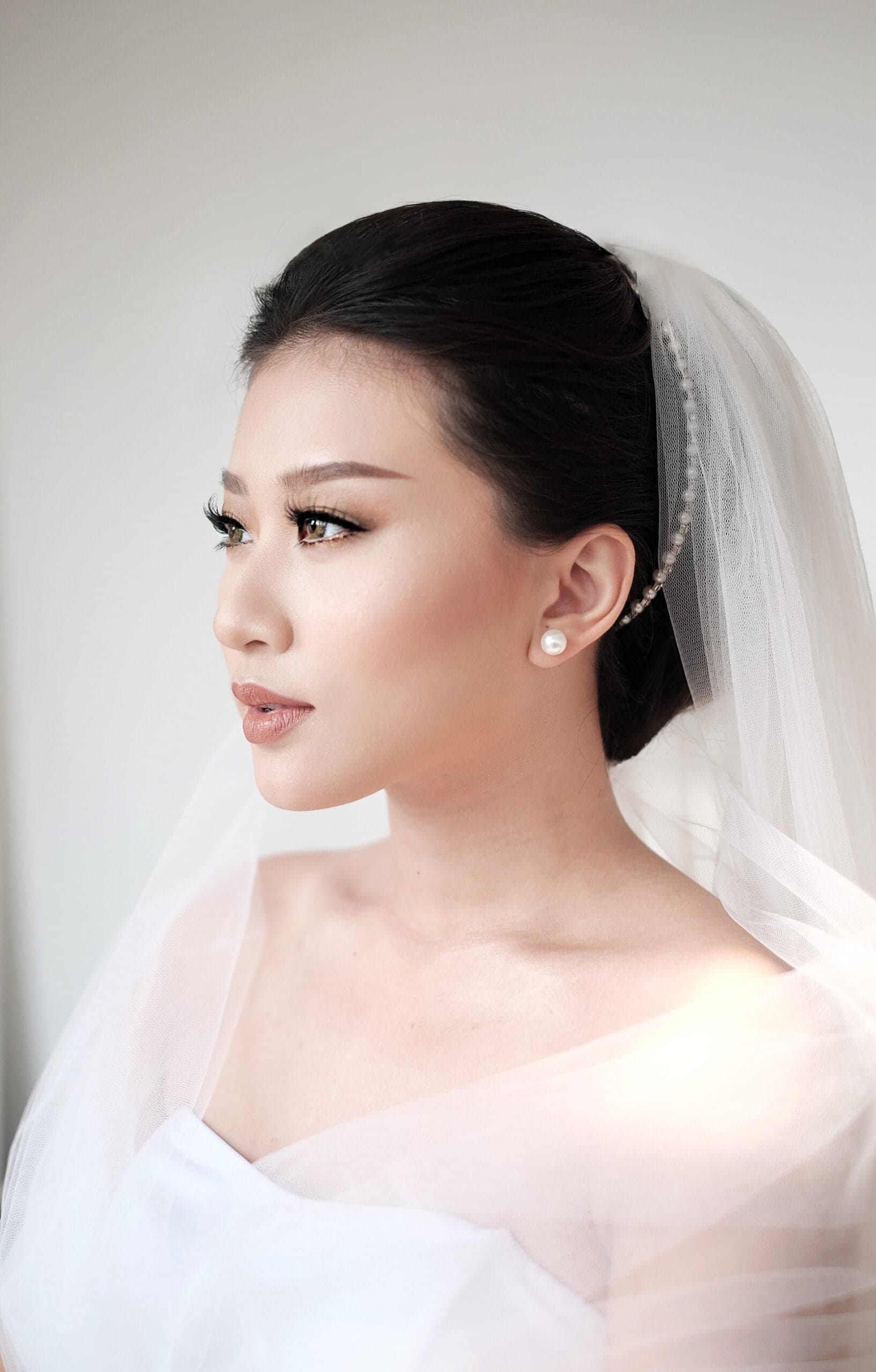
Why do brides wear veils? The tradition carries centuries of history, faith and family symbolism, while the moment a veil is lifted remains one of the most meaningful gestures of a wedding ceremony. This Wedded Wonderland guide explores its history and the decisions that matter today, from who lifts the veil to choosing a style suited to the setting.
For cuts and lengths, see our guide to wedding veil styles and lengths, and for the wider picture, our guide to wedding traditions.
Ask a room of brides why they chose a veil and you will hear a dozen answers. For some it completes the dress. For others it is a nod to a mother or grandmother, or a requirement of the ceremony they are marrying in. For many it is about one moment: the veil lifted, and the first clear look at each other as a married couple.
In English folklore, the veil is about luck. It is widely counted lucky to wear something on the wedding day that a happy bride has already worn, and women once took it as a compliment to be asked to lend their wedding veils to friends for exactly that reason. Many say the borrowed piece should come from a previous wedding whose marriage turned out happily, and the veil is singled out as the luckiest of all.
That is why a veil sits so naturally within something old, something new. A mother's veil can be old, borrowed and a family story all at once.
A Roman bride's look was set by ritual: hair in six locks bound with woollen fillets, a straight white tunic tied at the waist with a "knot of Hercules", and over it all a great flame-coloured veil. Her husband would untie the knot later. The Roman bridal veil, in other words, was not white.
The veil outlived Rome, changing in look and meaning along the way. In the early Christian centuries it became part of the Christian wedding, adapted from the Roman model, while women consecrated to God "took up the veil" as a symbol of their marriage to Christ and a sign of chastity. That link between veil and bride shaped how church fathers saw women entering monastic life: veiled, as befitted "brides of Christ".
The bridal look most of us picture today owes much to one wedding. In 1840 Queen Victoria wore white satin trimmed with orange blossom, a wreath of the same flowers, and a veil of Honiton lace thrown over the wreath, not over her face. Earlier royal brides had worn white, but often heavy with gold or silver embroidery; her simple ivory satin set a royal precedent. By 1800 white or cream was already usual for a bride, a colour that implied purity, cleanliness and social refinement.
Victoria chose English lace to promote British manufacture, and encouraged other brides to follow. A Devon Honiton veil of about 1850 carries a pattern of pea-pods, symbols of fruitfulness and happiness, and its bride would have worn it at the back of her head; veils over the face came later.
That is the Victorian veil in one line: lace, worn back from a crown of flowers.
A Honiton lace veil worn at St James's Church, Piccadilly, in February 1865 was designed so its pattern sits on the outside when the veil is folded over. The matching dress, made more than 20 years after the Queen's wedding, was based on hers. The veil, dress and a pair of boots stayed in the bride's family until her daughter bequeathed them in 1947.
Orange blossom stayed with the veil into the new century. A veil of 1902 was worn with a wax orange blossom hair ornament and hair piece, arranged on the head together with the veil.

For many couples, the veil is part of the ceremony itself. Many faiths and cultures have their own bridal head coverings, each with its own meaning, and the right person to explain yours is the officiant or family elder who will stand with you.
Jewish women covered their hair in public as an act of modesty from biblical times, and the earliest clear evidence for the bridal veil in Jewish custom dates from the early Middle Ages.
At a Jewish wedding, the badeken (veiling) follows the short pre-chupah receptions hosted by the bride and groom. A procession led by the groom goes to the bride's reception room, where he covers her face with a veil. The fathers and grandfathers of the bride and groom then bless her, and her face stays veiled for the whole chupah ceremony, giving her privacy at a holy time.
Jewish tradition traces the custom to the Matriarch Rebecca, who covered her face when she met her groom, Isaac. In Jewish teaching, the veil shows that the groom values the bride's inner beauty, which never fades, and not only her outward beauty. In Chassidic custom, the veil is dense enough to hide the bride's face completely, with no silver or gold thread, because bride and groom wear no jewellery to the chupah.
If you are planning a Jewish ceremony overseas, give the badeken its own place in the run sheet. It needs a separate room near the ceremony space, time for family to gather, and an early conversation with your rabbi about how dense the veil should be.
The bridal veil has been part of the Christian wedding since the early Christian centuries. In many church weddings today, the bride walks in with her face veiled and the veil is lifted at the altar. In others, it is worn back throughout. Ask your priest or minister whether the church has a custom of its own, particularly for a Catholic or Orthodox ceremony abroad.
Who lifts the veil is a choice, not a rule, and couples settle it in a few different ways.
The partner, after the vows. The most familiar version: the veil comes back just before the first kiss.
A parent, at the top of the aisle. A mother or father lifts it as they hand over, so the bride stands at the altar with her face clear.
The bride herself. Many brides prefer to lift it alone, or to wear it back from the start.
No lifting at all. A long veil worn back never covers the face, so the question falls away.
Partners of any gender can lift the veil, and it is worth deciding who before the rehearsal. Practise once with the actual veil and headpiece: a blusher has to lift cleanly over the crown without catching on pins or a comb, and the person lifting it should know how far to fold it back.
Tell your photographer and celebrant which version you have chosen. It is a few seconds long, and it is a photograph many couples treasure.

The blusher is the short layer worn forward over the face, ready to be lifted during the ceremony. For lengths and how it pairs with a longer veil, see our guide to wedding veil styles and lengths. Here the question is how you use it.
Many brides walk in with the blusher down and lift it, or have it lifted, at the altar. Others fold it back over the crown from the start, so it adds volume behind the head without ever covering the face. Both are right. A Victorian Honiton veil of about 1850 was worn at the back of the head, not over the face.
If the veil will be folded forward, check which side the pattern sits on. A Honiton lace veil worn in 1865 was designed so its pattern reads on the outside when folded over, and photographs catch both the back and the front.

An heirloom veil carries a family into the ceremony, and it can be your something borrowed. Start the conversation early. A family veil may need cleaning, a new comb or a repair to the edge, and some veils are fragile enough to be carried or displayed rather than worn.
Agree with the owner how the veil will be worn, who carries it there, and when it goes home.
A veil that floats softly down a chapel aisle behaves very differently on a clifftop. Plan for the setting, not the fitting room.
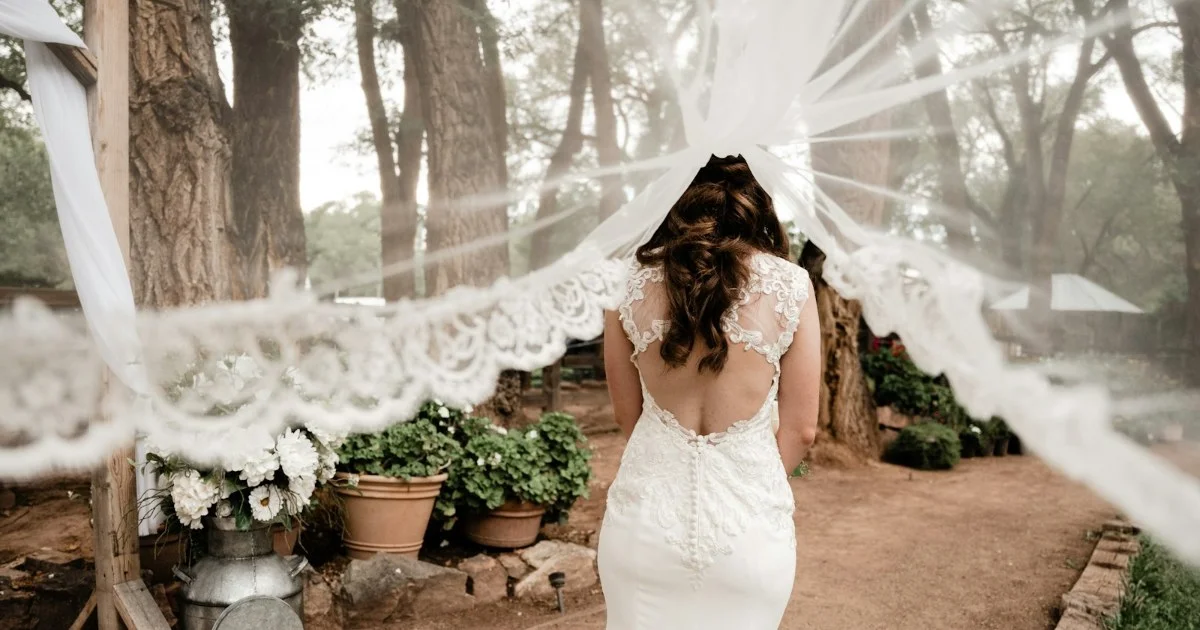
On a coast or a hilltop, sheer tulle lifts and wraps. Secure the veil firmly to the hair or headpiece, and name one person, a bridesmaid or whoever is coordinating your ceremony, to settle it before each walk and each photograph. The movement can be lovely in pictures, so long as someone is ready to catch it.

In summer sun, a heavy lace veil over the shoulders adds warmth. Many brides choose a lighter fabric for an outdoor ceremony and keep the heirloom lace for the portraits.
Long veils trail through sand, grass and gravel. Decide whether yours will be lifted and carried between the ceremony and the photographs.
The usual rhythm is the veil on for the ceremony and portraits, then off for the reception. Plan where it goes when it comes off, and who looks after it.
Settle these before you fly:
Who holds the veil while you dress?
Where does it wait overnight, and where on the morning until the ceremony? Ask your venue where it can be kept safely in the getting-ready room.
Who fixes it in place, and who checks the comb or pins before you walk?
If the veil is borrowed or an heirloom, who returns it to its owner, and when?
Keep the veil with you in your hand luggage, folded in tissue. As at August 2026, standard travel insurance typically doesn't cover items left unattended or stolen from checked baggage. Policies often limit each item's value, so check the item limit and whether an heirloom veil needs extra cover for valuables. Smartraveller has the current guidance.
If the veil belongs to someone else, ask whether their own insurance covers it overseas before it leaves home.
No. A veil is a choice, and plenty of brides leave it out. The question is what you want in its place, and how the people around you will feel about it.
What to wear instead: Fresh flowers in the hair, a single comb or pin, a hair vine, a headband, or nothing at all. A floral crown echoes the Victorian wreath of orange blossom without the veil.
When the ceremony asks for a head covering: Some religious ceremonies expect one. Ask your officiant early, and if a veil is not what you want, ask whether a scarf or mantle would suit.
Family expectations: A mother who has kept her veil for decades may hope to see it again. Talk before you shop. Many brides find a middle way: wearing the family veil for the ceremony only, carrying a piece of its lace in the bouquet, or wearing it for portraits the day before.

From a Roman bride's flame-coloured veil to Queen Victoria's lace, the veil has always been about history, faith, family and the moment it is lifted. Whether you wear your mother's veil, fold back a blusher on a windy clifftop or choose fresh flowers instead, its meaning is yours to decide. If you are torn, try one on at your fitting, because many brides know at once.
Written by

SEO Specialist
Ayrton Christian Braga is an SEO Specialist at Wedded Wonderland, where he writes optimized articles and web pages that center on destination weddings, cultural wedding traditions, and guides for everything in between.
Search real weddings, venues and vendors from around the world.
Search Wedded Wonderland