Something old, something new, something borrowed, something blue is one of the best-loved wedding traditions. Most couples can recite it, but few know where it came from. This Wedded Wonderland guide explains each line, the sixpence and the rhyme's origins. It then shows how to choose, borrow and safely carry each piece to a wedding overseas.
The rhyme in its earliest recorded form has just two lines:
Something old, something new,
Something borrowed, and something blue.
That is how it was written down in 1883, as the saying of "some Lancashire friends". It is the best-known wedding rhyme today.
A fifth line about a coin travels with it today. By 1946 the rhyme was in print with it:
Something old, Something new,
Something borrowed, Something blue,
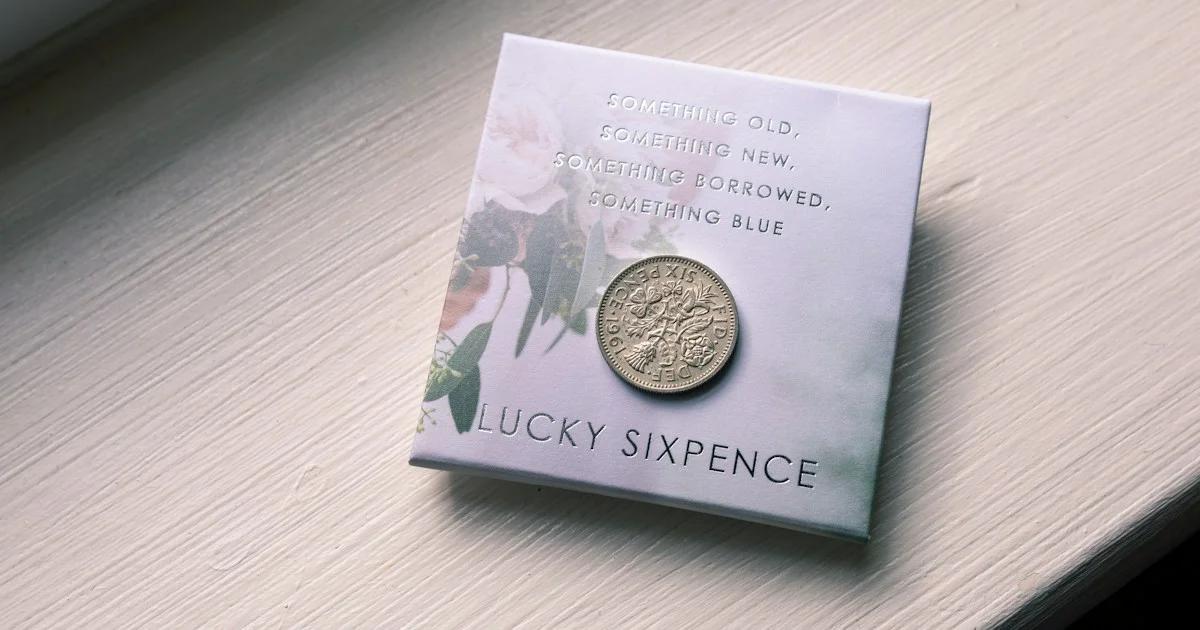
And a silver sixpence
In your shoe.
The wording shifts a little from one telling to the next. In Sean O'Casey's I Knock at the Door, set in Dublin, a bride is ready on her wedding morning, "having with her something old and something new, something borrowed and something blue, and a lucky sixpence in her shoe".
Some couples say "her shoe", others "your shoe", and many now drop the pronoun altogether. Partners of any gender can carry any of the five, and plenty of couples share them between the two outfits.
The rhyme was first recorded in 1883, in a collection of Shropshire folklore, though the friends who knew it came from Lancashire.
Something borrowed appears in print even earlier: by 1866, a bride in England's northern counties was expected to wear something borrowed. The custom held well into the twentieth century, and by 1957 the four items were "almost always worn, even by the most sophisticated brides".
Something borrowed carries the clearest meaning. It has long been thought lucky to wear something on the wedding day that a happy bride has already worn. Many hold that the borrowed piece should come from a previous wedding whose marriage turned out happily.
Blue is linked with loyalty and true love, and hence is lucky for brides. The link rests on the rhyme of blue with true, noticed from the Middle Ages onwards, and Chaucer links blue with "trouthe", or faithfulness.
Something old and something new are where couples make the rhyme their own. Many choose something old that already belongs to the family, and something new made or bought for this wedding. The sections below show how couples choose each one well.
The strongest something old is a piece with a name attached: a grandmother's brooch, a father's cufflinks, a locket that has been to three family weddings. Couples who plan well start the conversation with family early, because the best pieces are often in a drawer nobody has opened in years.

Many couples wear the piece exactly as it came to them. A brooch pinned to the bouquet wrap, a strand of pearls, a lace handkerchief folded into a jacket pocket. Have a jeweller check clasps and settings a few months before the wedding, so nothing gives way on the day.
Clothes count too, and many couples rework a mother's dress or her lace into something of their own. A block-printed cotton wedding dress from an 1841 Lincolnshire wedding has a bodice that was carefully enlarged. Dresses like it were worn as Sunday best long after the wedding, or handed down.
When an heirloom ring does not suit the hand it is meant for, many couples keep the stone and change the setting. A family diamond or sapphire can move into a new band, a pendant or a pair of earrings, and still be something old on the day. Our guide to engagement ring styles can help you choose a setting that suits the stone.
Agree with the family before anything is reset. A grandmother may love the idea, or may want the ring to stay as she wore it.
For many couples the dress or suit itself is something new, and that is enough. Others want one piece that will become the something old of the next generation.

Commissioning a piece gives you something new with a reason to exist. Couples often choose earrings, a bracelet or a watch, engraved with the wedding date or the place. Some commission a matching pair of pieces, one for each partner.
Allow time. A commissioned piece needs design meetings, a making period and a final fitting, so start several months before you travel. If you are weighing up stones, our guide to lab-grown diamonds sets out the choices.
Something new does not have to be jewellery. A hand-stitched veil, a monogrammed handkerchief or shoes made to measure for a long ceremony on uneven ground all work, and all become heirlooms in time.
Something borrowed is the one item that has to go home again, and that is part of its point. Tradition favours borrowing something worn at an earlier wedding whose marriage turned out happily, and the veil is often singled out as the luckiest piece to borrow.

Good choices for something borrowed:
A mother's or grandmother's veil, cleaned and refitted.
A sister's earrings or bracelet from her own wedding.
A friend's hair comb or pin, if she is happily married.
A father's or grandfather's cufflinks or tie pin for a partner in a suit.
A family prayer book, rosary or ring carried rather than worn.
Ask early. A borrowed veil may need cleaning or alteration, and a borrowed piece of jewellery may need a clasp repaired. Agree with the owner how the piece will travel, who carries it and when it goes back, and return it in person after the wedding.
Blue has a long habit of staying out of sight. When the wedding gown was white, the blue was carried by making the garters blue. Blue was also once recommended as the lucky colour for the dress itself, and a mother of the bride in 1988 still mentioned "the blue garter of course". That 1841 dress is white cotton printed with ribbon-like motifs in cream, pink, blue and purple, a reminder that blue can sit in a fabric rather than on top of it.

Something blue ideas for a wedding overseas:
Initials or the wedding date stitched in blue inside a hem, cuff or jacket lining.
A sapphire, as earrings, a pendant or a stone set into a band.
A pale blue silk ribbon wrapped around the bouquet stems.
Blue soles or blue lining in shoes.
A blue garter, the classic choice.
A small blue flower, such as cornflower or forget-me-not, tucked into the bouquet or a buttonhole.
For a destination wedding, choose blue that survives a long-haul flight. Stitched initials and a sapphire need no care at all. A fresh flower depends on what grows where you are marrying, so ask your florist early.
The sixpence goes in the left shoe, where it is meant to bring luck. A silver sixpence has long been a lucky charm, especially in a bride's shoe.
Many families keep one sixpence and pass it from wedding to wedding, so the coin becomes something old as well. Others give a new one as a gift on the morning. Either way, a coin under the heel for hours is uncomfortable, so many couples tape it inside the shoe, tuck it under the insole or carry it in a pocket instead.
A sixpence is small and easy to lose. Pack it with your other pieces, not loose in a shoe in your suitcase.
Couples marrying overseas often treat the rhyme as a way to bring family into a wedding many relatives cannot attend. These combinations work beautifully:
One piece from each side. Something old from one family, something borrowed from the other, so both are in the room.
One piece, several lines. A grandmother's sapphire ring, lent for the day, is old, borrowed and blue at once.
A commission that starts a tradition. A new piece engraved with the date, which you plan to lend to the next family bride or groom.
The outfits share the load. One partner wears the heirloom cufflinks and the blue lining, the other the borrowed veil and the new earrings.
A gift on the morning. Parents or grandparents present something new or the family sixpence as part of getting ready, and the photographer is there for it.
Keep a short list of who gave what. It makes thank-you notes easier, and it is the record your own children may one day ask for.
When the brooch is irreplaceable and the wedding is on another continent, getting it there safely matters as much as choosing it. As at November 2026, these are the steps to take.
Before you go. Consider which pieces need to travel at all, and leave behind anything you can do without. Take photos of every piece you are taking and record any serial numbers. Keep valuations or proof of purchase with your travel documents, because an insurer may ask for them if you claim.
In transit. Carry heirlooms, borrowed pieces, rings and the sixpence in your hand luggage or on your person. Standard travel insurance policies typically don't cover items stolen from checked baggage on an airline, train or bus. Keep your bags close and valuables out of sight.
At the destination. Use the hotel safe between events. Standard policies typically don't cover items that were not stored in a hotel safe when one was available, or items left unattended. If something is stolen, report it to the local police, because you can't claim on travel insurance without one.
On the wedding morning. Settle these questions before you fly, and share the answers with everyone involved:
Who holds each piece while you dress, and who hands it to you?
Where is each piece kept overnight, and where is it kept on the morning between getting ready and the ceremony?
Who takes each piece back to the safe after the last event?
Who returns each borrowed piece to its owner, and when?
Insurance. Travel insurance can cover replacing valuables that are lost, damaged or stolen, but policies often limit each item's value, so check the item limits and whether you need extra cover. Read the Product Disclosure Statement before you buy, and declare everything upfront, or you may void the policy.
Check how your insurer defines "unattended". Credit card travel insurance may only cover the cardholder, and generally only the trip paid for on the card. Moneysmart has more on choosing a policy.
A borrowed piece belongs to someone else, so ask the owner whether their own contents policy covers it overseas before it leaves home. Our guide to engagement ring insurance covers specified cover for rings and jewellery in more detail.
Most couples can recall something old, something new, something borrowed, something blue, and now you also know where the rhyme came from and what each line asks of you. Choose an heirloom with a story, a new piece made for the day, something borrowed from a happy marriage and a blue that survives the flight. Then carry all four, and the sixpence, safely to your wedding overseas, where one of the oldest wedding traditions becomes part of your own.
Written by

SEO Specialist
Ayrton Christian Braga is an SEO Specialist at Wedded Wonderland, where he writes optimized articles and web pages that center on destination weddings, cultural wedding traditions, and guides for everything in between.
Search real weddings, venues and vendors from around the world.
Search Wedded Wonderland