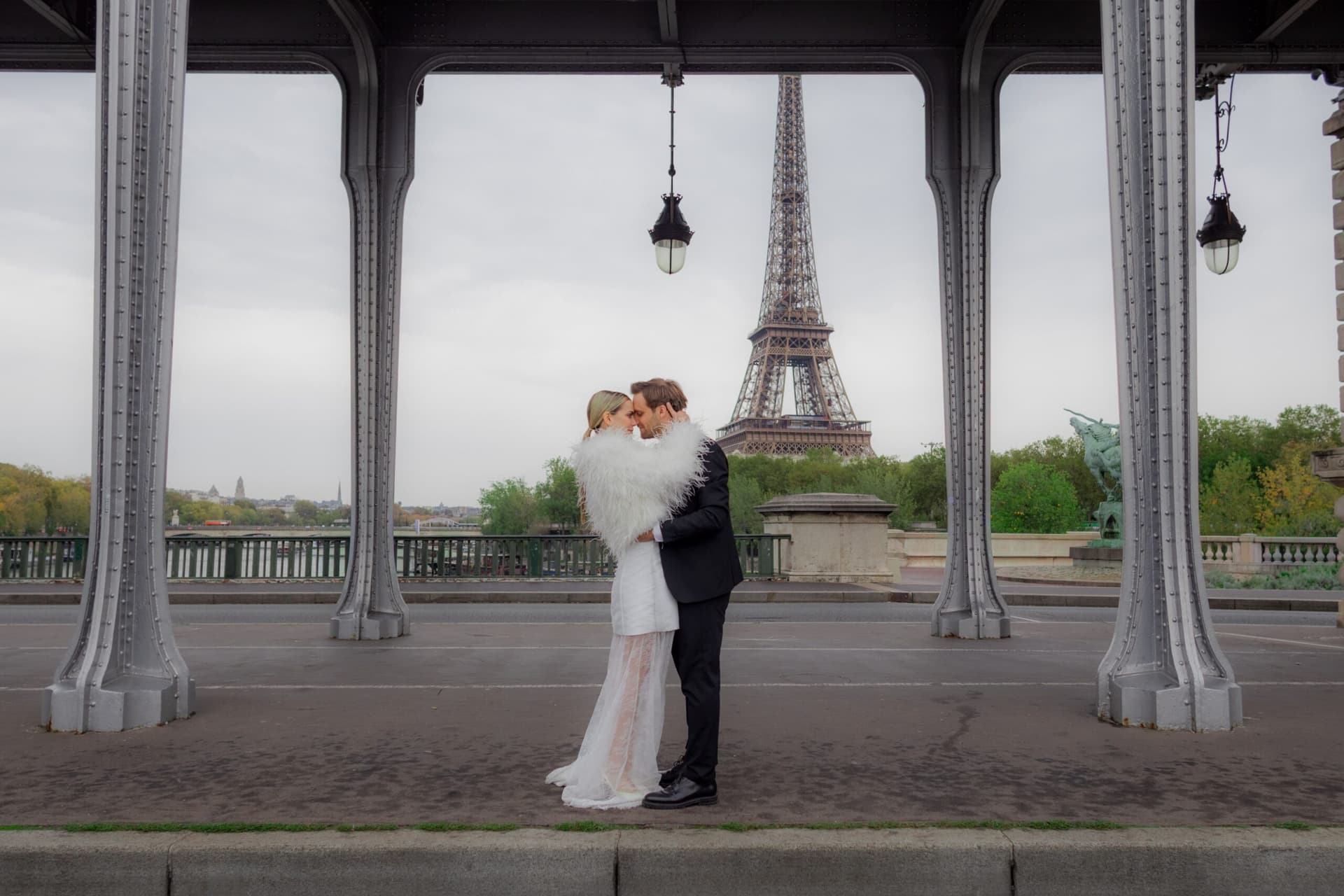
Getting married in France as a foreigner starts with one legal question: does either of you live there? Two foreigners who don't live in France can't marry at a French town hall (mairie). At least one of you must be French or a legal resident of France. This Wedded Wonderland guide covers both routes, from mairie paperwork to marrying legally in Australia first.
Yes, when one of you has a real tie to France. The Australian Embassy in France says a marriage must take place at a mairie to be legally recognised, and at least one of you must be a French citizen or a legal resident of France. Marriages are not performed at Australian embassies or missions.
Service-public.gouv.fr, the French government's official guide, says two foreigners who do not live in France can marry only at their own country's consulate or in a commune of a French overseas collectivity or New Caledonia. We checked every source on 16 November 2026; confirm each requirement with your mairie, the Australian Embassy in Paris or DFAT.

So getting married in France comes down to which route fits you.
Legal in France | Legal in Australia, celebration in France | |
|---|---|---|
Who it suits | One partner is French or a legal resident of France | Couples who both live in Australia, or anyone who prefers the legal step at home |
Where the legal part happens | A mairie in France, before the mayor or a deputy | In Australia, before an authorised celebrant |
Extra paperwork | Certificat de coutume, birth certificate, No Record of Marriage, sworn translations, proof of residence, banns | A Notice of Intended Marriage (NOIM) given to your celebrant |
The French day | Civil ceremony at the mairie, then your celebration | A symbolic celebration at your venue, with no legal effect |
Beyond the Embassy's rule, service-public sets which commune can marry you: one where one of you has your home (domicile) or residence, or where a parent (father or mother only) of one of you lives, which can be a second home such as a family house in Provence. The residence must be established by at least one month of continuous living at the date the banns are published, with proof in that person's name at an address in the commune: an energy bill, a home insurance certificate or a rent receipt dated more than one month before the banns.
A parent's house chooses the commune; it does not change the rule for two foreigners who do not live in France. If neither of you is French or resident, the next section is your route.
Same-sex couples are covered on the same terms: service-public addresses couples of different sex and of the same sex throughout. We do not give visa or residency advice.
This route needs almost no French paperwork, because the legal marriage happens at home under Australian law. The Attorney-General's Department says you give your NOIM to an authorised celebrant at least one month and no more than 18 months before the wedding; you need not be citizens or permanent residents.
The ceremony itself cannot be remote: the celebrant must meet each of you in person and be physically present with you and two witnesses over 18, and an Australian celebrant cannot legally marry you overseas. A small ceremony at home, before you fly or after you return, then sits comfortably with a full celebration in France. For the detail, see how to marry legally in Australia first.
Italy works differently: two non-residents can marry legally at a comune (town hall) there, so if you are still weighing countries, see how the Italian legal process compares.
Service-public says a foreign national must present a certificat de coutume, generally issued by their embassy or consulate. It sets out your country's marriage rules, proves your civil status and shows you are not already married. The mairie may ask for other documents specific to your nationality, and it sets the final list. Australians have two ways to get it:
From the Australian Embassy in Paris: This produces the certificat de coutume in French. You sign its form before a person listed on it, who certifies a copy of your passport, and post it with certified copies of both passports to the Embassy's Consular section. The Embassy sends a payment form once the application is complete and estimates up to 10 working days, plus postage.
From DFAT in Australia: If you hold an English-language Certificate of No Impediment to Marriage (CNI) from a DFAT office (see Smartraveller's CNI guide), have it translated by a sworn translator (ask your mairie which translators it accepts), in Australia or in France. You then do not need to apply in France.
Under French law the Embassy's certificate is valid for only 90 days from issue, so ask your mairie at which step it must still be valid, and do not order it too early.
Document | Issued by | Apostille | Translation into French | Fee and timing |
|---|---|---|---|---|
Certificat de coutume (CNI) | Australian Embassy Paris (French) or DFAT (English) | Ask your mairie | Sworn translation of the DFAT English version | AUD 181 each (2026 fee); up to 10 working days at the Embassy; valid 90 days |
Birth certificate | Your state or territory BDM registry | Ask your mairie; the Embassy can apostille original BDM documents, AUD 105 each (2026 fee) | Sworn translator | Ask whether it must be under six months old |
No Record of Marriage | Your state or territory BDM registry | Ask your mairie | Ask your mairie | Replaces the certificat de célibat, which the Embassy cannot issue |
Proof of residence | Energy supplier, insurer or landlord in the commune | Not applicable (French document) | Not applicable (French document) | Dated more than one month before the banns |
The mairie's file also asks for ID, your occupations (in French), your parents' details and your witnesses'. Fees are on the Embassy's fee schedule and rise with CPI each 1 January, so an application made in 2027 pays the 2027 rate.
The Embassy's guidance for Australian papers is: a DFAT CNI in English must be translated by a sworn translator, and you contact a sworn translator directly to put your birth certificate into French. That is not the same as NAATI, the Australian accreditation, which NSW, for example, requires for foreign documents used at home. Ask your mairie which translators it accepts.
Whether your mairie wants an apostille on each document, and before or after translation, is its call; get the answer in writing before you order anything. DFAT publishes no fixed processing time and warns of delays at the end of the school year and in peak holidays. Before the translator starts, check that every spelling matches across your passport, birth certificate and CNI.
The banns (publication des bans) are notices posted for 10 days at the mairie where you marry and at the mairie of each partner's domicile. A dispensation can be requested from the procureur (the public prosecutor), and the wedding must take place within one year of the end of those 10 days.
The registrar will usually interview you together, and possibly separately. If needed, the file goes to the procureur, who has 15 days to respond or may set a renewable delay of up to one month.
A backward timeline, as an illustration only; your mairie sets the real one:
When | Legal in France | Legal in Australia |
|---|---|---|
12 months out | Contact the mairie of your commune | Choose your celebrant; a NOIM can be given up to 18 months ahead |
6 to 4 months out | Order birth and No Record of Marriage certificates; ask the mairie about apostilles and translators | Plan the celebration in France |
About 3 months out | Certificat de coutume, timed as your mairie advises; book sworn translations | Celebrant meets each of you in person |
By the banns | One month of continuous residence in the commune, with dated proof | NOIM given at least one month before the ceremony |
Banns | 10 days, plus time for the hearing | Small legal ceremony at home |
Wedding | Civil ceremony within a year of the banns | Fly to France for the celebration |
Service-public says the marriage must be celebrated at the mairie, in a room open to the public, or in another communal building such as a salle des fêtes if the mayor chooses, though the procureur can object. The mayor or a deputy (adjoint) conducts it, with both of you and your witnesses present. So the legal ceremony cannot move to a chateau or a vineyard; that is where your celebration comes in.

You choose two to four witnesses, at least 18 on the day, family or not, of any nationality; each brings original ID and stays to sign the register. A witness who does not understand French may have an interpreter, and a translator-interpreter may attend for you, at your cost if paid. Ask your mairie about any charge for the ceremony itself.
Afterwards you receive a livret de famille (the French family record book), and in the following days you can ask the mairie for a full copy (copie intégrale) of your marriage certificate.
Service-public is unambiguous: it is forbidden to celebrate a religious marriage before the civil marriage, so the mairie comes first. A symbolic ceremony has no legal effect, so it can sit wherever your celebration does: among the vines or on a chateau lawn, in your own words.

If you married in Australia, your celebrant sends the NOIM, the declaration and the Official Certificate of Marriage to the registry of the state or territory where you married within 14 days. That Australian record is your legal record.
If you married at a French mairie, Smartraveller's advice on marrying overseas says you cannot register the marriage in Australia, but in most cases it is recognised if it was valid where it happened and would have been valid under Australian law. Exceptions include a partner already married or under age, and Smartraveller suggests a lawyer if you want certainty. The French certificate is usually accepted as proof of the marriage, though it may not be enough for a name change. For the general steps, see what to do with a marriage certificate issued overseas.
You can keep travelling on your current passport, and the Australian Passport Office recommends booking travel in the name on it. For a passport in a married name, an applicant born in Australia who married overseas needs a change of name certificate from their state or territory registry. In NSW, a person legally married in Australia can take their spouse's family name without registering a change of name, so check your own registry.
One way a week could run, as an illustration, never a promise:
Monday and Tuesday: guests arrive and settle in.
Wednesday: for the legal route, the mairie ceremony at the time your mairie sets, with your witnesses.
Thursday: welcome dinner.
Saturday: the celebration at the chateau, with a wet-weather plan for an outdoor ceremony.
Sunday: a long recovery lunch.

Before anyone books, read Smartraveller's France advice: on 16 November 2026 it was at level 2, "Exercise a high degree of caution", and levels can change at short notice.
See our guide to weddings in France, plan guest stays through wedding and honeymoon travel, and keep euro and Australian dollar costs side by side in the free Wonderland Studio.
Written by

SEO Specialist
Ayrton Christian Braga is an SEO Specialist at Wedded Wonderland, where he writes optimized articles and web pages that center on destination weddings, cultural wedding traditions, and guides for everything in between.
Search real weddings, venues and vendors from around the world.
Search Wedded Wonderland