You can get married in New Zealand as Australians, and neither of you needs to be a New Zealand citizen. You need a marriage licence, a registered celebrant and 2 witnesses. This Wedded Wonderland guide takes each step in order, from the form you sign at home to the certificate you bring back.
Yes. You do not need to be a New Zealand citizen, and visitors to New Zealand can marry in New Zealand. Before the wedding you apply for a marriage licence, which confirms it is legal for you to marry, and a fee applies; the current amount is on the marriage licence page. Government fees change, so check the official page before you plan your costs. The New Zealand Government sets out the whole process in its guide on how to get married in NZ.
The legal tests are short. You cannot marry if either of you is already married or in a civil union, unless you are changing the relationship with the same person, if you are closely related by birth, marriage or adoption, or if either of you is under 16. Anyone who believes there is a legal reason you should not marry can lodge a caveat or notice of objection.
Australia then applies its own test when you come home, which this guide covers in the recognition section further down.
You must be married by a celebrant, and you choose between a personalised ceremony and a registry ceremony. Most marriage ceremonies in New Zealand are personalised: you design the ceremony with your celebrant, hold it at the time, date and place you choose, and write your own vows. That includes any day of the week, weekends and public holidays among them.
A registry ceremony is the simpler, fixed version. It uses standard vows and takes place during business hours on a weekday, 9am to 5pm Monday to Friday, never on a public holiday. A set ceremony fee applies, paid to the celebrant in advance on top of the licence fee, and you contact the celebrant before applying for your licence to make sure they are available.
For a wedding your guests fly in for, the personalised ceremony is the one that lets the day take the shape you picture. A registry ceremony suits couples who want the legal marriage done quietly, with the celebration held separately.
A few checks before you leave Australia keep the rest of the trip simple. Sort out entry for everyone travelling first, then prepare the papers your licence depends on.
Most Australian citizens don't need a visa to enter New Zealand, unless they have a criminal record or have been deported from any country, and Australian citizens are exempt from the New Zealand Electronic Travel Authority (NZeTA). If anyone in your wedding party travels on another passport, ask them to check their own entry rules early.
Before passport control on arrival, you complete a New Zealand Traveller Declaration (NZTD), online or in the NZTD app. Put it on the checklist you send guests with their travel details, alongside the passport they will need.
Smartraveller rates New Zealand at its lowest advice level, "Exercise normal safety precautions", and notes crime rates similar to Australia's, with thieves often targeting valuables left in cars and campervans. Read the full Smartraveller New Zealand advice before you book.
An Australian driver's licence covers driving for up to 12 months but is not approved ID for buying alcohol or entering licensed premises, so guests should carry their passport to the bar. Australians can access public medical care by showing an Australian passport and a valid Medicare card. The Australian High Commission is in Wellington and the Consulate-General in Auckland.
The licence application asks for information about both of you, though only one of you needs to complete it. Couples who live outside New Zealand use the notice of intended marriage form for parties ordinarily resident outside New Zealand, known as BDM 58. You fill in everything except the statutory declaration, then sign that declaration in front of one of the authorised people listed on the form, and send the fee to Births, Deaths and Marriages.
Read the form through before you book flights. Two details on it shape the rest of your plans: the venue you name, and the date your licence window opens.
Anyone can apply for a marriage licence, whether in New Zealand or not, and you can apply for a marriage licence online or on a paper form. For an Australian couple, the steps run in this order.
Only registered celebrants can perform weddings or civil unions in New Zealand. Celebrants set their own fees on top of the licence fee. The New Zealand Government keeps a page on registered celebrants, and our guide explains who can legally marry you more generally.
Choose your celebrant before you lodge the licence application. For a registry ceremony this is part of the process. For a personalised ceremony it simply makes sense: the celebrant shapes the ceremony, receives your licence papers and registers the marriage. Ask them:
Are you registered to perform marriages in New Zealand?
What does your fee include, and when is it paid?
How do you work with couples planning from Australia?
Will you meet us before the day, in person or by video?
You need to arrange the licence at least 3 working days before you marry, and it expires after 3 months. Those two numbers set your window: apply too late and there is no licence on the day; apply too early and it lapses before the wedding.
You need to know your venue when you apply. The ceremony can only take place at the places you put on the application, so include a back-up venue; if the place changes because of unforeseen circumstances, the new location must still be within New Zealand. For an outdoor wedding, the back-up is your wet-weather plan in legal form, so name it with care.
Couples from outside New Zealand visit a registry office on arrival to sign a declaration that they are legally allowed to marry and have been truthful on the form; this is not the ceremony. When you send the BDM 58, ask Births, Deaths and Marriages how to book the visit and whether you both need to attend, and plan it well before the rehearsal. For a personalised ceremony you are then sent the licence and 2 copies of the Copy of Particulars of Marriage, and you give all 3 documents to your celebrant before the wedding.
You need 2 witnesses. They must understand what is happening, be able to clearly identify both of you, and be satisfied that you both consent, though they need not have known you for any length of time. If your witnesses speak a different language, an interpreter is needed, who signs a declaration before the ceremony.
A marriage cannot happen virtually. You, your celebrant and your witnesses must be physically present in the same place. For an elopement, ask your celebrant how witnesses are usually arranged, and whether your photographer can stand in as one.

You can write your own vows, as long as each of you says words to the effect of "I [name] take you [name] to be my legal wife, husband or partner". Share your draft vows with your celebrant early so that line sits naturally in what you have written.
After the ceremony, you and your witnesses sign the 2 copies of the Copy of Particulars. You keep one, and your celebrant sends the other to Births, Deaths and Marriages within 10 days. The Copy of Particulars is not the same as a marriage certificate; your celebrant uses the other copy to register the marriage with the New Zealand Government.
In most cases, yes, but the paperwork does not end at the ceremony. Here is how to order your certificate, prepare it for Australian use and update your name.
A New Zealand marriage certificate is the official record of your marriage. You order it online and it is posted to you, and a fee applies. Order it once your celebrant has registered the marriage, and order a second copy if you expect to send one away for an Apostille while keeping one at home.
Australia is listed as an Apostille country for New Zealand documents. Apostilles are issued by the Department of Internal Affairs Authentication Unit, and you can ask for a paper Apostille or an electronic e-apostille, so ask the Australian organisation receiving your certificate which it wants.
The Authentication Unit processes applications within 15 working days, with an urgent service within 5 working days for an extra fee, and a fee applies; the current amount is on the using your NZ documents overseas page. Check whether it needs your original certificate or a notarised copy, and whether the organisation receiving it has its own requirements, such as a recently issued document.
You cannot register an overseas marriage in Australia, but in most cases it is legally recognised if it was valid under the law of the country where it took place and would have been valid under Australian law had it happened here. Australia does not recognise an overseas marriage where either person is already married to someone else, is not old enough to marry, is too closely related to the other, or is forced to marry. Smartraveller covers the detail in its guide to getting married overseas.
Once Australia recognises your marriage, you cannot marry again in Australia, though you may choose to hold another kind of ceremony, such as a confirmation of vows. That suits couples who marry in New Zealand with close family and celebrate at home afterwards.
For banks, passports and records, read our guide to changing your name after marriage, and ask each organisation whether it wants your certificate with an Apostille.

With a personalised ceremony, the choice of place is yours. What that place requires beyond the licence is a question for the people who manage it. Before you fall for a shoreline, a lakeside reserve or a clearing in a national park, put these questions to your celebrant and your venue:
Is this land public, private or conservation land, and who gives permission for a ceremony here?
Is a permit or concession needed, who applies for it, and how long before the date?
Are there limits on guest numbers, set-up, music, drones or vehicles?
Can the site be reserved for our ceremony, or is it open to the public throughout?
Where is the named back-up venue on our licence, and how quickly can we move there?
Using public conservation land for an activity needs permission from the Department of Conservation in the form of a concession, so ask early whether your ceremony needs one. For local beaches and parks, ask your celebrant and venue who gives permission.

An elopement in the mountains strips the day back to the two of you, your celebrant and 2 witnesses, all present in the same place. The licence still names your location, so a ceremony on a high ridge needs a named back-up as much as a garden wedding does.
Weather conditions can change quickly in New Zealand, and severe weather can leave you stranded, especially in remote areas. Ask your celebrant and any operator how they decide on the day whether to go ahead, and where you will marry if they don't.

There is no single right month, and the seasons play out differently from the subtropical north to the alpine south. Queenstown is known for four distinct seasons: crisp, blue-sky days in winter, snow lingering into longer, warmer days in spring, sunshine and long twilights in summer, and autumn colour after that. Choose the season for the wedding you picture, then test it with your venue.
Smartraveller is plain about the hazards. Earthquakes are a constant risk, large damaging quakes can happen at any time, and all of New Zealand's coastline is at risk of a tsunami. New Zealand has several active volcanoes, and alert levels can rise quickly, with evacuation ordered at short notice. Weather can leave you stranded, and on the roads ice, snow, fog and high winds can make driving hazardous, so monitor MetService forecasts and warnings. These are questions to settle in writing with your venue and suppliers before you sign.
Ask your venue and celebrant:
What is the weather usually like here in the month we are considering, and what has caught couples out?
When does daylight end on our date, and how does that shape the ceremony time?
What is the indoor or covered plan, and is it named on our licence?
What is your emergency and evacuation plan for guests, and how do guests leave if roads close?
If an alert, closure or severe weather stops the wedding going ahead, what happens to our deposits and our date?

New Zealand gives you alpine lakes, island vineyards, a subtropical bay and wine country across the Tasman from Australia. Our Oceania destination weddings hub sets New Zealand alongside its neighbours.
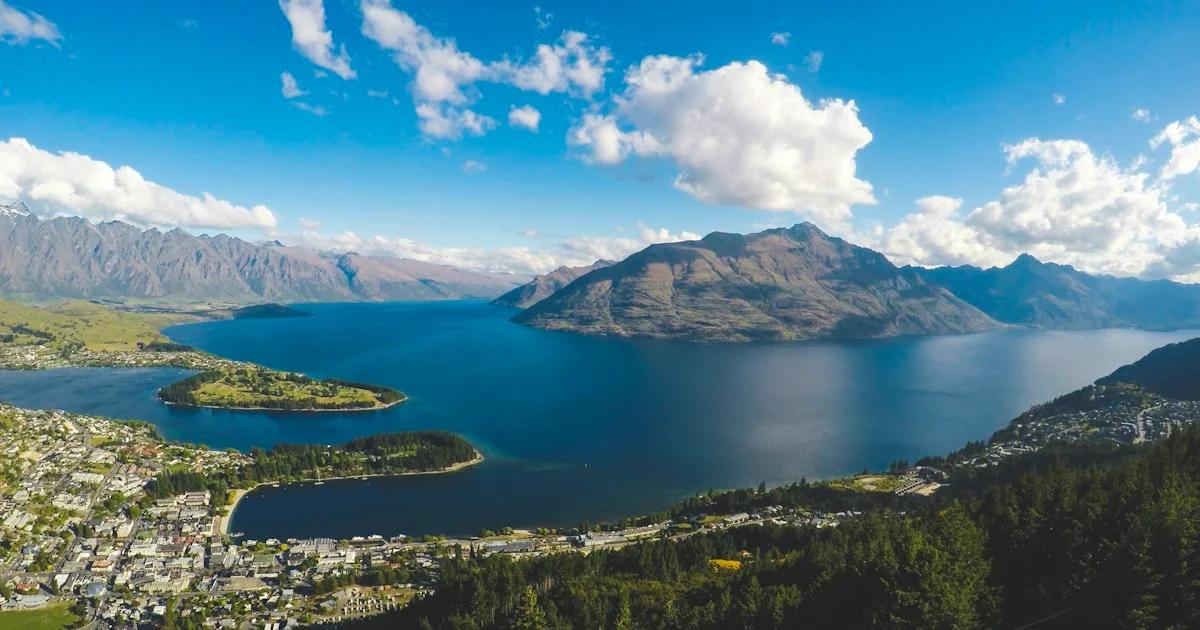
Queenstown sits on the shore of Lake Wakatipu among alpine ranges. Beyond the town, Central Otago brings Arrowtown's gold-mining history, vineyard stays in the Gibbston, and rural Glenorchy and Paradise Valley at the northern tip of the lake, a short drive from Mt Aspiring National Park.
Tāmaki Makaurau Auckland has three main wine-growing areas, Waiheke Island, Matakana to the north and Kumeu to the west, along with 26 regional parks, black-sand surf beaches such as Piha and Muriwai, and harbour-side dining at the Viaduct Harbour and Wynyard Quarter. Waiheke Island, in the Hauraki Gulf, is a haven of vineyards, olive groves and beaches, reached by ferry from downtown Auckland.
The Bay of Islands is a subtropical area of 144 islands between Cape Brett and the Purerua Peninsula, with the towns of Opua, Paihia, Russell and Kerikeri. Ask your venue how guests travel in from Auckland for your dates.
Hawke's Bay is wine country with a warm, temperate climate, known for cabernet sauvignon, merlot, syrah and chardonnay, and more than 30 cellar doors. Napier and Hastings were rebuilt in Art Deco style after the 1931 earthquake, which gives a reception a setting with real period character.
Marlborough is New Zealand's largest winegrowing region, known for Sauvignon Blanc, with more than 30 cellar doors, and the Marlborough Sounds are a 20-minute drive away. It is also one of New Zealand's sunniest places.
Whether you choose a lodge, a vineyard estate or a private home, ask how the season, the number of nights you take the property, how many guests stay on site, how remote the setting is and how much has to travel in shape the price. Ask every venue to set its quote out in writing, line by line.
Before you sign, put these questions to the lodge or estate:
Deposits and contracts: whose name is on the contract, in which currency are payments made, and when do deposits become non-refundable?
Access: which ceremony, dining and guest spaces have level access?
Sole use: can we take the whole property for the nights we need, with no other guests or events alongside?
Privacy: how do you handle other guests, drones and outside photographers during our events?
Security: how does your security work, and how would it work alongside any security we bring?
Weather: what is the covered or indoor plan, and can it be named as the back-up venue on our licence?
Guest travel: how do guests reach you from the nearest airport, and what happens if roads close?
The legal side has a clear order: the BDM 58 form signed in Australia, a registry office visit on arrival, your celebrant and 2 witnesses on the day, then registration, your certificate and an Apostille if an Australian organisation asks for one. Everything around it is where the planning begins. If one of you is still planning the question, see our proposal spots in New Zealand.
Written by

SEO Specialist
Ayrton Christian Braga is an SEO Specialist at Wedded Wonderland, where he writes optimized articles and web pages that center on destination weddings, cultural wedding traditions, and guides for everything in between.
Search real weddings, venues and vendors from around the world.
Search Wedded Wonderland