Australia does not issue a marriage licence. The legal step is the Notice of Intended Marriage (NOIM), which you give your celebrant at least one month before the wedding. This Wedded Wonderland guide covers who can witness it, the documents you need, state fees and marrying overseas. Rules and fees change, so confirm your plans with your celebrant or registry.
No. Section 42 of the Marriage Act 1961 says a marriage cannot be solemnised unless written notice has been given to the authorised celebrant who will marry you.
The rules come from the Marriage Act 1961 and the Marriage Regulations 2017, and the Attorney-General's Department (AGD) publishes them in plain English. Many couples expect a licence because other countries, such as the United States, issue one.
In practice, three things make an Australian wedding legal:
Notice in time: a NOIM given to your celebrant inside the one-month to 18-month window.
The right person: an authorised marriage celebrant who is in the room with you.
The right ceremony: specific legal words, said in front of two adult witnesses, and three certificates signed on the day.
The NOIM must be completed, signed and given to your celebrant at least one month, and not more than 18 months, before the wedding. The 18 months limits when you give notice; it is not a period for which the notice stays "valid", as some websites suggest.

You both give notice. If one of you cannot sign when the form is handed over, the other may sign and give it, and the second partner must then sign before the wedding in front of that celebrant or another authorised celebrant.
In Australia, your NOIM signatures can be witnessed by:
an authorised marriage celebrant
a justice of the peace
a barrister or solicitor
a medical practitioner
a member of the Australian Federal Police or a state or territory police force.
Outside Australia, the witness can be an Australian consular officer, an Australian diplomatic officer, a notary public, or a Commonwealth or Austrade employee authorised under the Consular Fees Act 1955.
Since 12 June 2024, a NOIM can be witnessed remotely by audio-visual link. If you are in Australia, the remote witness, who can be your celebrant, must also be in Australia. If you are overseas, AGD says a NOIM for someone outside Australia cannot be witnessed online, and a witness abroad cannot be a celebrant. The practical answer: the partner who is overseas signs in person in front of an authorised witness where they are, such as a notary public or an Australian consulate.
Talk to your celebrant first. A prescribed authority (the official your celebrant can point you to) may agree to shorten the notice period for reasons AGD lists: employment-related or travel commitments, wedding or celebration arrangements, medical reasons, legal proceedings, or an error in giving notice. Approval is a decision, not a formality, so do not plan around it.
Download the NOIM from AGD's Notice of Intended Marriage page, or use the copy your celebrant sends you. The form itself was last revised on 1 September 2021, and AGD's page explains the changes since, including remote witnessing, so avoid old copies saved on other websites.
Read every field before you sign: knowingly giving or signing a NOIM with a false statement or error is an offence under section 104 of the Act. If your plans change, a NOIM can now be transferred to another authorised celebrant, including at your request.
Australian marriage law sets a short list of conditions that both of you must meet, whoever you are and wherever you live. Your celebrant checks them against your NOIM and documents before the wedding, so it pays to confirm them early. To marry in Australia, you must:
not already be married to someone else
not be marrying a parent, grandparent, child, grandchild, brother or sister
be at least 18 (a court can approve a marriage where one person is 16 to 18, but two people under 18 can never marry)
understand what marriage means and freely agree to marry.

Neither of you needs to be an Australian citizen or permanent resident, and the right to marry is no longer determined by sex or gender. Your celebrant must see evidence before the wedding, and AGD's NOIM form sets out what counts:
What you prove | What the celebrant can accept | Worth knowing |
|---|---|---|
Date and place of birth | Birth certificate, official extract from a birth register, or an Australian or overseas passport | The order of acceptable evidence changed on 12 June 2024, so ask your celebrant which they want first |
Identity | Passport, driver licence, proof of age card or official identity card, with a photo | Bring the original your celebrant asks for |
A previous marriage has ended | Evidence of the divorce, or the death certificate of your last spouse | A divorce that is still pending must take effect before you can marry |
Details you cannot find | Written as "unknown", with a statutory declaration | Not needed for your parents' details |
If any document is not in English, ask your celebrant early what translation they need. Check, too, that your names are spelled exactly the same on your passport, birth certificate and NOIM. AGD recognises four types of authorised celebrant, from civil celebrants to ministers of religion, and you can check anyone on AGD's register of authorised celebrants. Before the wedding, your celebrant must meet each of you separately and in person.
The Marriage Act 1961 applies across Australia, so the NOIM, witness and ceremony rules are the same everywhere. What changes is the registry. After the wedding, your celebrant sends the paperwork to the Births, Deaths and Marriages (BDM) registry in the state or territory where you married, and that registry issues your official certificate at its own fee.
State or territory | Registry | Official certificate fee | Standard processing | How to order |
|---|---|---|---|---|
NSW | AUD 70 standard, AUD 105 priority, both including AUD 11 postage (from 1 July 2026) | Online up to three weeks (priority up to two weeks), plus five to seven days postage | Online, by post or via Service NSW; your celebrant can also apply | |
VIC | AUD 59.10, plus AUD 10.60 express post (from 1 July 2026) | Not published | Not published (pay by card, BPAY or money order; no cash) | |
QLD | AUD 58.10 (page updated 12 November 2026); urgent AUD 34.45 extra | Up to 10 business days (urgent within two) | Online, by post, at a Magistrates Court or QGAP office, or the Brisbane registry | |
WA | AUD 60.00 including regular post (form updated August 2026); priority AUD 44.00 extra | Up to two working days plus postage (priority within 24 hours) | By post, at the Perth Registry or a courthouse | |
SA | AUD 72.00 (page updated 6 October 2026); priority AUD 50.00 extra | Not published (priority within one business day) | Online, by post or at a Service SA centre | |
TAS | AUD 60.76 (from 1 July 2026); priority AUD 43.12 extra | Not published (priority within 24 hours) | Not published | |
ACT | Not published (an application fee applies) | Not published | Online, with three proofs of identity | |
NT | AUD 74 (fee page undated, checked November 2026); priority AUD 39 extra | Not published | Not published |
Your celebrant must be physically present, together with both of you and two witnesses, so there is no such thing as a wedding by video link. The two witnesses must be, or appear to the celebrant to be, over 18 (section 44 of the Marriage Act 1961).

Before the ceremony, each of you signs a Declaration of No Legal Impediment to Marriage, confirming nothing in law stops you from marrying. In a civil ceremony, the Act sets out a short reminder for the celebrant to say, known as the monitum (section 46). Its closing line reads: "Marriage, according to law in Australia, is the union of 2 people to the exclusion of all others, voluntarily entered into for life."
Then come the vows. In a civil ceremony, each of you says to the other, in front of the celebrant and witnesses, words to this effect: "I call upon the persons here present to witness that I, [your name], take thee, [your partner's name], to be my lawful wedded wife (or husband, or spouse)." The Act allows "words to that effect", so you can keep the legal core and write the rest yourselves. If a minister of religion is marrying you, ask them how the legal words sit within your rite.
Once you are married, three marriage certificates are signed by the two of you, your celebrant and both witnesses. Your celebrant hands you one on the day. Within 14 days, they send the NOIM, your declarations and the official certificate to the registry in the state or territory where you married.
The certificate your celebrant gives you on the day is ceremonial: lovely to frame, but not the legal record. Queensland's registry says neither the ceremonial nor the commemorative certificate can prove your relationship, and the ACT treats only its standard certificate on security paper as official.
You apply to your registry for the official certificate; Queensland, for one, does not send it automatically. AGD notes your celebrant can apply for you, generally at a cost. You need the official certificate to change your name or prove you are married.
Victoria's registry says that if you married in Australia, you do not need to register a change of name to take your spouse's family name: you give organisations a copy of your registry certificate. Some may still ask for a formal change of name. The Australian Passport Office says you can keep your current passport or get a new one, using your Australian birth or citizenship certificate plus an Australian registry marriage certificate to link your names. In other states, check your registry's page first.
If you want to marry abroad, or to celebrate abroad after a legal wedding at home, there are three ways to make it work, and the right one depends on where you want the legal part to happen.

One fact frames all three: an Australian-authorised celebrant cannot legally marry you overseas, and a marriage that takes place overseas cannot be registered in Australia.
You follow every step above at home: NOIM, documents, a short legal ceremony with your celebrant and two witnesses, and an official certificate from your state registry. The ceremony abroad is then symbolic, and you choose the setting, the wording and who officiates. The legal ceremony in Australia and the celebration abroad are yours to sequence. For the Australian side, our free Get Wedded in Australia magazine is a good next read.
Smartraveller's guide to getting married overseas puts it simply: an overseas marriage cannot be registered in Australia, but in most cases it is legally recognised if it was valid where it took place and would have been valid under Australian law. Australia does not recognise an overseas marriage where either person was already married, not old enough, too closely related, or forced to marry. A foreign certificate is usually accepted as proof of marriage but may not work for a name change; our article on using a foreign marriage certificate back home explains what to check.
Many countries also ask for proof that you are free to marry. Australia's version is the Certificate of No Impediment to Marriage (CNI), issued by DFAT through Australian Passport Offices, missions overseas or by mail; at least one of you must be an Australian citizen or permanent resident. Confirm with the overseas authority first whether they need a CNI at all, where it must be issued, and whether it needs an apostille (a DFAT certificate on an Australian document, AUD 105 in 2026). DFAT's notarial fees for 2026 are AUD 181 per CNI, and they rise with CPI each 1 January, so if you apply on or after 1 January 2027, check the new fee on DFAT's page.
Every country runs its own process. Our guide explains how the legal process works in Italy. Requirements vary by country and change, so confirm them with the destination's authorities and for your own passports.
If you live abroad and want to marry in Australia, or one of you is overseas when the NOIM is due, AGD confirms you can complete the NOIM while overseas. Sign it in person before one of the authorised witnesses abroad listed above, then send it to your celebrant in time to give it at least one month before the wedding.
This is an example built on the official rules above, not legal advice, and your celebrant's timing comes first.
As soon as you have a date and venue: choose your celebrant, check them on AGD's register, and confirm they are free on your date.
From 18 months before: the earliest you can give your NOIM. Gather birth evidence, photo ID and any divorce or death certificates.
Well before the one-month minimum: sign and give the NOIM, booking an in-person witness abroad if one of you is overseas.
In the months before: your celebrant meets each of you separately and in person; check that names match across your documents.
One month before: the last day to have given notice, unless a prescribed authority has shortened the period.
Before the ceremony: you each sign the Declaration of No Legal Impediment.
The wedding day: the legal words, vows, two witnesses over 18 in the room, three certificates signed.
Within 14 days: your celebrant lodges the paperwork with your state or territory registry.
After registration: order your official certificate (see the table for fees and times), then update your passport, bank and employer.

If you are marrying overseas, order DFAT documents only once the destination's authority has told you exactly what it wants, and well before you travel, as DFAT publishes no fixed processing time.
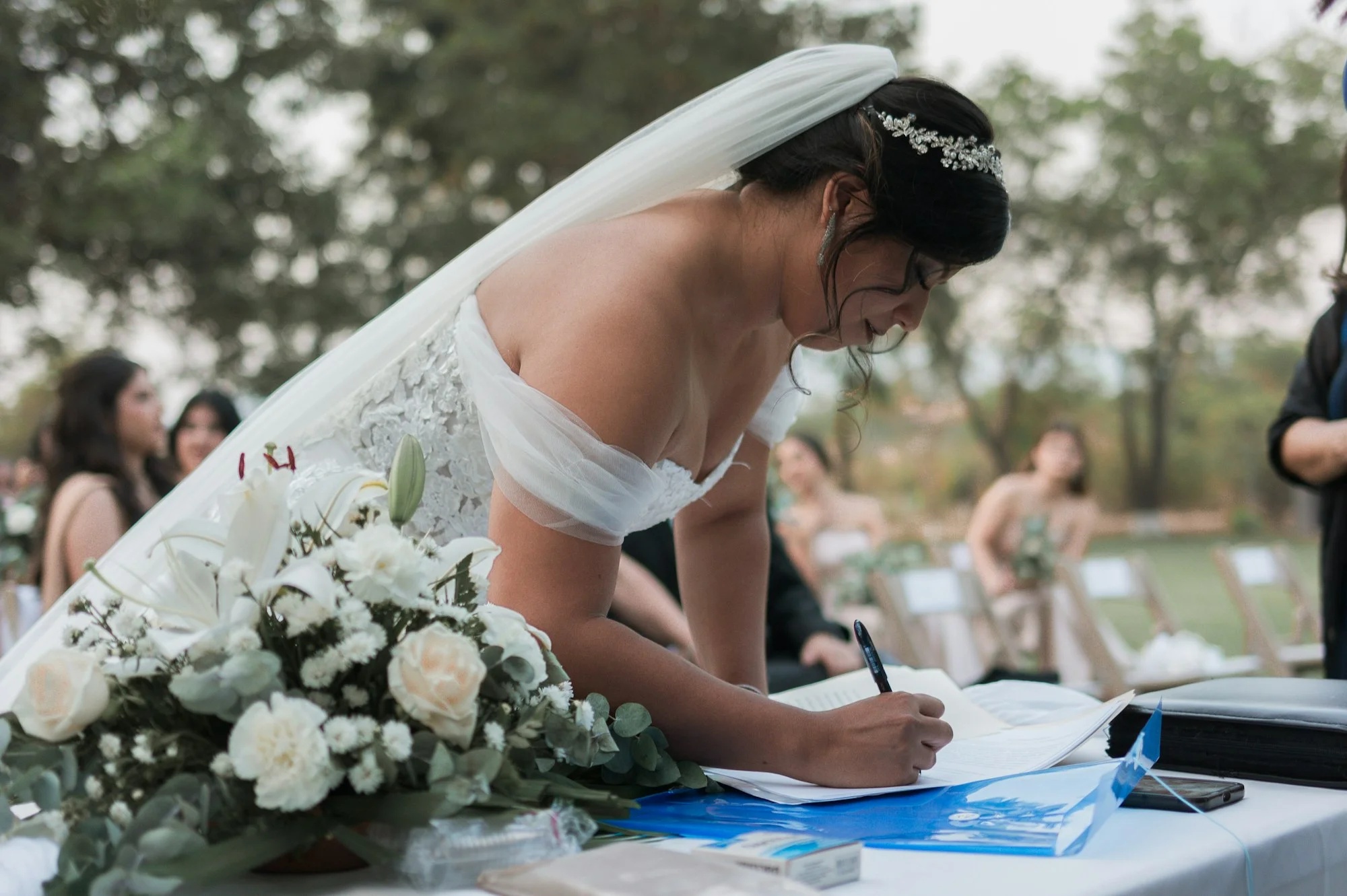
The signing table needs a place in the run sheet, between the vows and the first photographs, and your wet-weather plan should move the celebrant, the witnesses and that table together. Because both witnesses must be in the room, choose two adults who will certainly be there, not the aunt landing that morning. With 70 to 110 guests travelling from interstate or abroad, keep the legal dates on the same timeline as flights and arrivals. Wonderland Studio is free and keeps your timeline, guest list and seating in one place; you can also read about planning a destination wedding with us.
Some steps are yours alone. Only the two of you can sign the NOIM and your declarations, provide your documents, meet your celebrant, say the legal words and order your certificate. The people who decide the legal questions are your celebrant, your state or territory registry and, for weddings abroad, DFAT and the destination's authorities. AGD's Marriage Law and Celebrants Section takes general questions on 1800 550 343 (or +61 2 6141 3111 from outside Australia), though it gives guidance rather than legal advice.
What sits around those steps is where Wedded Wonderland Concierge helps: depending on your wedding, your concierge may recommend a partnered planner, or help you move forward confidently without one. In practice, that means one point of contact keeping your legal dates and documents in view alongside the travel plan and, for celebrations abroad, guest travel, accommodation, deposits, payments and currency across borders. It does not replace your celebrant or registry, and the team has worked on 800+ weddings and celebrations in 54 countries.
We also host Wedded World, our wedding showcase: see upcoming Wedded World events.
Written by

SEO Specialist
Ayrton Christian Braga is an SEO Specialist at Wedded Wonderland, where he writes optimized articles and web pages that center on destination weddings, cultural wedding traditions, and guides for everything in between.
Search real weddings, venues and vendors from around the world.
Search Wedded Wonderland