
Most couples spend months on the wedding dress, the venue, and the guest list. The readings tend to come up late, often when the officiant asks a simple question: "Have you thought about what you'd like read?" Suddenly there are thousands of poems, prayers, and passages to choose from, and no obvious way to narrow them down.
A few simple principles can make the choice much easier. Before we get to them, it helps to understand what a reading is meant to do.
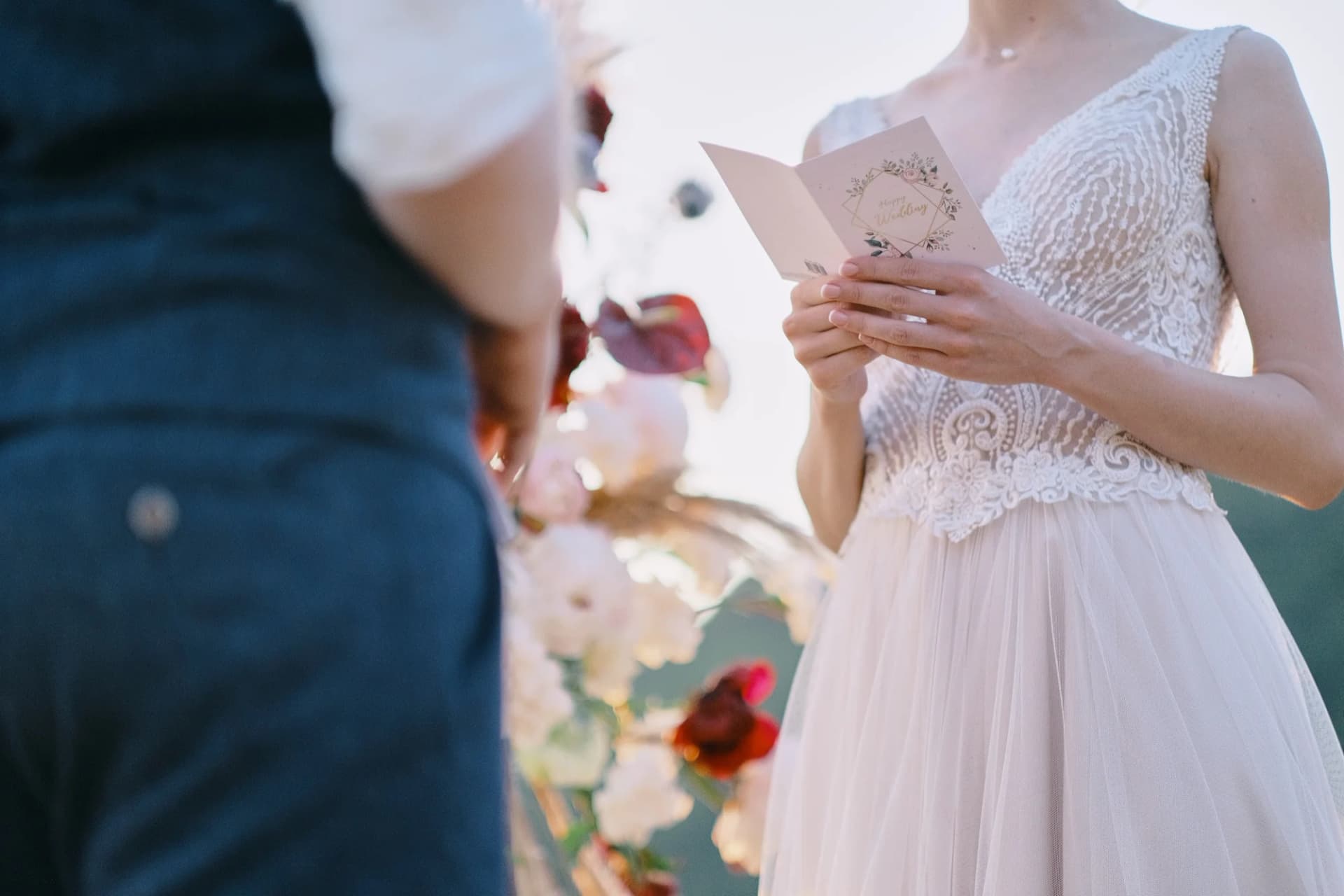
A wedding reading is a short poem, passage, or piece of writing read aloud during the ceremony, usually by a friend or family member. It often comes after the officiant’s welcome and before the vows.
Most readings are around two to three minutes long, and couples usually choose one or two that match the tone of their ceremony.
Readings are also a simple way to include someone special in the ceremony without asking them to give a full speech. They can share something meaningful about love and marriage while having a special role in your day.
Once you know what you are looking for, the next step is seeing what is out there. The types below run from classic to unexpected.
As you read, notice which ones make you think, "That sounds like us."
If you want something heartfelt and classic, a romantic poem or passage is an easy place to start. You could choose a piece about finding love, growing together or choosing someone for life.
E.E. Cummings' "i carry your heart with me" is a popular example of an intimate love poem. Pablo Neruda's love poetry suits couples who prefer something more literary.
Whichever you pick, aim for a reading that feels romantic without sounding like it could belong to any wedding. A simple test helps here. Ask yourself, Does this remind me of us?
Not every ceremony needs a five-minute literary masterpiece. Sometimes a few carefully chosen lines are enough.
Short readings are especially useful when your ceremony already has several speakers, or when it is small and you want to keep it moving. They also help if you are including religious readings, vows and other rituals, since too many long pieces can crowd the day.
If your reader is nervous about speaking in front of everyone, a short piece takes the pressure off. You can also pair a short reading with a longer one to create contrast.
Couples having a civil wedding or secular humanist ceremony have the most freedom. You can choose almost anything that reflects your relationship, provided it fits your ceremony's requirements.
Popular sources include love poems, literary passages, song lyrics, film and television quotes, children's books, personal writing, funny pieces about marriage and poems about friendship and partnership.
Because non-religious readings do not have to follow a traditional format, they can be very personal.
If you would like a starting point, three well-known options are worth a look:
"The Art of Marriage" by Wilferd A. Peterson: a classic that focuses on the everyday work of building a lasting marriage.
"Union" by Robert Fulghum: a thoughtful choice for couples who want to reflect on partnership and commitment.
"i carry your heart with me" by E.E. Cummings: a more poetic, intimate option.
Your ceremony does not have to be serious from beginning to end. A funny reading is a good way to bring your personality into the room, particularly if you and your partner naturally joke around together.
Some celebrants recommend readings that find humor in the ordinary parts of being in love, rather than relying on a string of wedding jokes. Pam Ayres' "Love Is Like a Curry" and Taylor Mali's "Falling in Love Is Like Owning a Dog" both take a playful look at relationships in this way.
The key is that the humor should sound like something you would actually say. It also helps to think about your audience.
A joke that works brilliantly between the two of you may land differently with grandparents, children or a very formal crowd.
For a Christian wedding, the Bible offers many passages about love, commitment, marriage and faith. The best known is 1 Corinthians 13, often called the "love chapter". Other possibilities include passages from Ruth, Song of Solomon and Ecclesiastes.
If you are having a religious ceremony, check with your church or officiant before you decide. Some traditions have specific requirements about which passages you can use.
You do not have to choose a reading about romance. Some of the most meaningful wedding readings are about what it actually means to share a life: supporting each other, growing together, getting through difficult moments and finding joy in ordinary days.
These readings suit couples who want the ceremony to acknowledge that marriage is about more than the wedding day. When you search, look for passages about partnership, friendship, growing old together, building a home and choosing each other through hard times.
If you and your partner love reading, a passage from a favorite book can make the ceremony feel much more personal. It might be a passage about love from a novel, a letter between two characters, a poem by a writer you both admire, or a passage you read early in your relationship.
You do not need the most famous wedding poem. A passage that reminds you of your own story can be far more meaningful than one everyone has heard before.
A favorite song can also become a reading. This works well when a particular song has been part of your relationship, perhaps because it was playing when you met or because it captures how you feel about each other.
One idea is to have someone read the lyrics rather than play the song. A familiar piece of music can take on a different feeling when it is spoken. Check whether your venue or officiant has any restrictions on what you can include.
If your ceremony is religious or culturally traditional, your options go well beyond the Bible. Depending on your faith, readings or blessings may come from other sacred texts, prayers or established ceremony traditions.
Jewish weddings, for example, may include the Seven Blessings. Muslim marriage ceremonies center on the Nikah and may include religious recitations and blessings as part of the ceremony.
Whatever your tradition, the goal is the same: choose something that respects the ceremony while still feeling meaningful to you.
Your cultural background can be another source of inspiration. A reading, blessing or traditional passage connected to your family's heritage adds a sense of history, and it gives you a way to honor where you both come from.
You can also mix old and new. A traditional reading beside a modern poem or a personal passage works well, especially for couples bringing two cultures or family traditions together.
A wedding reading does not have to be about romantic love. A passage about friendship can be a lovely choice, because marriage is also about finding someone you want beside you through everyday life.
This can mean even more if the person reading has known you as a couple for years. Look for words about companionship, trust, loyalty, or finding someone who makes life better simply by being there.
No rule says your reading has to come from a published writer. You could write something together, or ask a close friend or family member to write a short piece about your relationship.
Ideas include how you met, a favorite memory, what you admire about each other, what marriage means to you, or a message for your future selves. A personal reading can be especially moving. Just keep it short, and make sure the person reading it is comfortable sharing it aloud.
For couples who love film or television, a memorable scene can make a surprisingly good reading. Think beyond the obvious romantic films. A funny quote from a show you both love, or a passage from a film that has become part of your relationship, can make the ceremony feel unmistakably yours.
The best choice is usually one your guests can follow even if they have never seen the film.
A children's book might sound like an odd choice, but some of the simplest stories hold lovely ideas about love and companionship. This works especially well when you both loved the book growing up, when the story has a special meaning for you, or when children will be at the wedding.
It can also be a warm way to involve a younger member of the family in the ceremony.
Some couples want something guests have not heard at every other wedding. You might choose a reading about food, travel, friendship, pets, adventure, or the funny realities of sharing a life.
Celebrant Polly Miller, for example, includes playful choices such as "Love Is Like a Curry" alongside more traditional romantic readings. An unexpected reading tends to be memorable because it tells guests something about you, rather than simply telling them what love is supposed to look like.
By now you may have several ideas, or you may be staring at hundreds of options and feeling stuck. If that is you, start with the feeling you want, not the title of the poem. Then work through these six steps.
Do you want the reading to feel romantic, funny, emotional, thoughtful, religious, modern, personal or unexpected? Choosing a tone cuts your options down at once.
What do you actually love about being together? Perhaps you make each other laugh, love travelling together, or are best friends. Perhaps you have been through difficult things side by side. Look for a reading that speaks to that, instead of searching for "best wedding poem".
A funny reading might suit a relaxed outdoor ceremony perfectly but feel out of place in a formal religious service. Think about the venue, your officiant, the other elements of the day and the people who will be there.
This is one of the easiest ways to rule a piece out. Does it sound natural? Does it drag? Are there awkward phrases? Remember that a reading is meant to be heard, not just read on a screen.
A confident friend might be perfect for something funny and expressive, while someone nervous about public speaking may feel far happier with a short, simple poem. Being asked to read is also a meaningful role. Polly Miller describes it as an honor, because it shows the couple chose that person for a reason.
Time yourself reading the piece naturally. If it takes five minutes alone, it may feel longer once pauses, laughter and emotion are added. When in doubt, shorter is easier for everyone.
There is no single required position, but readings most often come after the opening welcome and before the vows. A simple ceremony might run like this:
Processional
Welcome and opening remarks
First reading
Address or homily
Second reading, if included
Declaration of intent
Exchange of rings
Pronouncement and first kiss
Recessional
Your officiant can help you decide where a reading fits best in your own ceremony.
Written by

SEO Specialist
Gino Reichert is an SEO specialist and content strategist who helps brands improve their online visibility. He enjoys creating useful, engaging content and staying up to date with the latest trends in search and digital marketing.
Search real weddings, venues and vendors from around the world.
Search Wedded Wonderland