No mandap. No stage lighting. Just a private ghat, a hundred lit diyas, and a couple who let one of the world's most sacred rivers become the actual witness to their wedding.
There's a moment in most weddings where the setting becomes furniture, a pretty backdrop for the real event happening in front of it. Naman and Pooja's wedding refused to let that happen.
At Pilibhit House in Haridwar, the Ganges wasn't dressed up, lit dramatically, or angled for a hero shot. It was given a role. The couple's private ghat access meant the river was close enough to touch through nearly every ritual of the wedding, and by the time a hundred diyas were released into its current at dusk, it stopped being scenery entirely. It became the officiant.

Even the ceremony bent around it. Instead of building an architectural mandap, Naman and Pooja took their pheras beneath a sacred mango tree growing right at the water's edge, so the river was literally within view of every vow.
It's the kind of detail that makes a wedding impossible to scroll past. Here's exactly how it came together.
Pilibhit House, Haridwar, a century-old Taj-managed haveli, had never staged a wedding of its kind. Naman and Pooja weren't chasing a viral venue. Years earlier, they'd stayed there and never quite left it behind, the stillness, the old-world architecture, its quiet relationship with the river.

So when it came time to choose, they weren't really choosing a venue. They were returning to one.
The couple went on to celebrate with over 500 guests at a larger reception elsewhere. But Haridwar was reserved for the 100 people who actually knew them.
Forget the conventional sangeet playbook. The opening night was built around pind, the ancestral hometown that survives through music, food and inherited ritual, whether or not you've ever actually lived there.
Inside a transformed 1,200 sq. ft. space, Pilibhit House became a living portrait of Punjab: a baithak-style stage for folk performances, a mehendi corner seated nearly 60 guests deep, and the Ganges left to do what no lighting rig ever could, sit quietly in the background and mean something.

The palette borrowed from old Lahore: moody, layered, unexpected bursts of colour against ghungroos, dholkis and gota patti detailing. Corners of the property were dressed with namkeen, namak pare and bhaji boxes, so the elders had somewhere to sit, snack and watch the room dance.
Every woman in attendance was invited into her own shringaar corner: jhumkas, gajras, bangles, potlis, parandas, turning "getting ready" from a backstage chore into part of the celebration itself.
And then, the detail that made the night: there was no DJ.
No overpowering sound system, no scripted set list. Just Punjabi tappe, live dholkis, spontaneous dance circles and guests singing along barefoot. As the night wore on, the energy didn't fade, it softened, into an intimate sit-down musical evening under the stars.
The people were the entertainment. The culture was the décor.
If Day One was Punjab, Day Two was Haridwar, and the city was given room to lead.
Guests entered to the sound of shankhs echoing through sandstone corridors, welcomed with chandan teekas and rudraksha, a Nandi statue anchoring the courtyard's energy before a single ritual had even begun.

And then came the moment the entire wedding was quietly building toward: an intimate Ganga Aarti at the property's private ghat. Pilibhit House's direct access to the river meant Naman, Pooja and their guests weren't watching the ritual from a distance, they were standing in it. Temple bells, flickering flames, and one by one, diyas released into the current until the river slowly turned into a floating constellation of prayers, drifting off toward the rest of the city. No stage. No script. Just a hundred small lights doing exactly what they were meant to do.
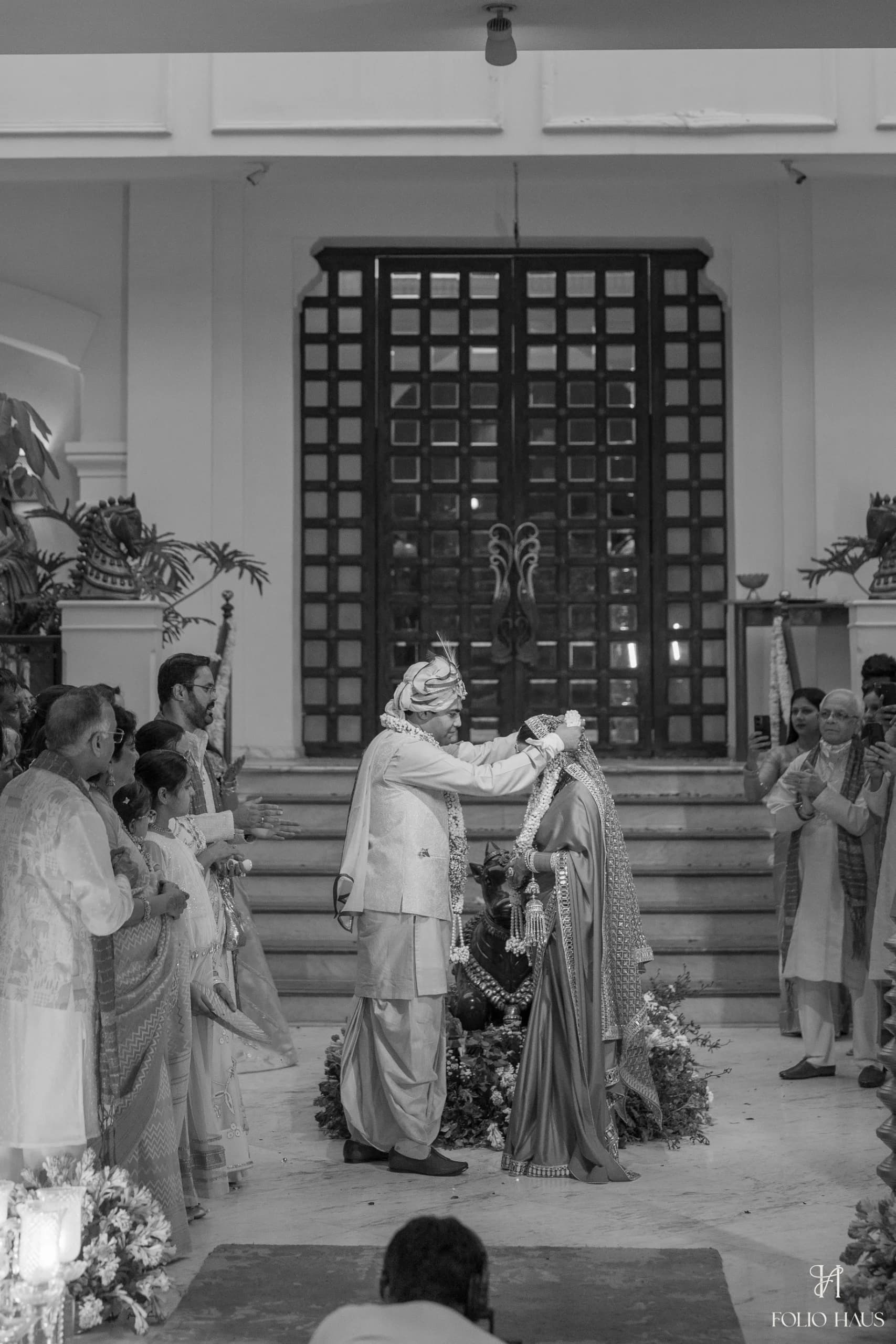
The baraat moved through Haridwar's temple-lined galiyan rather than staging a large-scale procession, with the groom's parents dancing with a joy that outshone any choreography could have. The varmala unfolded around the courtyard's Nandi statue: no spectacle, just family standing close enough to touch.
Before the pheras, the groom's sisters tied kaleeras onto the ceremony's sacred tree, stitching the ritual physically into the property itself.
And for the pheras: no elaborate architectural mandap at all. The couple stood beneath Pilibhit House's revered mango tree, wrapped in sacred orange thread and marigold, with the Ganges running close enough to hear as live music merged with Vedic mantras. The tree gave the ceremony its structure. The river gave it its soul.
The speeches that followed weren't about grandeur. The groom's parents spoke about friendship as the real foundation of marriage, simple, honest, and enough to move a room from laughter to silence to tears.
Guests departed with hampers in custom Aali boxes, a Mor Pankh card, a lotus urli candle, kumkum and chandan danis, peacock feathers, moon-inspired wind chimes, small ways to carry Ma Ganga's blessing home.
Every detail above, the restraint, the storytelling, the decision to let a 1,200-year-old relationship with a river outshine any production budget, is the signature of Parinaya Sutra, the wedding planning team behind Naman and Pooja's celebration.
Parinaya Sutra doesn't plan weddings by starting with a Pinterest board. They start with a couple's actual story and ask what a celebration built entirely around that would look like, then have the discipline to leave out everything that doesn't serve it. It's why an evening with no DJ can still feel like the most electric party you've never been to, and why a mango tree can hold more meaning than the tallest floral mandap.
For couples drawn to India's heritage destinations, Haridwar, and beyond, Parinaya Sutra is fast becoming the name behind the celebrations that people are still talking about long after the last diya hits the water.

This wasn't a wedding designed to look impressive in a highlight reel. It was designed to be felt, by a hundred people who mattered, on a riverbank that had already meant something to this couple long before it was ever a wedding venue.
Intentionality over extravagance. Heritage over performance. Experience over spectacle.
That's the whole story, really. Most weddings borrow a beautiful view. This one let the Ganges show up as family.
Planning a celebration that leans into culture, heritage and the places that already mean something to you? Start Planning with Wedded Concierge and we'll help you start building it.
Credits
Couple: Naman & Pooja
Wedding Planning & concept: @parinayasutra
Venue: @pilibhithouseharidwar
Floral setting: @turnthetables__
Photography & Videography @foliohaus
Production: @theembellishedevents_
Search real weddings, venues and vendors from around the world.
Search Wedded Wonderland