Escort cards vs place cards comes down to where each directs your guests: one to their assigned table, the other to their specific seat. Which your reception needs depends on your seating arrangement, and at Wedded Wonderland, we plan reception details around the guest experience.
The distinction is simple: escort cards tell guests where to sit as a group, while place cards tell them exactly where to sit at the table.
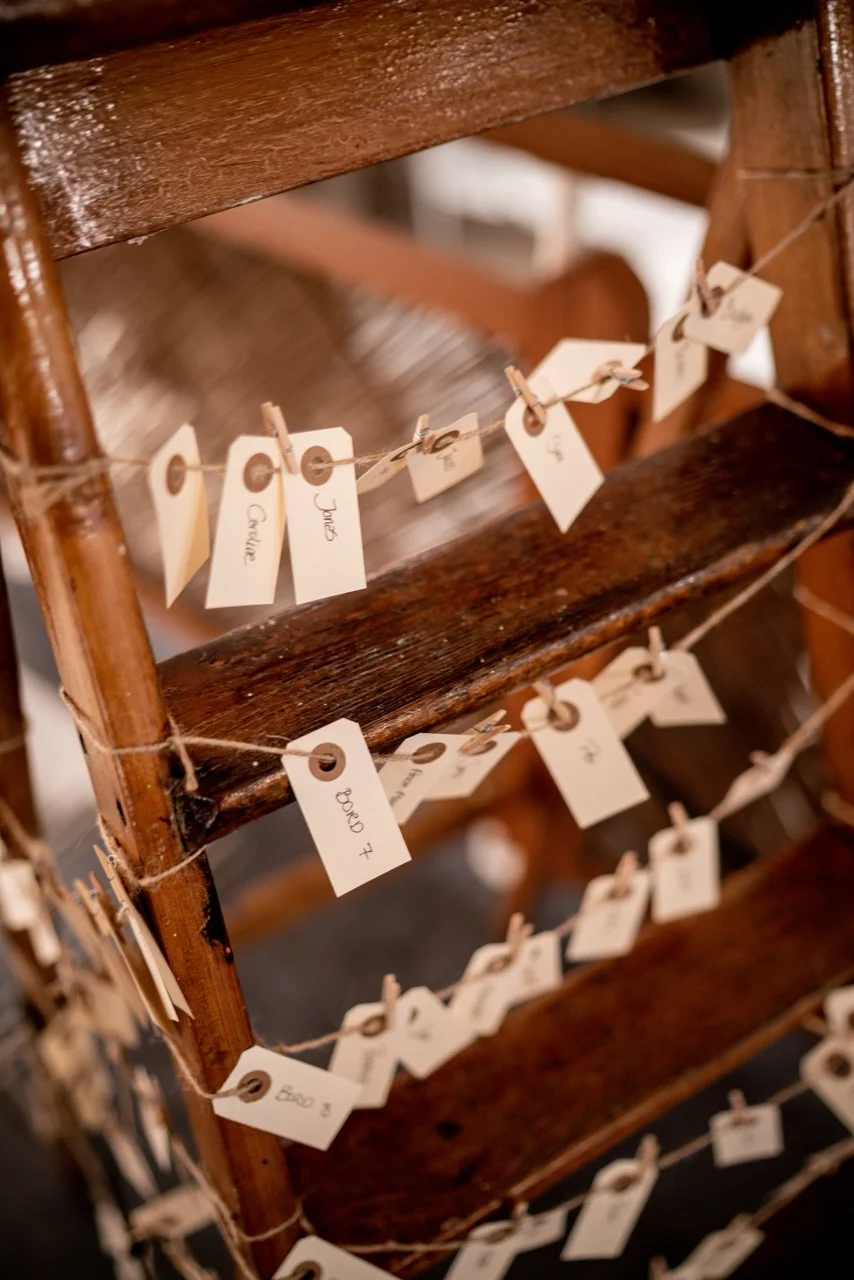
Escort cards are usually collected from a display near the reception entrance or welcome area. Each carries a guest's name and their assigned table number or name. Place cards, by comparison, are positioned at individual table settings, marking each guest's allocated seat.
The choice is not purely a stationery decision. It determines how guests move into the reception, find their tables and settle in for dinner.
Details | Escort card | Place card |
|---|---|---|
Tells the guest | Which table | Which seat |
Where it sits | Entrance or welcome table | Table setting |
What it carries | Guest name and table name or number | Guest name, and sometimes a meal marker |
When it is used | Before guests sit down | At the table |
One card for | Each guest or each couple | Each seat |
Not every reception requires both. The format should follow the level of seating direction your celebration needs, rather than adding stationery for its own sake.
When planning reception layouts, we look at the dining format, guest numbers and whether couples want to manage individual seating or allow guests more freedom.
Seated dinner with assigned seats: Use both escort and place cards, or a combined card displaying the table assignment and individual seat. This gives guests clear directions from arrival to their setting.
Assigned tables with open seating: Escort cards are sufficient. Guests find their designated table and choose their own seats.
Family-style dining: Escort cards generally work well when guests are assigned to tables but can choose where to sit within their group.
Cocktail reception: Neither is usually necessary if guests are free to mingle. If there are designated dining areas, a seating sign can provide sufficient direction.
Mixed-format reception: Use escort cards for the seated portion of the celebration while keeping cocktail and mingling areas flexible.
For a closer look at organising guests by table, our wedding seating chart guide explains how to build a seating plan that works.
Escort cards are particularly useful for larger guest lists, assigned-table receptions and celebrations where guests need a clear arrival point before entering the dining space.
They prevent guests from having to search individual tables for their names, while allowing the seating display to become part of the reception's visual introduction.
There are several ways to arrange them:
Alphabetically: Guests find their names quickly, making this a practical choice for larger celebrations.
By table: Cards are grouped according to table assignments, which can work particularly well when the display is clearly organised.
As a single installation: A wall, table or styled display presents the cards as part of the reception design.
The presentation can be as understated or expressive as the wider celebration. Our collection of 23 unique seating charts offers inspiration for displays that balance practical direction with thoughtful styling.

Place cards are the better choice when individual seating arrangements matter. They are particularly suited to formal dinners, multi-course receptions and celebrations where couples have carefully considered who sits beside whom.
They also help the service team identify meal selections and dietary requirements, provided these are communicated through an agreed symbol, notation or accompanying seating list. This can make service more efficient without requiring staff to interrupt guests at the table.
Beyond their practical purpose, place cards contribute to the finished tablescape. From handwritten names to personalised keepsakes, their presentation can complement the menus, tableware, florals and overall styling.
For inspiration, explore our collection of 25 unique place cards for your wedding.
The stationery should only go to print once the seating plan and guest details have been confirmed. Getting the sequence right avoids unnecessary reprints and last-minute changes.
Confirm your guest numbers. Work from the latest RSVPs and check the venue's deadline for final guest numbers.
Finalise the seating plan. Allocate guests to tables, review individual pairings and confirm any special seating arrangements.
Choose the card format. Decide whether your reception needs escort cards, place cards or both.
Proof every name. Check spelling, preferred names and titles against your guest list before approving the artwork.
Allow for additional copies. Keep a small reserve for printing errors or late changes. Around 10 per cent is a useful working allowance, although the final quantity should reflect how stable your guest list is.
Organise by table. Sort the cards into their intended order and label them clearly for whoever is responsible for setting them out.
Assign day-of placement. Give the venue team, stylist or wedding coordinator the final seating plan and a clear deadline for arranging the stationery.
For example, a reception with 100 guests seated across ten tables of ten would typically require:
Item | Quantity |
|---|---|
Escort cards, one for each guest | 100 |
Place cards, one for each seat | 100 |
Spares at about ten percent of each | 10 and 10 |
Table cards showing the table name or number | 10 |
These quantities assume individual escort and place cards. If escort cards are issued to couples or households instead, the number required will reflect those groupings, while individual place cards remain one per guest.
The information on each card should be immediately recognisable, without making the design unnecessarily complicated.
Escort cards should include:
Guest's name or household name.
Assigned table number or name.
Place cards should include:
Individual guest's name.
An optional meal indicator or discreet dietary notation, where required.
Use the names guests have provided, paying attention to preferred spellings and titles. Consistency matters across the full stationery suite, particularly when escort cards, place cards, menus and table numbers are being produced by different suppliers.
Table numbers are often the clearest option for larger receptions, while table names can introduce a personal detail or complement a particular celebration theme.
Our guide to wedding seating etiquette offers further guidance on guest placements, while our wedding stationery guide explores the printed details that bring a reception together.
Someone on the day should own the cards, and the venue team, a stylist or a coordinator is the usual choice.
This is one of the smaller details that benefits from proper coordination. Include it in your wedding day timeline, with enough time for the responsible team to check each name and placement before guest arrival.
At Wedded Wonderland, we consider seating as part of the wider reception experience, from guest arrangements and table layouts to stationery coordination and the transition between each part of the day. For celebrations at home or abroad, our team helps bring these details together so that the practical decisions are resolved well before the first guest arrives.
If you are organising your guest list and seating arrangements independently, explore our wedding planning tools as a starting point. For a more considered approach to the celebration as a whole, our team can help coordinate the details around it.
Written by

Editor & Content Writer
Jillian Arambulo is the Editorial and Content Writer at Wedded Wonderland, specialising in branded content strategy. Her writing spans luxury lifestyle, travel, culture, beauty and emerging trends, bringing together comprehensive guides and features that connect readers with the places, ideas and experiences worth discovering.
Search real weddings, venues and vendors from around the world.
Search Wedded Wonderland