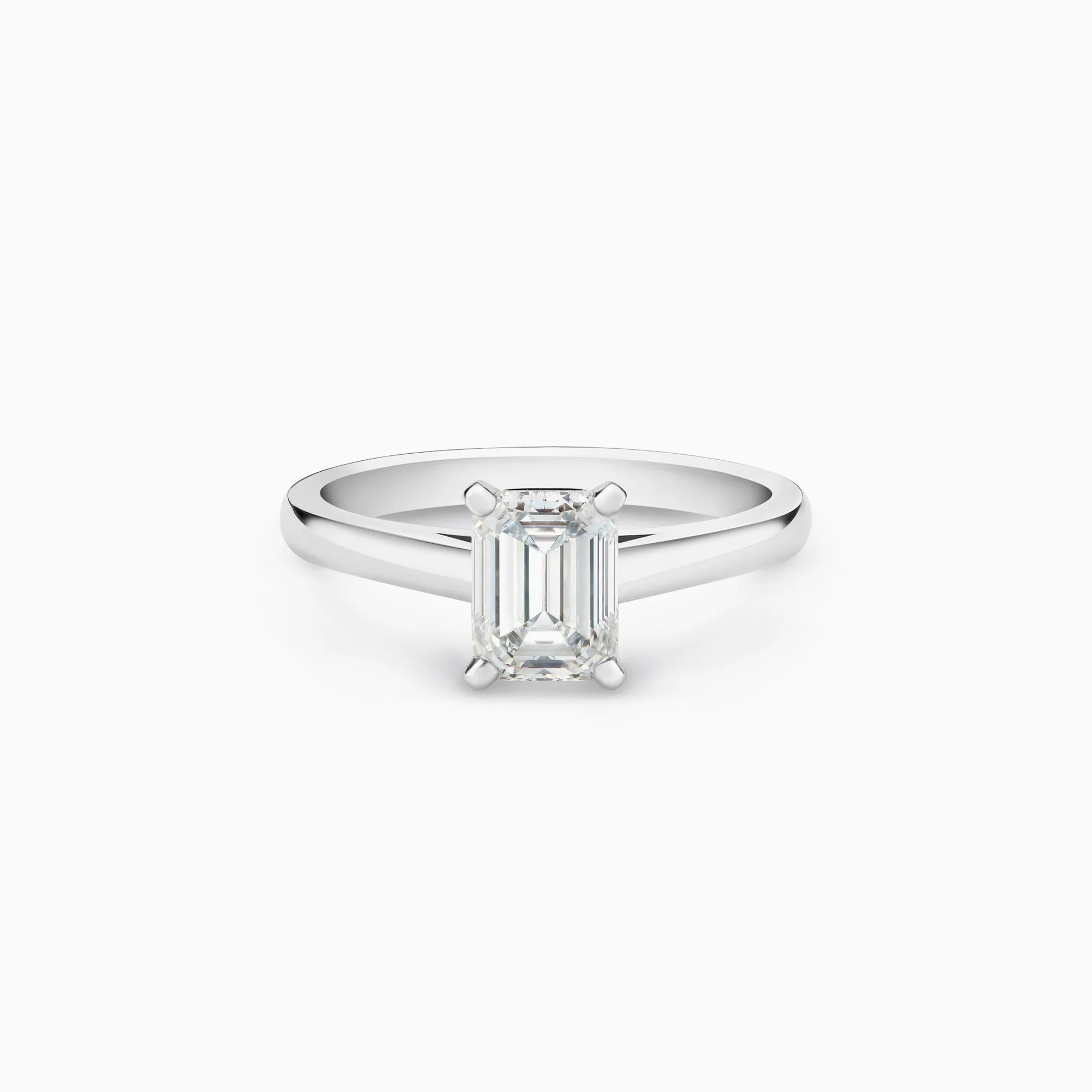
An emerald cut engagement ring holds a rectangular diamond with cropped corners and long, open step facets, which GIA calls a "hall of mirrors": broad flashes of light rather than sparkle. Those open facets also show inclusions and colour more easily than other shapes, so the grade matters more here than on a round or an oval.

The Knot's 2026 Real Weddings Study puts emerald at 8 percent of engagement rings, and Stuller's director of bridal, Katelyn Meche, told National Jeweler it is among the shapes that grew most over the past year. Porsha Williams' new ring is an emerald cut with baguettes, by Bravo's description, and Wedded Wonderland has the couple's story.
Each of the seven rings below settles one choice, and makers by country follow the list.
The plainest ring here makes the first decision obvious. De Beers sets one emerald cut on four claws over a platinum band about 2.1 mm wide, and its DB Classic page lists stones of almost the same weight across colours D to K and clarities VVS1 to SI2. Move along that grid and you see the grade, not the size, setting the price.

GIA recommends VS2 clarity and G colour or above for this shape. Its reports give a cut grade only to standard round brilliants (GIA), so on an emerald cut you read the polish and symmetry grades, then judge the stone itself.
Ask to see it face up in daylight and again in low, warm light. A well-cut stone keeps its flashes in both; a poorly cut one can show a glassy patch in the centre that no grade on paper flags. Add that to the questions you take to your jeweller.
The ring at a glance:
Metal: platinum, band about 2.1 mm wide
Grading: De Beers Institute of Diamonds, each stone inscribed with the DB Marque
Price: listed by grade on the maker's site
Cartier's 1895 Solitaire takes an emerald cut of 1.00 to 3.99 carats in platinum 950/1000, on a band paved with brilliant-cut diamonds. Book an appointment to try it at the size you have in mind.

Ratio is length divided by width, and no laboratory sets a standard for it. Mervis Diamond recommends about 1.30 to 1.50 and calls 1.40 the classic, while Diamonds.pro rates 1.40 to 1.50 highest. Lower ratios look squarer and more Art Deco; higher ones look longer, and at the same weight a longer stone covers more of the finger.
Size raises the stakes on grade: GIA advises grades above VS2 and G from 2 to 3 carats. At that size, choose cleaner before bigger, and if you are still weighing shapes, compare them side by side.
The ring at a glance:
Centre stone: emerald cut, 1.00 to 3.99 carats
Reference: CRN4798500
Price: on request, by appointment
Harry Winston's Classic Winston flanks an emerald cut of 1.00 carat or more with two tapered baguettes on a platinum band. The house says every diamond engagement ring comes with an original GIA report and that it carries only D, E or F colour above VS2 clarity (Harry Winston FAQ). The grade is settled for you; the side stones are the choice.

Baguettes are step cuts too, so their flashes match the centre's long, still planes. Choose the wedding band at the same appointment, because a three-stone ring sits wider than a solitaire and a straight band can leave a gap.
The ring at a glance:
Centre stone: emerald cut, from 1.00 carat, D to F colour, GIA report
Side stones: two tapered baguettes, reference RGDPEC010TB
Price: on request
Queensmith's Bardot East to West turns an emerald cut across the finger, on four soft talon claws in a cathedral setting, over an 18k yellow gold band of 1.9 mm that the maker notes may widen with carat weight.

East-west gives a low, horizontal line that stacks well with bands. Turned this way, the corners face your neighbouring fingers, so ask how low the setting sits; only a jeweller can judge how it meets gloves or a desk on your own hand.
Yellow gold flatters a slightly warmer stone, so a colour a grade or two lower can be a deliberate choice, recorded on the report. For a statement stone of 3 carats or more, ask for the heavier band to match.
The ring at a glance:
Metal: 18k yellow gold, band 1.9 mm
Centre stone: natural or lab grown, chosen separately
Price: setting priced in the UK section below
The corners are an emerald cut's weak point, and a bezel covers all four. VRAI's Signature Bezel wraps a rim of 18k white gold around the whole stone, shown with a 1.0-carat lab-grown emerald cut.

GIA notes that partial bezels and V-shaped claws protect corners, and that a bezel guards the girdle against knocks (GIA). Mervis Diamond warns that an extremely thin girdle leaves the corners highly vulnerable, so read the girdle description on the report too.
A bezel also sits lower and catches less on knitwear and gloves. If you want the stone to look bare from the front, V-tipped corner claws are the lighter option. Ask whether the ring can be resized without unsetting the stone; VRAI ships to Australia, the UAE and the UK.
The ring at a glance:
Metal: 18k white gold, plain band
Setting: full bezel
Price: setting priced in the UK section below
For more light without a halo that shows from the front, look under the stone. VRAI's Classic Hidden Halo tucks small diamonds beneath the emerald cut and adds pavé to the claws on a plain 14k rose gold band, shown with a 1.5-carat stone.

Face on, it reads as a solitaire, and the hidden stones catch light only as your hand turns. It also comes in 18k white gold.
The ring at a glance:
Metal: 14k rose gold with pavé claws, or 18k white gold, on a plain band
Centre stone: lab-grown emerald cut, shown at 1.5 carats
Price: setting priced by market below, stone chosen after
The antique dealer Berganza lists an English Art Deco ring from about 1935: a 1.08-carat emerald cut of G colour and VS1 clarity with a GIA report, flanked by small eight-cut diamonds of about 0.12 carats in all, in platinum. Hold any antique to that standard: a current report, and grades you would accept in a modern ring.

An old stone was cut to the proportions of its day, so judge it face up beside a modern one rather than by the numbers alone. "Vintage style" means new work made in an old manner, so ask whether the stone itself is antique before you pay for age. Berganza delivers worldwide, fully insured (Berganza).
The ring at a glance:
Centre stone: 1.08 carats, G colour, VS1 clarity, GIA report 5231507715
Side stones: eight-cut diamonds, about 0.12 carats in all
Price: shown on the listing in your currency
Judge either by its report and grade first. GIA says the two are essentially the same chemically and optically, so traditional gemmological observation cannot tell them apart and only a laboratory can (GIA). Where they part is price, now and later.
BriteCo, a jewellery insurer, puts the median lab-grown carat in its 2026 price index at under a quarter of the natural one, and reports that 3-carat lab-grown prices fell 59.65 percent over 2023. The sum lab grown frees can go into a larger stone, a cleaner grade, platinum or a hidden halo, while natural keeps more of its price later. Few retailers publish both side by side at your size, so ask for the same grade quoted both ways.
Whiteflash, a retailer, cites CaratX's trade estimate that natural diamonds typically resell at 25 to 50 percent of their retail price. If you might want natural later, ask any maker for its trade-in terms in writing. If sustainability matters to you, ask what a claim rests on: the FTC, the US consumer regulator, has warned jewellery sellers that unqualified "eco-friendly" or "sustainable" claims are highly unlikely to be substantiated (FTC).
GIA's Laboratory-Grown Diamond Report names the growth method, CVD or HPHT, and GIA laser-inscribes the stone with its report number and the words "LABORATORY-GROWN". Whether the report is from GIA or IGI, look the number up on that lab's own site and match it to the inscription under a loupe; where two stones carry reports from different labs, compare them side by side, not by grade alone. When family ask, show them the report and the inscription together, and the question is answered before it is asked.
Insure either within days of collection, on a written valuation that names it natural or lab grown and gives the report number, grades, mount, metal and the centre stone's weight apart from side stones. A valuation can sit well above the price paid: Berganza's states a replacement figure about 30 percent higher (Berganza), so insure on the valuation, not the receipt. Before you travel, check the policy covers the ring abroad and the customs rules on your route, carry it in hand luggage, and keep a copy of the report apart from it.
Prices change, so confirm when you book. If the ring will be presented abroad, the destination proposal checklist covers ring security and timing.
Larsen Jewellery makes its Deco ring in Australia: an emerald cut between baguettes on a 2.4 mm platinum band, from $9,070 with a 0.60-carat centre and $24,410 as pictured with 1.5 carats, both including GST. The Sydney studio is on Level 5 of The Strand Arcade.

Temple and Grace makes its Emerald Cut Engagement Ring on four claws, with natural or lab-grown centres from 0.50 to 10.00 carats, in gold or platinum, from $3,460 in 9K yellow gold; ask for a written quote at the carat and metal you want. VRAI's Australian site lists the Classic Hidden Halo in 18k white gold at A$1,785 for the setting.
Fergus James sees clients by appointment in Jumeirah Lake Towers and makes most bespoke rings within 7 to 14 days of final design approval, with free resizing. It advises VS1 clarity or better for emerald cuts, stricter than GIA's VS2 floor; where a maker sets the higher bar, follow it. Its emerald solitaires are listed natural and lab grown side by side: AED 71,036 against AED 13,684 at 2 carats, and AED 174,319 against AED 17,452 at 3 carats. The listing does not name the metal, so ask for 18k yellow gold and a heavier band by name.

For natural stones only, Solitaire Jewels at Gold and Diamond Park on Sheikh Zayed Road says every diamond it sells is certified and laser-inscribed by a lab such as GIA. Few UAE sellers publish their disclosure terms, so ask for the origin, report number and return terms in writing before you pay. Cartier's UAE site offers the 1895 emerald cut, up to 3.99 carats, by appointment, and VRAI ships to the UAE with duties collected at checkout.
Queensmith at 98 Hatton Garden prices the Bardot East to West setting at £1,595, with the natural or lab-grown diamond quoted separately. Manufacture takes four to five weeks, so allow six to seven (FAQs). The London Assay Office hallmark certifies the metal's purity (Queensmith), not the stone. For that, Diamond Verification Services, a Sheffield Assay Office company, screens diamonds already set in jewellery for natural or lab grown.

Pragnell has a 1.51-carat F VS1 natural emerald cut with a GIA report, on four platinum claws and an 18ct yellow gold band, handmade in Britain, at £19,950. VRAI's Signature Bezel setting is £1,175, and Berganza's showroom is at 88 to 90 Hatton Garden. NFU Mutual calls certification vital because natural and lab-grown prices differ greatly (thewealthnet), and its bespoke cover ties underinsurance protection to a professional valuation from the last three years.
Harry Winston's salon at 701 Fifth Avenue needs no appointment. The De Beers DB Classic starts at $11,600 for a natural 1.01-carat J SI2, and a 1-carat F SI1 is $13,900: roughly what $15,000 buys in a natural house ring.

VRAI lists its Signature East-West setting in yellow gold at $1,150 and the Classic Hidden Halo at $1,840, so ask for the complete figure with the lab-grown diamond before you commit. Ring Concierge sees clients by appointment in Midtown Manhattan and advises finalising the diamond 8 to 10 weeks before you want the ring.
Settle natural or lab grown first, then the grade, then size and ratio, then the setting that guards the corners, then the metal, and only then the maker. Allow about three months. Ring Concierge's 8 to 10 weeks from final diamond to finished ring already takes in a making time like Queensmith's six to seven weeks, and the remaining weeks leave room to resize.
With less time, choose a finished ring such as Berganza's, or ask each maker for its lead time before you commit. For a famous emerald cut to compare against, Grace Kelly's features among Wedded Wonderland's royal engagement rings.
The ring is between you and your jeweller. Once there is a date, Wedded Concierge is a personalised wedding advisory service: one expert team sources your venue, vendors and guests' travel, with one point of contact. If the wedding crosses borders, the team handles deposits, payments and currency, and arranges negotiated group rates with a private booking link for guests. To browse first, start with the Wedded Marketplace.
Written by

Content and Creative Manager, Wedded Wonderland
Joseph Joshua Ngushual is Content and Creative Manager at Wedded Wonderland, part of Wonder Group, where he leads the editorial and search team behind its guides to destination weddings, honeymoons, babymoons and milestone celebrations. He works alongside the Wedded Advisors who plan those celebrations, and much of his advice comes from that side of the business: what to ask a villa before signing, which dates decide whether a babymoon is relaxing, and how to keep a wedding weekend calm when the weather turns. He oversees Wedded Wonderland's destination and honeymoon guides, the Get Wedded magazine and the planning guides inside Wonderland Studio, and covered Wedded World Melbourne at 1 Hotel Melbourne in November 2026. He has written more than 150 articles for Wedded Wonderland.
Search real weddings, venues and vendors from around the world.
Search Wedded Wonderland