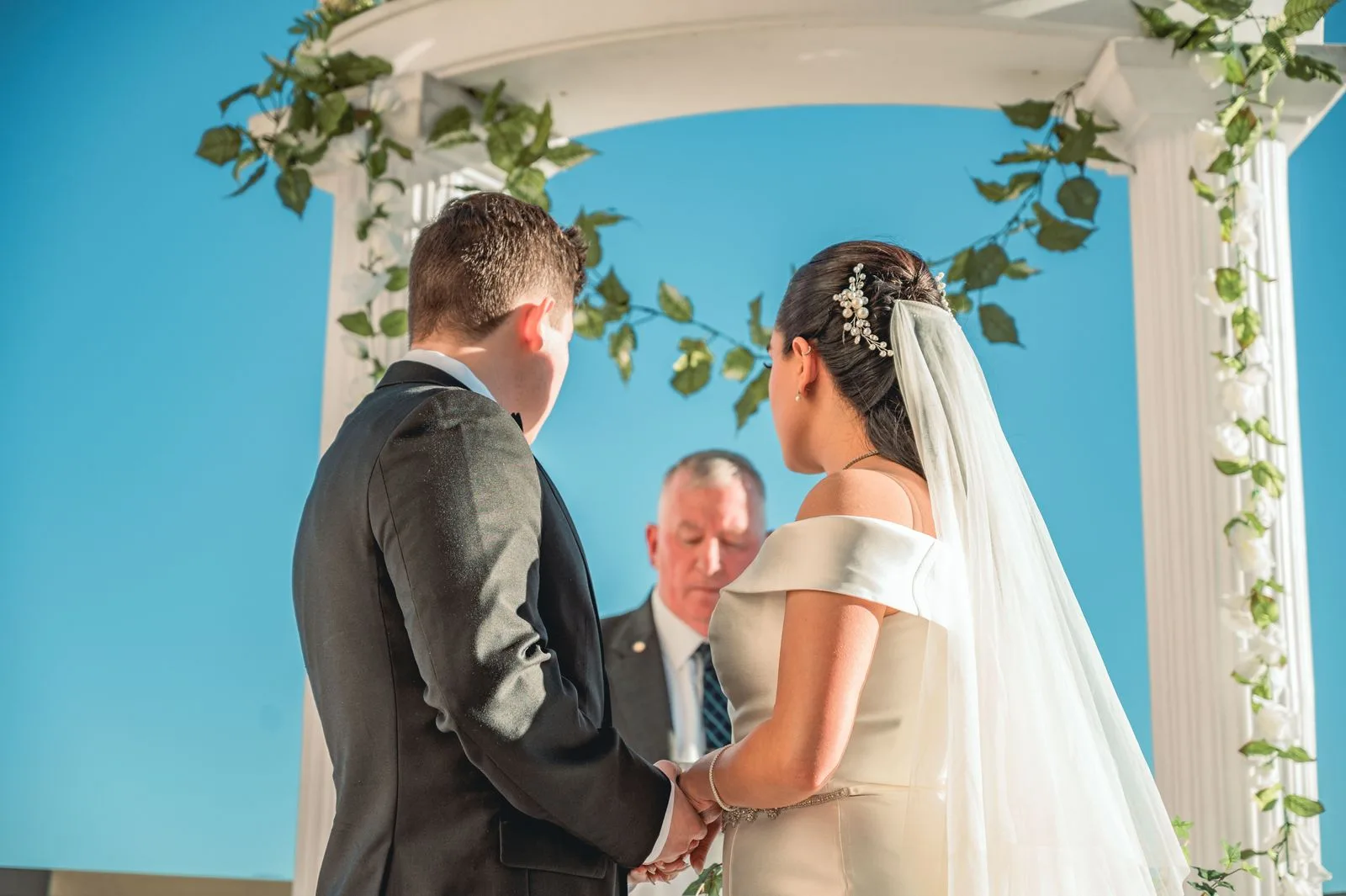
A unity ceremony is a short symbolic act within your wedding ceremony. You join two things into one, such as a cord, a flame, water or stones, to show two lives or two families coming together. It isn't the legal part of the marriage, which follows the law of wherever you sign.

Which ritual suits you depends on where you marry and who stands in the front row. A candle that glows in a chapel gutters on a clifftop, and a ritual from one family's faith can sit uneasily with the other's. If you are planning the whole celebration, a Wedded Advisor through Wedded Concierge can source the venue and vendors to suit your ritual.
Unity ceremony and unity ritual mean the same thing. Where the ritual sits among the vows and rings is set out in what happens in a wedding ceremony, and our guide to wedding traditions around the world goes wider.

Origins are often told with more confidence than the record allows. The Dictionary of the Older Scottish Tongue records "handfast" as betrothal by joining hands from about 1400, with no mention of a cord, and historian Tyler D. Parry's Jumping the Broom traces the broomstick wedding to marginalised groups in the British Isles.
If a priest marries you, ask before adding anything. The Bishop of Honolulu said, as reported in the Hawaii Catholic Herald, that he was "not opposed" to the unity candle, but that clergy must "be careful" about such additions.
Settle five questions, in this order, before you order a cord or a candle:
Where the legal marriage happens: It decides who leads and what wording is allowed. Sign at home first, and the later ceremony is symbolic, led by your celebrant in your own words.
Your faiths and your families: A candle lit from family candles, a cord with a cross worked in or a cup of wine can read as religious to someone in the room.
Your setting: Wind, sun, cold, the venue's naked-flame rules, and whether the back row can see.
Who takes part: You two, your children, a parent or every guest. Guests flying in can place a stone on arrival.
Where the object lives afterwards: At your table, on a shelf, split between two homes or planted.

With less than four months to go, choose something you own or can buy ready-made, such as a family cup or a plain silk ribbon. Otherwise, work back from the date:
Six months out: Choose the ritual, brief your celebrant and get the venue's flame rules in writing.
Four months out: Agree the words with both families, then send the ritual line to whoever prints or letters your order of service. Order anything made or engraved by hand, with a firm finish date and shipping time from the maker.
The rehearsal: Use the real objects and time the act. Carry the piece in your hand luggage.

Skip sand, the wine box and ring warming unless they already mean something to you. Sand blows away and the box leaves out anyone who doesn't drink. Ring warming slows a large ceremony.
You join hands, and the celebrant or a parent wraps a cord round them and ties it; you slip free with the knot intact.

Meaning and roots: The joined hands are recorded in Scots from about 1400; the cord isn't in that record. Without a Scottish link in the family, a silk or linen ribbon sits better than tartan.
Best for: Clifftops and terraces, since nothing can blow away, and any guest count.
Watch for: Conservative elders can read bound hands as restraint, so explain the act in one line first. Ask your celebrant how many wraps they plan before you order a length.
Keepsake: The cord, framed, or wrapped round a late parent's handkerchief.
You drink from one cup, each holding a handle, then pass it to a parent or an elder.

Meaning and roots: The quaich is a Scots two-handled drinking cup, its name from Scottish Gaelic "cuach". A grandparent's glass does the same job.
Best for: Interfaith and alcohol-free families, with water or rosewater in the cup, and any ceremony where an elder should take part.
Watch for: Red wine near ivory silk. Agree with both families who drinks first.
Keepsake: A cup engraved with your initials and the date, used on anniversaries.
Each guest takes a stone on arrival, holds it through the ceremony and places it in a bowl on the way out.

Meaning and roots: No documented origin, so treat it as modern.
Best for: Large guest lists, wind and blended families, where each child gets a stone of their own.
Watch for: Beach and park stones can be protected, so buy them, and check customs rules before anyone carries stones across a border.
Keepsake: The bowl on your table, or the stones divided between two homes.
Each of you lights a taper, and together you light one larger candle.

Meaning and roots: No reliable origin is documented, and it isn't part of the Catholic rite.
Best for: Indoor, evening and chapel ceremonies that allow flame.
Watch for: Wind, wax on old floors and the venue's flame rules. Outdoors, the candle goes inside a hurricane glass.
Keepsake: The candle, relit on anniversaries.
You each add soil to a sapling in a pot, then water it together.

Meaning and roots: No documented origin, so treat it as modern.
Best for: Weddings near home, or a venue willing to plant and tend it.
Watch for: Don't plan to fly the plant home, and get the venue's permission in writing if it stays.
Keepsake: A second tree, planted at home later.
Your sponsors, the padrinos, drape a cord, rosary or veil over your shoulders (the lazo), and you exchange coins (the arras).

Meaning and roots: These are Hispanic and Filipino Catholic customs. The 2016 Order of Celebrating Matrimony places the arras blessing after the rings and the lazo at the start of the Liturgy of the Eucharist.
Best for: Family heritage in these traditions, or padrinos you want to honour.
Watch for: Without a family link, it can feel borrowed. In a Catholic wedding, your priest decides where it goes.
Keepsake: The coins and the lazo, kept together.
You jump a decorated broom together as you walk out.

Meaning and roots: Parry traces it to marginalised groups in the British Isles and through the records of enslaved people in the US. Today it is most associated with African American weddings.
Best for: African American heritage, or another family tie to the custom.
Watch for: If it isn't your family's, ask first. Jump on flat ground, never stone steps in a long gown.
Keepsake: The broom, decorated by family beforehand.
You each pour sand or water from your own vessel into a shared one.

Meaning and roots: No documented origin for either, so treat both as modern.
Best for: Indoor or sheltered settings, with water where sand can't travel.
Watch for: Wind takes loose sand at once, a narrow funnel clogs, and layered colours blur when the vessel moves.
Keepsake: A lidded vessel for sand, or the bowl once the water goes into a garden.
You seal a bottle of wine and a letter from each of you in a box, to open on a set anniversary.

Meaning and roots: No documented origin, so treat it as modern.
Best for: Two wine drinkers who want a date to look forward to.
Watch for: Wine is sacred in some Christian rites, so seal the letters alone if that matters.
Keepsake: The box itself.
Your rings pass from guest to guest before the vows, and each person holds them for a moment with a silent wish.

Meaning and roots: No documented origin, so treat it as modern.
Best for: Under about 50 guests, or the welcome dinner of a three-day weekend, kept to the top table and both families.
Watch for: Thread the rings on a ribbon inside a closed pouch, and name one person to collect it.
Keepsake: Only the rings, if you'd rather not keep an object.

Let the child's parent offer three options in private, plus "none of these", and let the child change their mind up to the day. Show the exact words about the children to their other parent beforehand, so nothing comes as a surprise.
A quiet act with their hands, such as adding a stone, usually asks less of a child than a line spoken in unison. Words that don't tell a child how to feel work best: "Mia and Leo are part of this family, and they're here today as themselves."
Your surviving parent decides how visible it is. One spoken line, a name in the order of service or a handkerchief wrapped round the cord all work, and none asks a grieving guest to perform.
Let a celebrant lead, with one elder from each side speaking, a neutral vessel and no wine. If a nikah, katb el kitab or church service sits elsewhere in the weekend, ask the imam or priest what already happens in it, so the unity act doesn't repeat it.
Where the families don't share a first language, print the line in both, drafted in each language rather than translated, and have an elder from each side check it. Our guide to planning a multicultural wedding goes further.
Allow two to four minutes, with one piece of music of about the same length under it. The usual slot is after the vows and rings and before the declaration. Face your guests, raise the table to waist height and tell the photographer where your hands will be.

Print one line in the order of service saying what the ritual is and where it comes from, such as "The Quaich, a Scots two-handled cup, shared by the couple and then their parents."
For the cord, a line in a formal register: "With this cord your hands are bound, as your lives now are. The knot holds because you both chose to tie it."
If you married legally at home, or this is a second, smaller celebration, leave out "I now pronounce you" and try: "You married at home in May. Today, with both your families here, you say it again out loud."
Four fixes to settle before the day:
Buy two long lighters on arrival, try both at the rehearsal, and light the taper behind glass.
Weight the tablecloth and clip the orders of service against the wind.
Use dripless candles on a tray over heritage floors, and ask about smoke alarms in a marquee.
Plan the indoor version for rain or cold at the same time as the outdoor one.

The legal step, local makers and customs differ by market. Prices change, so confirm them when you book.
Marrying at home, you give your Notice of Intended Marriage to an authorised celebrant at least one month and no more than 18 months before the date, says the Attorney-General's Department. At a winery or country estate, get the naked-flame policy in writing, including for a total fire ban day, and agree the marquee fallback.

Guests flying in with stones or sand for the bowl must declare them. The Department of Agriculture says items made from sand, stone, shells or seeds must meet import conditions and go on the Incoming Passenger Card. For the stones, Mud Australia's Pebble Bowl Large is handmade in porcelain in its Sydney studio, 34 by 34 by 6 cm, from AUD 200.
UNESCO records that Arabic coffee is served at weddings, with older people and guests served first and the coffee poured with the right hand. It's hospitality rather than ceremony, so it belongs at the welcome or the reception, while a shared cup in the ritual can hold rosewater.

In Abu Dhabi, the Abu Dhabi Judicial Department runs civil marriage for non-UAE nationals, visitors included, at its Civil Family Court for a standard fee of AED 300, aiming to finish within 15 minutes, so the ritual belongs to the celebration afterwards. Check the Ramadan and Eid dates for your year with both families before you fix the weekend.
For England and Wales, GOV.UK says a civil ceremony, at a register office or a council-approved venue such as a stately home, can include readings, songs or music "but must not include anything that's religious". Agree the ritual's wording with the registrar, or hold it afterwards with a celebrant. For a church wedding, raise the candle or cord with the vicar or priest at your first meeting. Scotland and Northern Ireland set their own rules, so check with the registrar there.

With a Scottish link, Stewart Christie in Edinburgh makes a wool tartan handfast ribbon to order from £55, about 10 by 140 cm, in roughly three to four weeks plus delivery. For a later blessing in France or elsewhere, confirm with the celebrant there what it may include.
In New York, the City Clerk's Marriage Bureau sees couples by appointment only, booked through Project Cupid, so book it before you fix a ceremony abroad. For a Catholic wedding, the US bishops voted in 2013 to translate the coin and lazo rites into English, so ask your parish where they sit.

For a flame outdoors, the Simon Pearce Nantucket Hurricane, made in the USA, keeps a breeze off the candle; the small size, 4¼ by 4¼ by 6 inches, is US$170.
Choose the ritual for your setting and both families, and settle the legal step before you order anything. Wedded Concierge plans and books the celebration around it, and the Wedded Marketplace is the place to find the makers. For a flame or a cord, your Wedded Advisor looks for a venue with a covered terrace or an indoor fallback, so the ritual goes ahead whatever the weather.
Written by

Content and Creative Manager
Joseph Joshua is the SEO & Content Manager at Wedded Wonderland, bringing an editorial and search strategy perspective to the publication’s coverage of luxury weddings, destination celebrations and bridal lifestyle. His approach to content centres on helping readers move from inspiration to informed decisions, with attention to the design, craftsmanship and personal details that give a celebration its character.
Search real weddings, venues and vendors from around the world.
Search Wedded Wonderland