Ukrainian wedding traditions are more than a list of curiosities. They unfold as a sequence, from the matchmakers' visit to a long evening of song. This Wedded Wonderland guide walks through each custom in order and separates recorded fact from family story. It also shows how to bring them to a wedding in Australia, alongside our guide to wedding traditions worth keeping.
The Internet Encyclopedia of Ukraine describes the traditional wedding, the vesillia, as a well-planned ritual drama in which the bride and groom were called princess and prince. It combined the spoken word, song, dance, music and visual art into one whole.
That scenario became well established between the 16th and 19th centuries and had many regional variations. The traditional wedding usually took place in early spring or autumn and lasted several days.
The honest framing is this: the church rite is set by the Church, and the folk customs around it vary by family and region. Over time, the church ceremony assumed the central role in the wedding.
Today many of the old rituals are no longer practised, and those that survive, such as the blessing and the wedding bread, are considerably simplified. So treat what follows as a menu your family chooses from, not a script every Ukrainian household follows.
The rushnyk is a long embroidered cloth, and it is often the object families recognise first. According to the encyclopaedia, embroidered rushnyky were used in folk rites, particularly for weddings and for decorating holy icons.
It has also outlasted much of the old ceremony: the encyclopaedia records that guests at Ruthenian weddings in the former Yugoslavia were still decorated with rushnyky. If your family has one, it is the most portable heirloom you can bring to the day.

These first acts happened in family homes, long before any guest list existed. Few couples stage them in full now, but they explain much of what comes later.
Traditionally, matchmaking (svatannia) was a discussion about the marriage between the groom's representatives, the starosty or svaty, and the bride's parents or relatives.
It is often told that a family accepting the proposal would present the matchmakers with embroidered rushnyky. The encyclopaedia's wedding entry does not describe this, so treat it as family memory rather than a fixed rule.
You may also hear that a bride's family could decline a proposal by handing the matchmakers a pumpkin, the harbuz. This is a story told in many families rather than a rite the encyclopaedia records, and its meaning shifts with the teller.
The betrothal, called zaruchyny (and also rukovyny or khustky), was the marriage agreement between the young couple. It was symbolised by the joining of hands.
For a modern couple, this could be as simple as a family dinner where both sets of parents are present and the two of you join hands before them.
Here the folk calendar turns to the bride and her friends. The details below are partly recorded and partly remembered, and the two are marked as such.
The divych vechir, the bride's evening, is often told as a gathering of the bride and her friends on the eve of the wedding, with songs and the making of her wreath. The encyclopaedia's wedding entry does not use the term, so families describe it in their own way.
What the encyclopaedia does record is the unbraiding (rozpleteny), the ritual combing of the bride. If it appeals, a quiet version is easy to keep: a mother or grandmother brushing out the bride's hair before she dresses.
The wreaths, the vinky, were ritually made using periwinkle. Periwinkle (barvinok, Vinca minor) plays an important role in Ukrainian folklore and in Easter and wedding rituals.
A practical note: if periwinkle matters to you, ask your florist early whether it is available in season where you marry. Ribbons, other flowers and the order of the weaving vary from family to family.

The encyclopaedia names the wedding bread as one of the customs that has survived, and traditionally every guest shared in it. Knowing how it was baked and shared helps you give it a proper place at your own celebration.
The encyclopaedia describes the korovai as a traditional braided wedding bread of wheat flour, embellished with little dough flags and figurines of the sun, moon, birds and animals. Women prepared it while singing traditional wedding songs at the new home of the couple.
It was baked and decorated from flour donated by all the wedding participants. That detail translates well: some couples ask each family branch to contribute something to the baking, even if a professional finishes the loaf.

The couple were blessed with the korovai before the marriage ceremony. After the nuptials, the best man served it to all the guests. The cutting and distributing of the bread among the guests was its own act, the rozpodil.
For a reception, give the korovai a visible place from the moment guests arrive, and plan a short moment after the ceremony for it to be cut and shared. Decide in advance who serves it.
On the morning itself, the mood often lightens with a game at the bride's door. The encyclopaedia is clear that this was play, not a transaction.
Ransoming the bride is among the rituals the encyclopaedia links to medieval influence, alongside a simulated military campaign and fighting between two camps. By the time these customs were recorded, they had lost their original significance and become mere play. Later acts included the interception (pereima), when young people captured the bride and she had to be ransomed.
The vykup as families often tell it today: the groom and his friends arrive at the bride's home, and her bridesmaids or relatives block the door. He answers riddles, sings or completes small tasks before he is let in. Keep it short, keep it kind, and build it into the run sheet before you leave for church.
The encyclopaedia names the blessing as one of two customs still preserved, and for many families it is the emotional centre of the morning.
The bride's parents blessed the couple, the blahoslovlennia, before they left for church. The blessing is one of the rituals still preserved today, if in simpler form. Later in the scenario came the reception (zustrich), the welcoming of the bride in her new home by her mother-in-law.
The welcome with bread and salt is often told: the parents greet the couple with a loaf and a little salt, sometimes held on a rushnyk, as they arrive at the celebration. The encyclopaedia's wedding entry does not describe it, and families explain its meaning in different ways, so let your own parents decide how they want to offer it.
The rite in church belongs to the Church, not to family custom. The two moments below are described as families tell them, in general terms only; your priest has the final word.
The church marriage ceremony, the vinchannia, was usually held on a Sunday. Gradually, the church ceremony assumed the central role in the wedding.
It is often told that the couple stand on an embroidered rushnyk in the service, and whoever steps onto it first will have the final say in the marriage. It is not church teaching.
Families often describe a crowning, with crowns held above or placed on the couple's heads; ask your priest about it. You will find a similar rite described in our guide to Greek wedding traditions.
The order of the service, and whether a rushnyk is used to bind the couple's hands, can differ. Ukrainian Catholic and Orthodox parishes may differ, so ask your parish priest.

Start this conversation before you book anything else. Ask your parish priest what the rite involves, how a family rushnyk may be used, and what the parish requires of you as a couple.
Your Wedded Advisor can plan the day around the service once the parish has given you its answers.
After the church, the vesillia opens up. This is where regional and family differences are widest, so treat the details as a starting point.
It is often told that guests interrupt the meal with cries of "Hirko!" and the couple answer with a kiss. Families explain the call in different ways, so let an uncle or the master of ceremonies introduce it in his own words for guests who did not grow up with it.
Song was never an extra. The encyclopaedia notes that each act of the wedding involved wedding songs and rituals. Even the baking of the korovai was done to traditional wedding songs.
If an older relative knows the songs, ask them to lead one at a turning point: the korovai, the blessing or the welcome.
Dance was one of the arts the traditional wedding combined, along with song and music. Many families tell of a small folk band, often remembered as fiddle, drum and hammered dulcimer, playing for circle and couple dances late into the night.

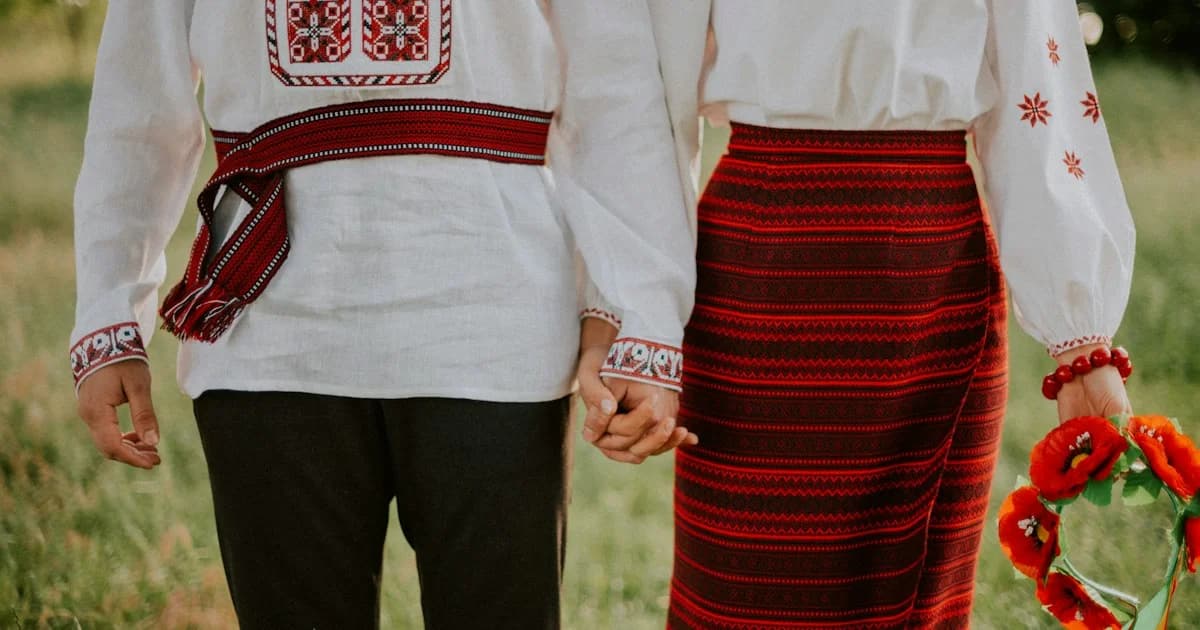
Embroidery is where heritage is easiest to wear, whether you are the couple, a parent or a guest. Dress codes are set by the couple, so guests should follow the invitation first.
The encyclopaedia records that embroidery is used mostly on clothing, and that a traditional form is used for the shirt for both men and women. On a woman's shirt, the main design sits on the upper sleeve, the polyk or ustavka. Cross-stitch is today the most popular method.
Patterns vary by region. Strict geometric patterns are preserved in Polisia and the Hutsul region, while floral designs predominate in central and eastern Ukraine along the Dnipro. Colours are often limited to one or two, such as black and red, while Hutsul and Bukovyna geometric patterns are multicoloured.
That gives you a lovely detail to plan around: match an embroidered shirt or the rushnyk to the region your family comes from, rather than choosing a generic pattern.

Ukrainian customs have long travelled with the families who keep them. The encyclopaedia notes that Ukrainians in Canada and the United States hold on to some elements of the traditional wedding as an expression of national identity. Ukrainian-Australian families do much the same, each in their own way.
You do not need to stage every act. Choose the two or three customs that matter most to your family. The parents' blessing and the wedding bread are the customs the encyclopaedia says have been preserved, if simplified. A family rushnyk, a vinok and a song led by a grandparent sit easily alongside them.
For mixed-heritage couples, pairing one Ukrainian custom with one from the other family helps both sides recognise themselves in the day. Our guides to German wedding traditions and unusual wedding traditions around the world are a good place to look for that balance, and we have written about why cultural destination weddings go beyond the venue.
The parish settles the church rite. Your planner settles everything around it: where the korovai sits, when the blessing happens and when the musicians start. Ask each venue about step-free access, seating and transfers for older or less mobile guests.
A Wedded Advisor is your single point of contact, start to finish; the fee is agreed in writing before any work begins, and your Advisor confirms inclusions in writing before you commit. Your Advisor does not handle church or legal paperwork: you check the legal steps with the births, deaths and marriages registry in your state or territory, and the church steps with your parish priest.
Smartraveller's advice for Ukraine is "Do not travel", updated 2 November 2026. The Australian Embassy is not able to provide in-person consular or passport services in Ukraine, and its ability to provide consular assistance is severely limited. Be sure to read the current Smartraveller advice for Ukraine before making any plans.
If one of you has family ties to Ukraine, Smartraveller notes that Ukraine does not recognise dual nationality for Australian citizens, and that "We may not be able to help you if you have Ukrainian nationality." It also says that under Ukrainian law, you may be a Ukrainian citizen if you were born, or have a parent born, in Ukraine.
If you marry outside Australia, Smartraveller's guide to getting married overseas says you cannot register an overseas marriage in Australia, but in most cases it is legally recognised here. To be recognised, the marriage must be valid under the law of the country where it took place and valid under Australian law had it happened in Australia. Smartraveller suggests speaking to a lawyer to confirm that an overseas marriage certificate is valid in Australia.
Some countries ask you to prove you are not already married, and Smartraveller directs couples to that country's embassy or consulate for what they will need.
The customs that matter most are usually the ones a parent or grandparent quietly asks for. Write them down early, talk to your parish, and then build the day around them. When you are ready, a Wedded Advisor from Wedded Concierge can talk through how those moments fit the celebration you have in mind, as your single point of contact from the first conversation onwards.
Written by

SEO Specialist
Ayrton Christian Braga is an SEO Specialist at Wedded Wonderland, where he writes optimized articles and web pages that center on destination weddings, cultural wedding traditions, and guides for everything in between.
Search real weddings, venues and vendors from around the world.
Search Wedded Wonderland