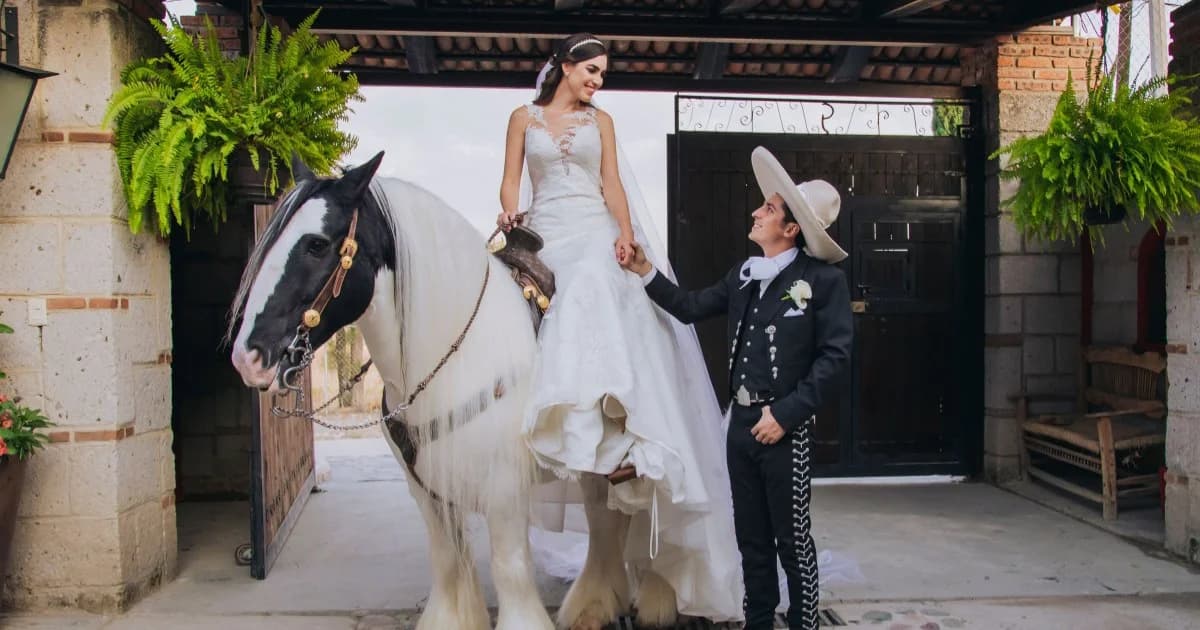
A Mexican wedding belongs to the whole family, from parents and grandparents to godparents. This Wedded Wonderland guide follows its traditions as the day unfolds, from the pedida de mano to the lazo, the arras and the Mass. Then come the music, the dances and the tornaboda. We close with what Australians need to know about planning a wedding in Mexico, or bringing these customs home.
Family sits at the centre of Mexican life. Family is the most important element of Mexican society, with strong links to extended family, including in-laws and "adoptive" relatives, and weddings are among the more lavish family occasions in the country.
There is no single script. Daily life in Mexico varies widely by region, ethnicity, rural or urban setting and other factors, and wedding customs in Mexico vary with it, from family to family and state to state. Some Indigenous communities keep their own marriage customs, distinct from the Catholic pattern most guests will know. Ask both families early which customs matter most to them.
La pedida de mano, the asking for the bride's hand, is where many Mexican weddings really begin. In Nahua communities of the Sierra Norte de Puebla, the young man's grandparents go with him to ask for the bride's hand, or, in their absence, his parents, baptism godparents, uncles or another trusted person.
The bride's parents always answer that the proposal needs thought, which leads to at least three more visits, and the decision is collective, taken with the bride's parents, padrinos, uncles and grandparents. In Totonac communities today, the man consults the woman first, then goes with his parents and baptism godparents to the petición de mano.
Elsewhere the steps have their own names. In Almoloya del Río, in the State of Mexico, the pedimento de mano has three moments, the aviso, the acuerdo and the contento, which have changed in their details but not in essence for at least two centuries. After a public conversation between the parents, the date is set, generally with an engagement of more than six months.
Some grooms keep the serenata, arriving outside the bride's home in the evening with musicians to sing to her before the wedding. Serenades sit within mariachi's wide repertoire.
If either family keeps the pedida, build those visits into the months before you set a date overseas.
Padrinos and madrinas are the sponsors who stand with the couple. Each pair takes on one part of the day, and the role can last long after the wedding.
A padrino is a man who accompanies someone receiving a Christian sacrament, as in "Seré el padrino de la boda", "I will be the padrino at the wedding". In the plural, padrinos means the padrino and the madrina together.
At a church wedding, each pair of sponsors has a moment. At one traditional church wedding in that same town, the padrinos de velación took their place at the kneelers, while the padrinos of rings, arras, lazo, medals, bible and bouquet sat near the altar. The padrinos de velación, those who watch over and care for the couple, give the candles, and are ideally the couple's baptism godparents.
The role does not end with the ceremony. In Nahua communities of the Sierra Norte de Puebla, parents and padrinos remain responsible for watching over the new couple, and before the party ends they give the couple their advice.
The madrina de ramo looks after the bouquet. At that wedding, the couple went to the altar of the Virgin Mary after the ceremony, and the bride left at her feet the bouquet she had carried in the Mass, as an offering. Other families add sponsors for the cake or the music.
There is no fixed rule. In many families the couple and their parents carry the main costs, and sponsors take on the item tied to their role as a gift. Hold that conversation early, and never assume what someone will offer.
If one of you has Filipino family, much of this will feel familiar: our guide to Filipino wedding traditions shows how sponsors, coins and a cord appear there too.
The typical lazo is two rosaries joined to form one. It is placed at the nuptial blessing, after the Our Father, when God's blessing is solemnly invoked.

At the same wedding, the padrinos de lazo covered the groom's back with the veil and laid the lazo over it, while the mariachi sang religious songs; at the end of the ceremony it was lifted away.
Choose these sponsors with care. In some communities, the padrinos de lazo must be a stable couple married in the church, as an example to their godchildren. Brief your photographer: the moment comes quickly.
In some marriage rites, the arras are coins the couple give each other as a symbol of their union. They are a sign proper to Christian marriages in Spanish-speaking America.

At that wedding, the groom received 13 gold-coloured coins from the priest and placed them in the bride's hands, and each spoke words about caring for their home. In many families, the padrinos de arras keep them in a small box until then.
For many families the Mass is the heart of a traditional Mexican wedding ceremony. In the Catholic Church, the principal sign of the sacrament is the couple's explicit consent, expressed in the words and vows of marriage, and some of the other signs are simply custom.

At the same wedding, the couple's parents gave them their bendición, their blessing, at the altar as the party took their seats. The padrinos of rings, arras, medals and lazo came forward so the priest could bless each of these symbols.
The madrina de cojines hurried ahead to place the cushions on the couple's kneelers before the other padrinos and guests came in, as the Ave María was sung.
Your parish priest will guide the order of service. Give each sponsor their cue and seat in writing.
In Mexico, a religious marriage does not replace the civil marriage, so a religious ceremony, if held, follows the civil one.
Marriage in Mexico is regulated by each state, and it is the couple's responsibility to check with the Registro Civil (civil registry) office nearest the ceremony. After the civil ceremony the registry issues an Acta de Matrimonio, the marriage certificate, which can be legalised and certified for use abroad.
Families often hold the two on different days. In Nahua communities of the Sierra Norte de Puebla, the civil wedding must take place before the religious one, and it can be held at the bride's home, with the town authorities, the day before the church wedding.
The callejoneada is closely associated with Guanajuato and Zacatecas. In the city of Guanajuato it is one of the most deep-rooted traditions: a walk through the main streets of the historic centre behind the Estudiantina Guanajuato, singing as it goes.
As at November 2026, both are states where Smartraveller advises Australians to "Reconsider your need to travel", and couples bring the callejoneada to weddings elsewhere.
At a wedding, a callejoneada works as an icebreaker before the ceremony, with guests touring the streets together.
Away from those streets, a walking band can lead guests from church to reception.
Mariachi is a small ensemble of mostly stringed instruments that emerged in the late 1700s or early 1800s in west-central Mexico. In 2011 UNESCO inscribed Mariachi, string music, song and trumpet on its Representative List of the Intangible Cultural Heritage of Humanity.

Mariachi is a fundamental element of Mexican culture, passed down through performance at festive, religious and civil events. Traditional groups have two or more members in regional costume adapted from the charro costume, while modern ensembles have four or more musicians, with trumpets, violins, the vihuela and the guitarrón.
Since the early 20th century, male bands have typically worn the traje de charro, the attire of Jalisco's cowboys, and there are now a number of all-female groups.
At many weddings the mariachi plays at the reception, and at some it also sings religious songs during the Mass as the lazo is placed. When you book, ask how many musicians will come and whether trumpets are included.
At many Mexican receptions, the money dance, el baile del billete, gives every guest a moment with the couple. Guests queue to dance briefly with the bride or groom and pin a note to their clothes, or drop it into a bag held by a sponsor, before handing over to the next in line. Some families leave it out; if you include it, keep it short and ask a sponsor to look after what is collected.
La víbora de la mar has become a popular wedding dance in Mexico. With the couple, the víbora stands for the problems they will face: whatever the obstacles, they must stay together and not let go.
At most receptions, the couple stand on chairs facing each other and join hands to make an arch. Guests link up in a long line and run beneath it, faster as the music speeds up. Have two steady guests beside each chair.
Many couples now add a hora loca, a "crazy hour", late in the reception. The music turns up, a troupe arrives with masks, hats, glow sticks and noisemakers for the guests, and the dance floor fills again. Agree the timing with the band and the venue.
At many Mexican receptions, small, crumbly cookies rolled in icing sugar, often called polvorones, sit beside the wedding cake, wrapped in paper or tulle for guests to take home.
The cake itself is often a family matter, sometimes with a sponsor for it, and it is cut later in the evening after the dancing has begun.
The tornaboda is the day after the wedding, and also the party held on that day.
In many Mexican families, the tornaboda is relaxed: close family and friends return the next day to share the remaining food, open gifts and talk over the night before.
As at November 2026, Smartraveller advice for Mexico is "Exercise a high degree of caution" in Mexico overall. It advises Australians to "Reconsider your need to travel" to Chiapas, Chihuahua, Colima, Guanajuato, Guerrero, Michoacán, north-western Durango, Sinaloa, Sonora, Tamaulipas and Zacatecas, each with listed exceptions. Check it again before you send invitations.

The hurricane and rainy season runs from June to November, and tropical storms and hurricanes can happen in other months. Coastal weddings then need a covered plan B.
Australian tourists travelling on a chipped ordinary passport can use e-gates at a number of major airports and are given a printed QR code with the days they may stay; without a chipped passport, tourists visiting for 180 days or less receive a visa on arrival. Entry and exit conditions can change at short notice. Same-sex relationships are legal and same-sex marriages are recognised, though the country is conservative.
Couples who marry in Mexico tend to choose places outside the higher-level states: Mexico City, Oaxaca, the Yucatán, Quintana Roo, Baja California Sur, Jalisco and Nayarit among them. Our tips for planning a destination wedding in Mexico goes further.
Before you settle on a region, work through the guest questions with your Wedded Advisor. Where will everyone stay? How will older or less mobile relatives manage the flights, the airport transfers and the old streets? How does a civil ceremony on one day and the Mass on another suit guests flying in? What travel insurance and medical cover does each guest need? And what is the back-up plan if a storm arrives in hurricane season? Your advisor holds the guest room blocks, with Wedded Privileges on every room.
Smartraveller's guide to getting married overseas says you can't register an overseas marriage in Australia, but in most cases it is legally recognised if it was valid under the law of the country where it took place and would have been valid under Australian law; talk to a lawyer to confirm. Some countries ask you to prove you are not already married, most commonly with a Certificate of No Impediment to Marriage (CNI).
Some authorities accept only a CNI issued in their own country, in which case the Australian embassy there can issue it, and DFAT charges fees. In Mexico, the Australian Embassy in Mexico City takes CNI applications in person, and honorary consulates, including the one in Cancún, do not provide notarial services.
The civil ceremony is the legal one, and each registry sets its own steps. Playa del Carmen's registry, for example, asks foreign couples to book the date in advance, bring identification for four witnesses and a prenuptial medical certificate valid for 15 calendar days. Before you book, put these questions to the Registro Civil where you will marry and to the Australian Embassy:
Which documents does the registry need, and does it accept a CNI issued in Australia or only one issued in Mexico?
Do your birth certificates or CNI need an apostille and a certified Spanish translation?
How far ahead must you book, and what witnesses and medical certificate do you need?
What fees apply, at the registry and at the Embassy?
Many Mexican-Australian couples marry in Australia, with the Mass, the lazo and the arras in their own parish and the mariachi, the víbora and the cookies at the reception. Your priest can guide which signs the Mass will include. Ask whether the venue suits a band and a long night of dancing.
A Mexican wedding begins with family, and it ends with them too, gathered again at the tornaboda the morning after. In between, every padrino, coin, cord and song gives someone you love a part to play. Whether you marry in Mexico or in your own parish at home, keep the traditions that matter most to both families, and the day will belong to all of you.
Written by

SEO Specialist
Ayrton Christian Braga is an SEO Specialist at Wedded Wonderland, where he writes optimized articles and web pages that center on destination weddings, cultural wedding traditions, and guides for everything in between.
Search real weddings, venues and vendors from around the world.
Search Wedded Wonderland