Guests remember very little of a ceremony running order, but they notice straight away when they can't follow it. The order of service is the small piece of paper that stops a hundred people wondering when to stand, what the ritual in front of them means, or who the woman reading Rumi is. Done well, it also becomes the one piece of wedding stationery people take home.
Wedded Wonderland plans weddings for couples who marry across cultures, faiths and borders, so this guide goes beyond the Western template. Below you'll find the standard ceremony order, what the law in your country requires to be said and signed, what goes on every page, copy-ready templates for civil, church, Catholic, Filipino and bilingual ceremonies, and how the order changes across the world's major traditions.
Yes, they are the same thing with different names. What you call it mostly depends on where you're from:
Where | What guests call it | Who usually leads the ceremony |
|---|---|---|
United States, Canada | Wedding program, ceremony program | Officiant (minister, judge, friend ordained online) |
United Kingdom, Ireland | Order of service, order of ceremony | Registrar (civil) or vicar, priest, minister |
Australia, New Zealand | Order of service, ceremony program | Celebrant (civil) or minister of religion |
Philippines | Wedding program, entourage list | Priest, pastor, judge or mayor |
India, South Asia | Wedding program, ceremony guide | Pandit, granthi or maulvi, depending on faith |
UAE, Middle East | Program, often bilingual | Imam or ma'zoon, priest, or a court notary for civil marriage |
Three related documents often get confused with it:
The ceremony script is the officiant's full word-for-word text. Guests never see it.
The wedding day timeline covers the whole day, from hair and makeup to the last dance. It's for your suppliers, not your guests.
The reception menu or schedule covers speeches, dinner and dancing. Some couples print it on the back of the program; most keep it separate.
Do you actually need one? Not legally, and not always. You can skip it for an elopement, a 15-minute registry ceremony, or a wedding with fewer than 20 guests who all know each other. It becomes genuinely useful when guests need to sing or respond, when the ceremony includes rituals some guests won't recognise, when it's in more than one language, or when you want to name the people who made the day happen.
Almost every Western-style ceremony, religious or civil, follows the same skeleton. Religious and cultural ceremonies add to it or reorder it (see the section on religions and cultures below), but this is the backbone most programs print.

Prelude. Music plays while guests arrive and are seated, usually for the 15 to 30 minutes before the start time.
Seating of family. Grandparents and parents are escorted to their seats. This signals to guests that the ceremony is about to begin.
Processional. The wedding party enters, followed by one or both of the couple.
Welcome. The officiant greets guests, and may acknowledge loved ones who can't be there.
First reading or song. Read by a friend or family member.
Address or your story. The officiant speaks about marriage, or about the two of you.
Declaration of intent. The "Do you take…" questions, answered "I do" or "I will".
Vows. The legal vows, your own vows, or both.
Exchange of rings.
Second reading, song or ritual (optional). A handfasting, sand pouring, unity candle, blessing or a family moment.
Pronouncement and first kiss.
Signing. The couple, officiant and witnesses sign the register, schedule or licence while music plays.
Presentation of the couple. "For the first time as a married couple…"
Recessional. The couple leads everyone out, followed by the wedding party.
Element | Typical time | Running total |
|---|---|---|
Processional | 3 to 5 min | 5 min |
Welcome | 2 to 4 min | 9 min |
First reading | 2 to 3 min | 12 min |
Address or your story | 4 to 8 min | 20 min |
Declaration and vows | 3 to 6 min | 26 min |
Rings | 2 to 3 min | 29 min |
Second reading or ritual | 3 to 7 min | 36 min |
Pronouncement and kiss | 1 min | 37 min |
Signing | 5 to 10 min | 47 min |
Recessional | 2 to 3 min | 50 min |
That's the upper end. A pared-back civil ceremony with one reading and no ritual comes in around 20 to 25 minutes. A church service with hymns runs 45 to 60, a Catholic Mass about an hour, and a traditional Hindu ceremony 90 minutes or more. If you're printing the order, you're really deciding how long your guests sit. Three readings is usually the most an audience will follow closely.
This is the section most guides skip, and it matters for your order of service. The legal steps can't be left out or reordered freely, and in some countries they limit what you're allowed to print. The rules below are summaries for planning. Your officiant, registry or court has the final word.

Country | What must happen at the ceremony | What it means for your program |
|---|---|---|
United States | A valid marriage licence from the county, a ceremony by an authorised officiant (or self-solemnisation where the state allows it, such as Colorado), and witnesses where the state requires them. Requirements vary by state: some ask for two witnesses, some for one and many for none. | Your program's "vows" and "pronouncement" steps are the legal core. Check your county clerk's rules on witnesses before you print their names. |
England and Wales | Notice given at a register office, vows exchanged, at least two witnesses present, and the marriage schedule or document signed. A civil ceremony must not include anything religious, such as hymns or Bible or Torah readings. | Get readings and music approved by the registrar before printing. A civil program can't list a hymn or a scripture reading. |
Australia | A Notice of Intended Marriage lodged at least one month (and up to 18 months) before the day. Civil celebrants must say the monitum: "I am duly authorised by law to solemnise marriages according to law…". Each partner says the legal vow: "I call upon the persons here present to witness that I, [name], take you, [name], to be my lawful wedded wife (or husband, or spouse)". Two witnesses over 18 must be present. | You can print your personal vows, but the legal wording stays in the ceremony. Most couples list "The Declaration" or "The Vows" rather than printing the legal text. |
Philippines | Under the Family Code, a licence (with limited exceptions), an authorised solemnising officer, and both partners personally declaring that they take each other as spouses in front of at least two witnesses of legal age, who then sign the certificate. | Filipino programs traditionally list principal sponsors (ninong and ninang), who usually act as the witnesses. |
India (Hindu) | Under the Hindu Marriage Act 1955, s7(2), where the rites include saptapadi, the marriage "becomes complete and binding when the seventh step is taken". Registration is separate and recommended. | The saptapadi is the legal and spiritual peak, so give it its own line and a one-sentence explanation. |
UAE (non-Muslims, Abu Dhabi) | A civil marriage at the Abu Dhabi Judicial Department's Civil Family Court, open to non-Muslim couples of any nationality. The notary acts as witness, and couples may exchange rings and their own vows. | Many couples marry legally at the court, then hold the full ceremony at a resort or in the desert. Label that ceremony honestly: "Celebration of our marriage". |
Singapore | A civil solemnisation by a licensed solemniser, with two witnesses aged 21 or over who sign the certificate. | Name your witnesses. At ROM-style ceremonies, the solemnisation itself may be the whole program. |
If you're marrying abroad: many couples sign the legal paperwork at home in the week before, then hold the ceremony overseas without the legal steps. If you do this, remove "signing of the register" from your program or replace it with a symbolic signing, so no guest assumes the paperwork is happening in front of them.
There is no single correct order. What follows are the conventions most guests will recognise.

A typical Western processional:
The officiant takes their place (in the UK and Australia, often already standing at the front).
Grandparents, then parents, are seated.
The partner waiting at the front enters, often from the side, with the best man or best person.
Groomsmen and bridesmaids, in pairs or one at a time.
Maid or matron of honour.
Ring bearer and flower girl.
The second partner, with a parent, both parents, or alone.
The recessional reverses it: the couple first, then the flower girl and ring bearer, the honour attendants, the rest of the wedding party in pairs, the parents, then the grandparents. The officiant leaves last or stays put. Guests file out from the front rows back.
Modern and inclusive options now appear on a lot of programs: two partners walking in together, each partner walked by both parents, a Jewish-style processional where both sets of parents walk with their child, or, for same-sex couples, two separate aisles meeting at the front. Whatever you choose, printing the names in walking order gives guests something to follow and quietly credits everyone involved.

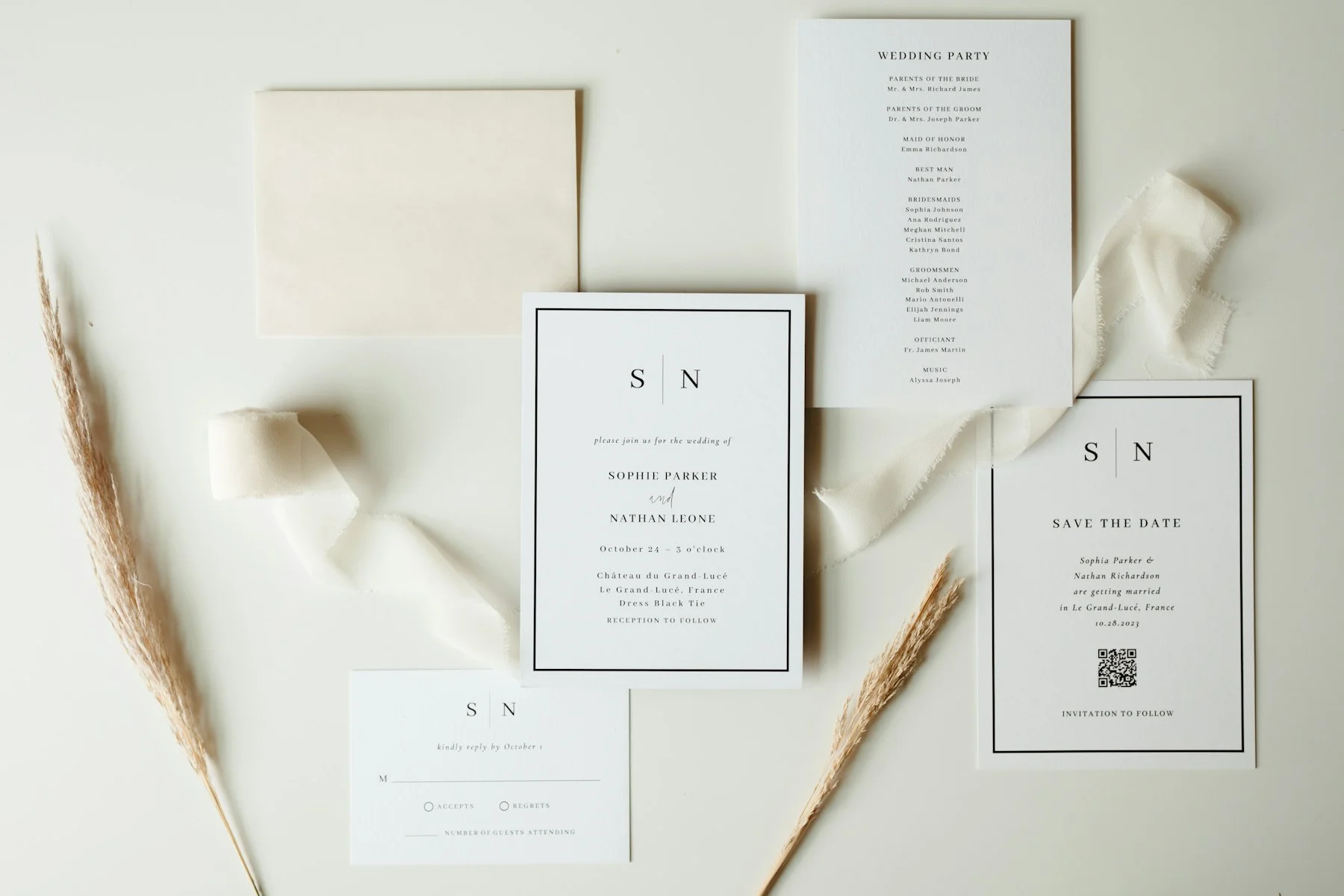
Front cover
Your names, in the order you prefer
The date and ceremony start time
The venue name and town
A line such as "The marriage of" or "Order of service" (or "Wedding program" for American guests)
Your monogram, a small illustration of the venue, or a line of verse
Inside pages
The running order, step by step, using the headings from your ceremony
Readers' names beside each reading ("Read by Sophie, sister of the bride")
Song or hymn titles, with composer or artist
Full words to anything guests sing or say together, such as a hymn, a response or a blessing
A one-line explanation of any ritual guests may not know
The officiant's name and title
Back cover
The wedding party with their roles
Musicians, ushers and anyone else taking part
A remembrance line for loved ones who have died ("We hold in our hearts…")
A short thank-you from the two of you
Reception details: address, start time, and a map or QR code if it's somewhere else
Your wedding hashtag, or an "unplugged ceremony" request
What to leave out: full lyrics to songs guests won't sing, anything you might change in the last week (a nervous reader's name, a still-undecided song), and anything private, like your personal vows, if you'd like them heard rather than read ahead.
Swap in your own names and details. Everything in square brackets is a placeholder.
The marriage of [Name] and [Name]
[Day, date] · [Time] · [Venue, town]
Officiated by [Name]
Arrival of the wedding party · [Song], [Artist]
Welcome
Reading · [Title], [Author], read by [Name]
Our story · [Officiant name]
The declaration and vows
The giving and receiving of rings
Reading · [Title], read by [Name]
The pronouncement
Signing of the register · [Song], [Artist]
Presentation of the couple
Recessional · [Song], [Artist]
Order of service
Entrance of the bride · [Organ piece]
Welcome and introduction · Revd [Name]
Hymn · [Title] (full words printed)
The preface
The declarations
Reading · [Scripture reference], read by [Name]
The marriage: the vows, the giving of rings, the proclamation
Address · Revd [Name]
Prayers
The Lord's Prayer (words printed)
Hymn · [Title]
The blessing
Signing of the register · [Music]
Exit of the bride and groom · [Organ piece]

Introductory rites: entrance procession, greeting, opening prayer
Liturgy of the Word: first reading, responsorial psalm, second reading, Gospel acclamation, Gospel, homily
Rite of Marriage: questions before consent, exchange of consent, blessing and giving of rings
Universal prayer (prayers of the faithful)
With Mass: Liturgy of the Eucharist: preparation of the gifts, Eucharistic prayer, Lord's Prayer, Nuptial Blessing, sign of peace, Holy Communion
Without Mass: Nuptial Blessing and the Lord's Prayer follow the universal prayer
Concluding rites: final blessing, signing, recessional
Add a short note about Communion for guests of other faiths if your parish recommends one. Your priest will usually want to approve the program.
Filipino programs double as an entourage list, and that part matters as much as the running order.
Entourage
Parents of the groom · Parents of the bride
Principal sponsors: [Ninong and Ninang names, in pairs]
Secondary sponsors: Candle [Names] · Veil [Names] · Cord [Names]
Best man · Maid or matron of honour
Groomsmen · Bridesmaids
Ring bearer · Coin (arrhae) bearer · Bible bearer · Flower girls
Ceremony: entrance procession, Liturgy of the Word, Rite of Marriage, blessing and giving of rings, giving of the arrhae (13 coins), lighting of the unity candle, veil and cord rites, Nuptial Blessing, Communion, final blessing, presentation of the couple
Parishes differ on exactly where the candle, veil and cord fall, so confirm the order with your priest before printing.
Print the two languages side by side, or on facing pages, not one after the other. Keep headings in both languages: Welcome / Bienvenue / أهلاً وسهلاً. Where a ritual belongs to one tradition, add a single italic line explaining it: "The breaking of the glass reminds us that love must be protected, and marks the moment of celebration."
A single A6 or 5x7 inch card: your names, the date and place, the four or five moments of the ceremony, and one line of thanks. Nothing else.
Each tradition below is condensed to what you'd print and what guests need explained. For the full rituals, see our dedicated guides.

Before the ceremony: the ketubah (marriage contract) is signed and the bedeken (veiling) takes place. Under the chuppah: the circling (traditionally seven times, often shared by both partners now), the betrothal blessings over wine, the giving of the ring, the reading of the ketubah, the sheva brachot (seven blessings) and the breaking of the glass, followed by a shout of "Mazel tov". Print a one-line meaning for the chuppah and the glass.
Customs vary widely by region and community, but a common order is: baraat (the groom's arrival) and milni (the families meeting), Ganesh puja, the bride's entrance, jaimala (garland exchange), kanyadaan, vivaha homa (the sacred fire), mangal pheras, saptapadi (the seven steps and seven vows), sindoor and mangalsutra, and ashirvad (blessings from elders). Programs for mixed guest lists often give each ritual a line of explanation and a rough time, because 90 minutes feels shorter when guests understand it.
Held in a gurdwara, usually in the morning, before the Guru Granth Sahib. The order runs: ardas (opening prayer), the palla ceremony (the bride's father places one end of a scarf in the groom's hand and the other in the bride's), the four laavan (four hymns, during which the couple walks clockwise around the Guru Granth Sahib), the Anand Sahib, a closing ardas and hukamnama, then karah prashad for everyone. Your program should tell guests to cover their heads and remove their shoes.
A nikah is often short and sometimes private, with the walima (reception) held separately. It usually includes a khutbah (short sermon), agreement of the mahr (the gift to the bride), the ijab and qabul (offer and acceptance) before witnesses, signing of the nikah contract, and du'a (prayers). Printed programs are less common. When couples do print one, it's usually bilingual and explains each term for non-Muslim guests.
Maronite, Greek Orthodox and Melkite ceremonies centre on the church service, often including a crowning. The celebration opens with the zaffe: a procession of drummers, dancers and sometimes sword or dabke performers who bring the couple into the reception. A program for this kind of wedding often covers both: the church order on the inside, and "The zaffe · [Time] · [Venue]" on the back.
The service has two parts: the Service of Betrothal, where the rings are blessed and exchanged three times by the koumbaros (sponsor), and the Service of Crowning, where the stefana (joined crowns) are placed and exchanged. Then come the readings (traditionally Ephesians and the wedding at Cana in John 2), the common cup, and the Dance of Isaiah, the couple's first steps together three times around the table. Traditionally no personal vows are spoken aloud, which surprises guests, so explain it in the program.
Often held on the morning of the wedding or between ceremony and banquet. The couple serves tea to parents and elders in order of seniority. Elders drink, offer blessings, and give red envelopes (hongbao) or jewellery. Print the order of elders being served, and add a line explaining that it's a gesture of respect and welcome into the family.
The best multicultural programs do three things.
Translate, don't duplicate. Run languages side by side so both halves of the family read at the same pace. Ask a native speaker to check the translation, not an app. Religious terms and family titles are where machine translation goes wrong.
Explain in one line. Every ritual that one side of the room won't know gets a single sentence: what it is and why it matters. Anything longer turns into a lecture no one reads.
Be honest about the legal part. If you married legally at home or at a court, like the Abu Dhabi Civil Family Court or a registry office, call the destination ceremony what it is. Drop the legal signing, or mark it as symbolic.
Practicalities for destination weddings:
Print at home and carry the programs in hand luggage, or use a local printer and proof the file carefully before you fly.
Humid and hot climates call for fans or heavy card stock. Thin folded booklets curl.
Remote venues benefit from a QR code linking to a digital version, directions and the reception schedule.
Readings that work across faiths and none: Rumi's poems on love, Pablo Neruda's Sonnet XVII, "The Art of a Good Marriage" by Wilferd Peterson, the Apache blessing, extracts from The Velveteen Rabbit or Captain Corelli's Mandolin, and 1 Corinthians 13 for church ceremonies. In a UK civil ceremony, keep scripture out, as the table above explains.
Music cues to plan (and print):
Prelude, while guests arrive
Processional, as the wedding party walks in (a moderate pace of about 70 to 80 beats per minute)
The second partner's entrance, if it's a different piece
The signing, which needs two or three songs to cover 5 to 10 minutes
Recessional, something upbeat
Unity rituals and their timings:
Handfasting (3 to 5 min)
Sand ceremony (2 to 3 min)
Unity candle (2 min)
Wine or tea ceremony (3 to 5 min)
Tree planting (5 min)
Ring warming, where guests pass the rings around (runs during the ceremony, so plan it for smaller weddings)
For writing your own vows, including how long they should be, see our vow guide.
10 to 12 weeks out: confirm the ceremony structure with your officiant and, for church ceremonies, get readings and music approved.
8 weeks out: confirm your readers and musicians, and collect exact titles and spellings.
6 to 8 weeks out: send final wording to your stationer, or finish your template.
4 to 5 weeks out: approve the proof. Read every name aloud, backwards if you have to.
2 to 3 weeks out: receive the printed copies. Most printers need 1 to 2 weeks.
The day before: hand them to the ushers or your coordinator, with instructions on where they go.
How many to order: one per couple or household is enough for most weddings. Order one per guest if everyone needs the words to sing along, or if you want each guest to have a keepsake. Add about 10% spare for the family, your photographer and your own memory box.
Which format works best
Format | Size | Best for |
|---|---|---|
Flat card | 5x7 in (US) or A5 / A6 (UK, AU) | Short civil ceremonies, elopements |
Tea-length card | 4x9 in (US) or DL 99x210 mm | Mid-length ceremonies, a clean modern look |
Folded booklet | 5.5x8.5 in (US) or A5 folded (UK, AU) | Church services, hymns, bilingual text |
Fan | Varies | Outdoor summer ceremonies, Asia and the Middle East |
Scroll | Varies | Themed, heritage or castle weddings |
Digital or QR sign | Screen | Sustainable weddings, large or destination guest lists |
Misspelling a name. It's the most common error and the most remembered. Check everyone's names with them directly.
Printing before the officiant signs off. Priests and UK registrars often change the order or reject a reading.
Listing a legal step that isn't happening. This matters most for couples who married legally before a destination wedding.
Printing full lyrics to songs no one will sing. It adds pages and cost without helping anyone.
Leaving guests guessing on cues. Mark sit, stand and respond moments, especially in church.
Forgetting the back cover. A program with no reception directions sends guests straight to their phones.
Ordering too few. Families always want extras. The 10% buffer is there for a reason.
Using a font no one can read in sunlight. Script fonts suit your names; everything else needs a clean, legible typeface at 10 pt or more.
The printed program is the easy part. The hard part is making the ceremony it describes actually run: the officiant who needs your readings three weeks early, the venue that won't allow confetti, the court booking in Abu Dhabi that has to land the day before your desert ceremony, the parish that wants the veil and cord in a different place. A Wedded Advisor holds all of it for you, from the first call to the recessional. Where the ceremony depends on an approval from a civil authority, a heritage site or a venue that doesn't usually host weddings, we handle that conversation directly, and we have someone on the ground on the day. There's no fee for the first conversation, and suppliers pay us at standardised industry rates, so you're never quoted a marked-up price.
Benefits vary by property and booking. Eligibility and availability conditions apply.
Written by
Content and Creative Manager
Joseph Joshua is the SEO & Content Manager at Wedded Wonderland, bringing an editorial and search strategy perspective to the publication’s coverage of luxury weddings, destination celebrations and bridal lifestyle. His approach to content centres on helping readers move from inspiration to informed decisions, with attention to the design, craftsmanship and personal details that give a celebration its character.
Search real weddings, venues and vendors from around the world.
Search Wedded Wonderland