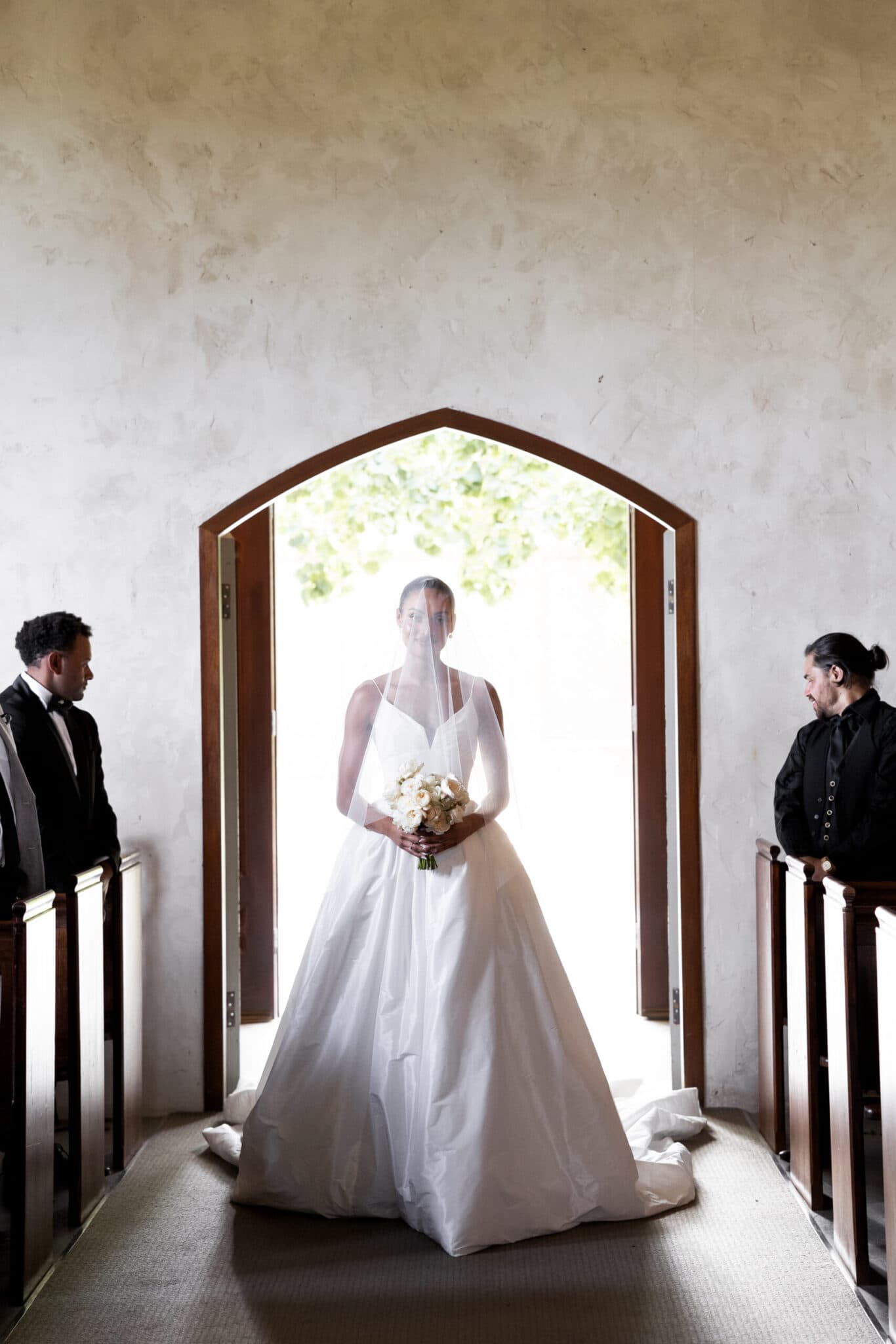
The walk down the aisle is the shortest part of the ceremony and the one everyone remembers. The music sets its pace and mood. Wedded Wonderland has grouped these 40 wedding processional songs by style: classical, church and hymns, instrumental, and modern. Each comes with a practical note on how it plays on the aisle and who it suits.
The processional is the music played as the wedding party and the couple walk in at the start of the ceremony. Some couples use one piece for everyone; many use one for the wedding party and a second for their own entrance.
Start with the setting. A chapel organ, a garden string trio and a clifftop guitarist each favour different music. Then think about pace: a slow piece suits a long aisle and a formal walk, while a brisker one keeps a large wedding party moving.
Instrumental versions carry well outdoors and leave space for the moment. Songs with vocals suit the couple's entrance if you are happy for guests to hear the words as they watch you.
In many ceremonies, the officiant and one partner wait at the front, the wedding party walks in, and the couple, or the person being walked in, arrives last. Your officiant will confirm the order.
You don't need a separate song for every group. A common shape is one piece for parents, grandparents and the wedding party, then a change of music for the couple. The change cues guests to stand, so make the second piece sound clearly different.
Long enough to cover the walk, which depends on your aisle and the number of people walking. Time it at the rehearsal. Live musicians can repeat a section while the wedding party walks and move to the ending as the couple reaches the front; with a recording, ask your celebrant or sound person to fade at a natural phrase rather than cutting mid-line.
Live music follows the room: a quartet or pianist can slow down, repeat or finish on cue. Recorded music gives you the exact version you love, and needs a reliable sound system, someone to press play and a back-up copy.
Many couples use live players for the ceremony and recordings for the reception.
Classical pieces are easy to arrange for quartet, organ, harp or piano, and simple to time to the walk. These ten range from slow, formal airs to bright fanfares.

The Canon and Gigue in D major is by Johann Pachelbel. The Canon's repeating bass line means musicians can stretch or shorten it without anyone noticing, which is why it handles a long or uneven procession so well.
Suits: the wedding party or the couple, in a garden or chapel.
The Air comes from Bach's Suite No. 3 in D major, BWV 1068. It is slow and unhurried and gives a formal entrance real calm.
Suits: the couple, for a slow, formal walk.
This chorale is part of Bach's Cantata BWV 147, Herz und Mund und Tat und Leben. Its flowing triplet rhythm moves steadily without rushing, so a wedding party can walk naturally to it.
Suits: the wedding party, in a church or chapel.
The Bridal Chorus comes from Wagner's opera Lohengrin, first performed in 1850 at Weimar. Guests know it from the first bar, a clear signal that the couple is arriving.
Suits: the couple, for a traditional entrance.
Also known as the Trumpet Voluntary, this march is by Jeremiah Clarke, an English organist and composer of mainly religious music. It is stately and bright, and it sounds its fullest on organ and trumpet.
Suits: the couple, for a grand entrance with organ or brass.
This is an Act III number in Handel's Solomon. It is quick and lively, for a wedding party who want to walk with energy.
Suits: the wedding party, for a brisk, upbeat walk.
Spring is Concerto No. 1 of Vivaldi's The Four Seasons, a group of four violin concertos published in 1725. The opening movement is bright and sunny.
Suits: the wedding party, for outdoor and daytime ceremonies.
Clair de lune is the third movement of Debussy's Suite bergamasque, a piano suite published in 1905. It is soft and spacious, and it sounds lovely on solo piano or harp in a small room or at dusk.
Suits: the couple, for intimate and sunset ceremonies.
Elgar composed Salut d'amour for violin and piano in 1888 and dedicated it to Caroline Alice Elgar. It is short, warm and melodic, and it sits naturally with a string trio or quartet.
Suits: the couple, with a string trio or quartet.
The Rondeau is the first movement of Suite 1 of Jean-Joseph Mouret's Symphonies de Fanfares. Its fanfare opening announces an entrance clearly, and it works on trumpet and organ or as a brass ensemble piece.
Suits: the wedding party or the couple, for a fanfare-style entrance.
Hymns and sacred pieces sit comfortably in a church service. Ask your officiant or music director early whether a particular piece, or any secular song, suits your service.

Schubert composed his Ave Maria for voice and piano in 1825. With a singer it becomes a focal point; on cello or violin it gives a slow, gentle walk.
Suits: the couple, in a church ceremony, with voice or strings.
Gounod revised this setting of the Ave Maria text into its present form in 1859. Its rippling accompaniment keeps it moving, so it carries a walk a little more easily than Schubert's version.
Suits: the couple, in a church ceremony.
Purcell's Trumpet Tune in C major dates from 1696. It is short, bright and ceremonial, and it is made for organ and trumpet.
Suits: the couple, with organ and trumpet.
Panis Angelicus is an extract from Franck's Messe solennelle, 1860. It is calm and lyrical, for voice or strings.
Suits: the wedding party, in a church ceremony; ask your officiant or music director.
John Newton published the hymn in 1779 in the Olney Hymns. It is sung to the tune New Britain, an Appalachian folk tune. It works on bagpipes, guitar or organ.
Suits: the wedding party, in a church or outdoors.
Slane is an old Irish folk tune, and the English text is by Mary E. Byrne and Eleanor Hull. The tune has a gentle, rolling lilt that suits a solo instrument such as a tin whistle, harp or violin.
Suits: the wedding party, for couples with Irish or Celtic heritage.
Eleanor Farjeon wrote the words in 1931, and the hymn is sung to the tune Bunessan. It is light, open and unhurried, and it belongs to the first half of the day.
Suits: the couple, for morning and garden ceremonies.
This hymn has a broad, singable melody. Suggest it to your music director if you want guests to sing as the wedding party enters.
Suits: the wedding party, as a hymn the congregation can sing.
Henry van Dyke wrote these words in 1907 to be sung to Beethoven's Hymn to Joy, adapted from the final movement of his Ninth Symphony. It is bright and celebratory.
Suits: the couple, for an uplifting church entrance.
The tune Crimond is by Jessie Seymour Irvine. It is steady and dignified, for organ or congregation.
Suits: the wedding party, with organ or a congregation singing.
Contemporary instrumental pieces sit between classical and pop, and a pianist or string player picks them up easily. These ten are chosen for the walk itself. For a wider list across the whole ceremony, see our guide to instrumental wedding songs.

A solo piano piece by Yiruma. Its simple, repeating melody is easy to time to the walk.
Suits: the couple, on solo piano.
Another Yiruma piano piece, lighter than River Flows in You, and a good partner piece for the wedding party.
Suits: the wedding party, on solo piano.
From Einaudi's album Una Mattina (2004). It starts quietly and builds slowly, so the musicians can time the fullest passage for your arrival.
Suits: the couple, on piano, for a slow build.
From Einaudi's album In a Time Lapse (2013). It grows steadily from piano to strings, which gives a long aisle a sense of arrival.
Suits: the couple, for long aisles, building to a peak.
From Yann Tiersen's soundtrack to Amélie, the 2001 film directed by Jean-Pierre Jeunet. It is light and quick, with a playful piano pattern that keeps a wedding party walking.
Suits: the wedding party, on piano, light and quick.
Composed by Ennio Morricone for The Mission. It is slow and lyrical, on oboe, cello or violin, and it suits a chapel's acoustic.
Suits: the couple, with strings or oboe, in a church or chapel.
Andrea Morricone is credited as composer of this theme, recorded by Ennio Morricone. It is tender and unhurried, and it carries well on solo violin.
Suits: the couple, especially for Italian ceremonies.
From Michael Giacchino's score for Up, which won the Academy Award for Original Score. It has a light waltz feel and a gentle wit.
Suits: the wedding party, for playful couples and film fans.
By Joe Hisaishi, from Howl's Moving Castle. It is a sweeping waltz that works on piano alone or with full strings.
Suits: the couple, for a waltz feel and film fans.
From The Cinematic Orchestra's soundtrack to The Crimson Wing: Mystery of the Flamingos. It builds slowly from strings to a full, open sound, and it suits wide outdoor spaces.
Suits: the couple, outdoors, for a slow build.
Modern songs bring something personal to the aisle, played as recorded or arranged for strings, piano or guitar. For the music as you enter the reception, see our wedding entrance songs.

Christina Perri's song was released in 2011. It is slow and steady, and it arranges well for strings or piano.
Suits: the couple, for a slow walk with a string or piano arrangement.
Elvis Presley's recording appeared on the Blue Hawaii soundtrack in 1961. It is short and gentle, so a live player may repeat a verse.
Suits: the couple, on a short aisle, live or recorded.
Ed Sheeran's song is from his third studio album, ÷, released in 2017. Its slow, swaying rhythm suits an unhurried walk, and the melody works well on solo guitar.
Suits: the couple, with an acoustic guitarist at a garden or beach ceremony.
Released as a single by Sleeping at Last in 2012, and also arranged as an instrumental. It is quiet and delicate, made for a calm setting.
Suits: the couple, in a small, quiet space, on piano or as a recording.
Bob Dylan's song comes from his 1997 album Time Out of Mind, and Adele released her recording in 2008. It is slow and simple, so it suits a single voice with piano.
Suits: the couple, with a singer and pianist, indoors or under cover.
Etta James released At Last as a single in 1961. It has a rich, slow swing.
Suits: the couple, at evening ceremonies, with a singer or as a recording.
From The Beatles' album Abbey Road. It is bright and easy-going, and it works on acoustic guitar or a string quartet.
Suits: the wedding party, for outdoor and daytime ceremonies.
Rascal Flatts' song spent five weeks at No. 1 on Billboard's Hot Country Songs chart. It is a slow country ballad that builds to a strong chorus.
Suits: the couple, for country fans, as a recording or with a singer and guitar.
From Sara Bareilles' album The Blessed Unrest (2013). It is warm and upbeat, with a steady pulse that works for a wedding party or a couple walking together.
Suits: the wedding party or the couple.
Yours was Russell Dickerson's debut hit and reached No. 1 on Billboard's Country Airplay chart. It is a gentle country ballad with a clear melody that suits acoustic guitar.
Suits: the couple, for country fans, on acoustic guitar at an outdoor ceremony.
Within the modern list, the brighter songs (Here Comes the Sun, I Choose You) suit the wedding party, and the slower ballads suit the couple's entrance. If a groom or partner walks in separately, a shorter, upbeat piece keeps that entrance distinct from the main processional.
Abroad, music becomes logistics. Send your shortlist to the venue early and ask these questions.
Live musicians: Can the venue recommend local musicians, and can they learn your pieces from sheet music or a recording?
The musician's quote: What does it include: rehearsal, travel, set-up time and how long they play? Is that confirmed in writing?
Deposit and cancellation: What deposit is due, when, and what are the cancellation terms? Are both set out in writing?
Who runs the sound: Who supplies and operates the sound system at the ceremony, and who on the venue side is responsible for the music on the day?
If something fails: What happens if a musician can't play, the power drops or the playback fails?
Sound outdoors: Will acoustic instruments carry across your ceremony space, or will you need amplification?
Power: Is there power at the ceremony spot for a keyboard, speakers or a microphone? Is a generator or battery system available, and who manages it?
Aisle length and terrain: How long is the walk on a beach, lawn or clifftop path, and is there a step-free route for older guests?
Music permissions: Does the venue have the permissions it needs for live or recorded music at your ceremony, and are there any sound limits or curfews?
Back-up plan: If the ceremony moves indoors for weather, where do the musicians set up, and does the processional still work?
Add sound limits, power at the ceremony site and music permissions to your booking checklist. Your Wedded Advisor confirms the inclusions in writing before you commit.
With Wedded Concierge, suppliers are paid at standardised industry rates, so you are never quoted a marked-up price. Wedded Concierge gives you a single point of contact for the venue, the musicians and every other supplier, and the fee is agreed in writing before any work begins.
The processional is the start of a day full of music. When you move on to the reception, our guides to first dance songs, father-daughter dance songs and wedding dance floor songs pick up from here, and the Wedded Wonderland magazine has more ideas for the day.
When you are ready, tell us your date and your guest list, and a Wedded Advisor will be your single point of contact, with the fee agreed in writing before any work begins, through Wedded Concierge.
Search real weddings, venues and vendors from around the world.
Search Wedded Wonderland