A Korean traditional wedding is a sequence of customs, not a single ceremony. It runs from a gift box carried to the bride's family to the pyebaek, where the couple bow to the groom's elders. This Wedded Wonderland guide explains each step in the order many families follow today. It also covers what Australian couples need to marry in South Korea or bring the customs home.
Marriage sits among the most important passages of traditional Korean family life, alongside a baby's first 100 days and the 61st birthday. Customs vary by family, region and faith, and some families add or leave out the steps below. Ask both families which parts matter to them. For customs from other cultures, see our guide to wedding traditions from around the world.
Before the wedding, many families still send a ham: a wrapped box of gifts from the groom's family to the bride's. It usually holds a letter to the bride's family, fabric or other gifts chosen by the groom's side, and it is tied in cloth for the journey.
At many Korean weddings today, the groom's friends deliver the ham to the bride's family home one evening before the wedding, bargaining their way to the door with a noisy call-and-response. The bride's family answers with food and drink before the box is let inside.
Plenty of couples now simplify the ham, deliver it quietly over a family dinner, or leave it out. If your families want one, agree early who carries it, what goes inside and who chooses it.
Yedan are the gifts the bride's side gives to the groom's family before the wedding. In many families they include bedding, fine clothing or other household gifts for the groom's parents and close relatives.
Yemul are the gifts exchanged between the couple and the two families, often jewellery or a keepsake for the bride and a watch or suit for the groom.
Both exchanges are matters for the families, and many couples now scale them down or give a single gift to each set of parents. Talk early: ask each family what they hope to give and receive, and whether they expect the full exchange or a simpler one.
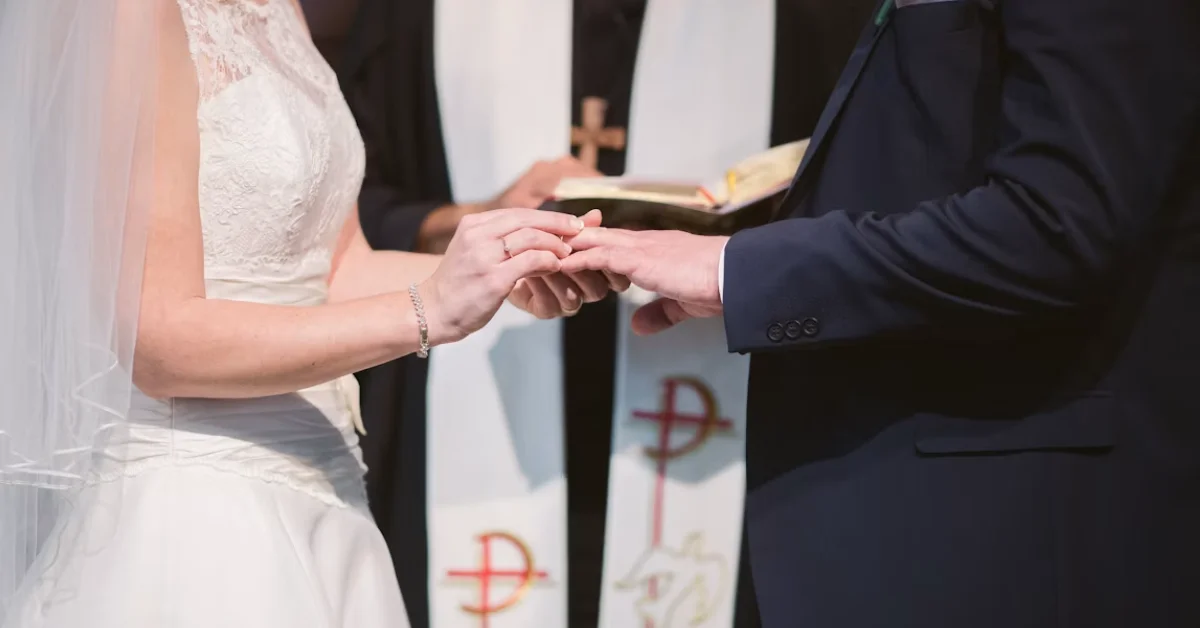
At many Korean weddings today, the ceremony takes place in a dedicated wedding hall or a hotel ballroom. The bride wears a white gown and the groom a suit or tuxedo, and the ceremony itself is brisk, often finished well within the hour.
Guests sign a guest book, hand their envelope to a family member at the reception desk, and move on to a meal. Halls host several weddings a day, so the timetable is tight.
Western dress has replaced hanbok in daily life almost everywhere, but even city families still commonly wear hanbok for special occasions, including weddings, and there are dedicated wedding hanbok. Mothers of the couple often wear hanbok to the ceremony, and the couple change into hanbok for the pyebaek.
Many couples also book a pre-wedding photo shoot months ahead.
Not usually in the Western sense. Friends help the bride, and many couples have a friend sing or speak during the ceremony. Couples marrying in Australia often add bridesmaids and groomsmen.
The jeontong honrye is the full traditional ceremony. Some couples choose it for the wedding itself, and others hold a shortened version for family and photos. It is slower and more formal than a wedding hall service, and an officiant usually calls each step aloud.
A traditional ceremony usually runs in this order:
The groom's arrival. The groom arrives at the bride's family and presents the wooden wedding geese (see section 5).
Facing each other. The bride and groom stand on either side of a ceremony table set with offerings, candles and greenery.
Washing hands. Attendants help each of them rinse their hands before the rites begin.
The bows. The bride bows to the groom, and the groom returns the bow, with attendants guiding each movement.
The shared cup. The couple drink from a cup, then exchange cups and drink again.
The announcement. The officiant declares the ceremony complete, and family and guests come forward.
The bride's robes are heavy and attendants guide her movements, so allow time in the run sheet. For a ceremony with its own rhythm of cups and vows, compare our guide to Japanese wedding traditions.

In a traditional Korean wedding, the groom brings wooden geese to the bride's house in a ritual called jeonallye. Live geese were used at first, and wooden geese began to replace them in the late Joseon period. Geese are a symbol of loyalty and fidelity, and the wooden geese were given as a sign of the groom's everlasting love for his bride.
The carved bird is known as gireogi in Revised Romanisation, and you may also see it spelled kirogi. Presenting a live goose was borrowed from Chinese Confucian wedding ritual, and the custom survived in Korea long after it disappeared in China.
Many people call them Korean wedding ducks. At many weddings today, the geese sit on the ceremony table, often wrapped in cloth, and couples take them home afterwards and keep them on display. If you are marrying away from Korea, ask whether a pair has been handed down in the family.

Women's formal hanbok is built from several layers of undergarments beneath a long, billowing skirt and a short jacket closed with a long tie, while men's hanbok pairs full-legged trousers with a long, wide-sleeved jacket. For the wedding itself, the clothes go further.
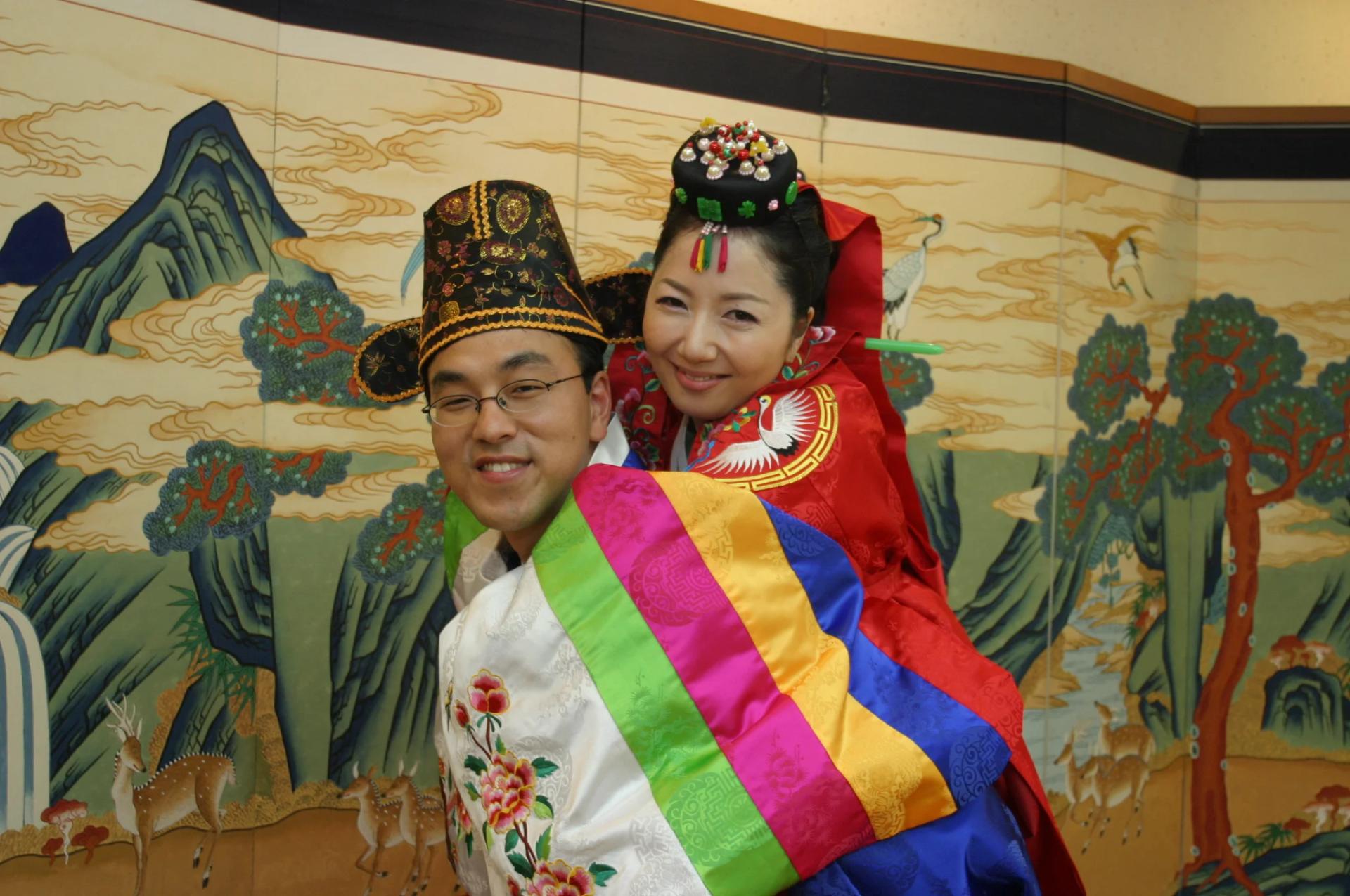
At many traditional ceremonies, the bride wears one of two women's ceremonial robes. The wonsam (원삼) is a woman's ceremonial silk robe, and one classic style has a green body, red ribbons and sleeves in red, yellow, blue, white and dark red.
The hwarot (활옷) is a fuller ceremonial ensemble, and one classic set pairs a red silk robe embroidered with flowers with a light green jeogori (jacket) and chima (skirts) finished with gold leaf.
With either robe, the bride often wears a jokduri, a small crown-like headpiece, and her hair is set low with a long ornamental pin.

At many traditional ceremonies, the groom wears samogwandae: a long robe in the style of an old court official, with a winged hat and a stiff belt. Many grooms change into it after the Western ceremony, or wear it for the pyebaek.
The layers take time, so brief your photographer and venue on extra dressing time and ask for a private room for the change. Many families hire the wedding robes, and parents often have their own hanbok made.
At many Korean weddings today, the pyebaek follows the main ceremony in a smaller room at the wedding hall or hotel. The couple change into hanbok, and the groom's parents sit behind a low table set with dried fruit, sweets and rice wine, often before a painted folding screen.
The couple make a deep, formal bow, the keunjeol, to the groom's parents. The parents offer rice wine and words of advice, and the couple bow again. Other relatives on the groom's side often take their turn, from grandparents and uncles to older cousins, in order of age.
Many families now include the bride's parents as well. For many couples, it is the most personal part of the day.

The pyebaek shares its spirit with the tea ceremony at a Chinese wedding, where the couple serve and honour their elders. Our guide to Chinese wedding traditions explains how that ceremony runs.
Near the end of the pyebaek, the groom's parents toss jujubes and chestnuts towards the couple, who try to catch as many as they can in the bride's wide skirt. It is one of the lightest moments of the day, and the parents add their own good wishes for the couple's future together.

At many pyebaek, the groom then carries the bride on his back around the room, sometimes for one lap and sometimes for several, while the family cheers him on. Some families add a turn with the groom carrying his mother as well.
Both moments happen fast, so brief your photographer and keep a clear path around the table.
Chukuigeum is congratulatory money given to the couple. At many Korean weddings, guests hand a white envelope with their name written on it to a family member at the reception desk, sign the guest book and then go in for the ceremony and meal.
Each family usually staffs its own desk, and amounts are not discussed openly. Guests who are public officials in Korea, including teachers, journalists and public servants, and their spouses, cannot accept meals, gifts or other benefits above set limits.
Guests should dress neatly and modestly, avoid white, and arrive on time, because the hall timetable is tight. For a guest's view of the day, read what to know before attending a Korean wedding.
Some couples marry in South Korea, close to family. Others bring the customs home to Australia.
As at November 2026, Smartraveller advises Australians to "Exercise normal safety precautions in South Korea", with no higher-level areas. The two Koreas remain technically at war, low-level clashes occur across the DMZ and the Northern Limit Line, and tensions can rise with little warning. Read the Smartraveller advice for South Korea before you set the date.
The rainy season usually runs from June to August, typhoon season from August to September, and heatwaves fall between June and September. Yellow dust and high pollution are most likely from March to May.
Australian passport holders can visit as tourists for up to 90 days without a K-ETA, and are exempt from the K-ETA until 31 December 2026. Travellers complete an e-Arrival card within 3 days before arrival, and conditions can change at short notice. For 2027 dates, recheck entry rules before the invitations go out.
Brief guests to avoid demonstrations and large public gatherings, which are common in Seoul, especially on weekends and public holidays, and not to photograph military zones, assets, personnel or official buildings.
The Australian Embassy in Seoul issues a Certificate of No Impediment to Marriage, a general statement of Australian law. It does not state that the applicant is single; a Single Status Certificate comes from your Australian state or territory registry. Applicants bring originals only: the completed form (signed in front of the consular officer), an Australian passport, and a divorce order or death certificate if applicable, while the partner brings their passport and the same documents. Documents not in English need a professional translation.
The Australian Embassy in Seoul provides notarial services by appointment or by mail, and fees apply. Consular staff cannot advise on specific legal requirements. Certificates of no impediment are also issued through Australian Passport Offices and by mail, and at least one applicant must be an Australian citizen or permanent resident.
Before you book, ask the local district office and the Embassy:
Which documents does the district office need from each of you, and in what form?
Will it accept a certificate issued in Australia, or does it need one from the Embassy in Seoul?
Does any document need an apostille, a translation or a certified copy?
Does either of you need to attend in person, and do you need witnesses?
What fees apply, and how long does registration take?
An overseas marriage cannot be registered in Australia, but in most cases it is legally recognised if it was valid where it took place and would have been valid under Australian law. Read Getting married overseas and talk to a lawyer to confirm your marriage will be valid.
Same-sex relationships are not criminalised in South Korea but are not legally recognised. South Korea recognises dual nationality only in limited circumstances, and men of military age who hold Australian and Korean citizenship may be required to do military service.
Couples who marry in South Korea often choose Seoul, close to family, hotels and the city's wedding halls, or Jeju, the island to the south, for a smaller gathering by the sea. Many couples plan portraits among the palaces and hanok villages of Seoul as places to visit, separate from the ceremony venue. For more options across the region, see our guide to wedding destinations across Asia and the dos and don'ts of Asian destination weddings.
Before you choose between Seoul and Jeju, settle the guest questions with both families:
Where will guests stay, and how far is it from the ceremony and the pyebaek?
How will relatives flying from Australia reach the venue, and who arranges the transfers?
How will older or less mobile relatives manage the flights, the transfers and a long day?
Can older relatives sit on chairs for the pyebaek, rather than on floor cushions?
What travel insurance and medical cover should each guest carry?

Many Korean-Australian couples hold a Western ceremony in Australia and a pyebaek the same afternoon, in a private room at the venue or at the family home. The ceremony needs a low table, floor cushions, a folding screen if you have one, dried fruit and rice wine, and hanbok for the couple.
Questions to settle with both families and the venue:
Will the pyebaek include the bride's family, or the groom's family only?
Which relatives will take part, and in what order?
Is there a quiet room near the ceremony space, and how long can you hold it?
Who will source the table, the screen and the hanbok, and who will set them up?
Can older relatives sit on chairs rather than floor cushions?
Will guests give chukuigeum, and who will look after the envelopes on the day?
Which parts will each family lead, and which would they like coordinated for them?
A Wedded Advisor is your single point of contact for the plans around the day. The legal marriage, any registration and every family custom stay with you, your families and your celebrant.
Written by

SEO Specialist
Ayrton Christian Braga is an SEO Specialist at Wedded Wonderland, where he writes optimized articles and web pages that center on destination weddings, cultural wedding traditions, and guides for everything in between.
Search real weddings, venues and vendors from around the world.
Search Wedded Wonderland