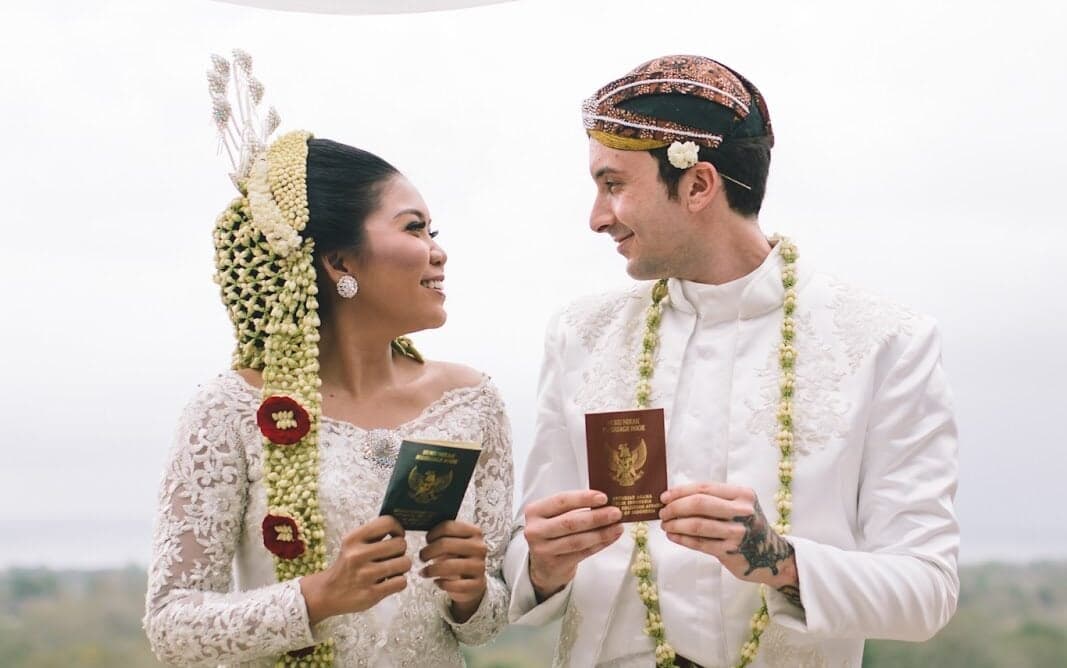
There is no single Indonesian wedding. Each community and faith marks a marriage in its own way. Wedded Wonderland ties ten of these customs to the groups its sources name. If you are drawn to Bali, the last part covers what makes a wedding there legal.
Indonesia is home to many ethnic groups and several faiths, so customs differ from island to island and from family to family. A ritual described here belongs to the community named beside it. It is not a national template.
The Australian Embassy lists the religions the Indonesian Government recognises for marriage as including Islam, Hinduism, Buddhism and Christianity. Faith and ethnicity overlap, which is why a Javanese Muslim wedding can hold both a Javanese bath and an Islamic vow.
What follows takes ten of those customs and ties each one only to the group its sources name:
Siraman: the Javanese flower bath before the wedding.
Midodareni: the Javanese night before the core rites.
Akad nikah: the vow at the heart of a Muslim wedding.
Panggih: the Javanese meeting of bride and groom.
Pawiwahan and purification: the Balinese Hindu wedding rite.
Balinese dances: which genres suit a reception.
Kebaya and batik: what is worn on the day.
Suntiang: the Minangkabau bridal headdress.
Ulos: the woven cloth of the Batak.
Uang panai and mappacci: Bugis and Makassar customs before the wedding.
Some details are recorded by a royal palace, a university journal or UNESCO. Others are simply often told, and we say so. For the wider picture, start with our guide to wedding traditions worth keeping.
The clearest account of the Javanese sequence comes from the Kraton Yogyakarta, the palace in Yogyakarta, describing its own royal weddings. Read it as the palace's account of a court ceremony, simplified over time, rather than a rulebook for every Javanese family.
The palace notes that Javanese marriage has three stages, before, during and after the wedding, and that marriage stands with birth and death as one of life's three key passages. The palace adds that in Javanese tradition the wedding is hosted by the bride's side.
Siraman is a ritual bath for both bride and groom, meant to cleanse them outwardly and inwardly. In the palace account it is given by the bride's mother, the future mother-in-law and senior relatives as a blessing, and the couple are bathed at separate times and places, the bride first.
At court, the bride's water is drawn from seven springs and mixed with flowers. That is royal practice, not a rule. Sundanese families in West Java are often said to hold a siraman of their own.
For a destination weekend, the practical point is timing. Siraman falls before the core rites, so elders who pour the water need to arrive a day or two early; plan their flights and rooms around it.

After the bath, the bride is dressed and made up. In the palace account this begins with shaving the fine hairs at the forehead and nape, the step known as ngerik, to shape the outline of the paes ageng bridal makeup. Allow a long, unhurried block for it.
Midodareni is held on the night before the core rites. Its name comes from bidadari, a heavenly nymph, carrying the hope that the bride will match one in beauty, and nymphs are believed to descend near midnight. The palace links the custom to the story of Jaka Tarub and Nawangsih.
It is often told that the groom's family visits the bride's home that evening, while the bride herself stays out of sight.
For Muslim couples, the akad nikah is the core rite that makes them husband and wife, and it is where the ijab qobul vow is spoken. In the palace's royal version it takes place in the palace mosque, Masjid Panepen, and the Sultan himself marries off his daughter.
Panggih is the meeting of bride and groom once they are legally married. In the palace account they take turns throwing rolled betel leaves (gantal) at each other, the groom first; then the bride washes the groom's feet and an egg is broken. It is often told that the groom steps on the egg.
It is often told, too, that the bride's parents walk the couple forward wrapped in a sindur cloth. Afterwards, in the palace account, come tampa kaya, where the groom pours coins and grains for the bride as a sign of his duty to provide, and dhahar klimah, a shared meal in which he forms rice into three portions for her.
In some Javanese weddings a master of ceremonies narrates panggih in poetic Javanese. A 2021 study in the journal Widyaparwa traced the similes and metaphors of beauty and good wishes in this narration, in the Surakarta style.
There is more on each stage in our piece on Javanese wedding rituals in more depth.
Islam is the faith of many Indonesian couples across many ethnic groups, so the akad nikah is not tied to one region. The vow is the heart of it: the ijab, the offer, and the qobul, the acceptance.
Indonesia sets out Islamic marriage law in the Kompilasi Hukum Islam, whose first book covers marriage and which a 1991 Presidential Instruction asked the religious affairs ministry to disseminate. The detailed requirements are best explained by the officiant, so ask the family's imam or the local office rather than relying on a list online.
Muslim weddings are performed by the Office of Religious Affairs (KUA), which issues the marriage book, the Buku Nikah. For how the ceremony runs elsewhere, see what happens at a nikah ceremony.
Bali's Hindu weddings are religious rites first and celebrations second. The account below comes from an academic study of the pawiwahan, and practice differs between villages and families.

Pawiwahan is the Hindu wedding ceremony; the word comes from the Sanskrit wiwaha, a wedding celebration. It is a sacred rite that binds a man and woman as husband and wife through purification of body and spirit, and it has three witnesses: the purification rite itself, the gods at the family shrine, and the village officials, family and guests.
The study sets out the order: an auspicious day chosen by the Balinese calendar, the bride's preparation (ngekeb), the groom's family collecting her, a knock at her door with songs (mungkah lawang), a welcome at the groom's home, then purification and the formal rites.
The purification, mekala-kalaan or mabyakala, is led by the ceremony leader after prayer. Bamboo is burned until it cracks and the couple step over it three times, touch a raw egg with their toes and are sprinkled with holy water. At the end they break a white thread to mark the start of married life.
In the common form, a high priest leads the mewidhi widana and the couple then pray at the groom's family shrine, telling the ancestors that someone new has joined. At her own family shrine, the bride takes leave of her ancestors.
None of this is a show for guests. If a Balinese family invites you, follow the priest and the family, dress as they ask and keep cameras down unless told otherwise.
UNESCO lists the three genres of traditional dance in Bali, inscribed in 2015: sacred, semi-sacred, and dance meant for enjoyment by communities at large, all accompanied by gamelan. UNESCO does not discuss weddings; it says the dances carry particular traditions, customs and religious values.
For a reception, ask the troupe which dances are performed for audiences, and leave sacred dances to the temple.
Batik has the firmest wedding link of any Indonesian textile. UNESCO inscribed Indonesian batik in 2009, and its own description says special varieties are part of celebrations of marriage and pregnancy, with batik present from baby slings to funerary cloth.
The craft is drawn by hand on cotton or silk in dots and lines of hot wax, which resists the dye, and it is often handed down within families. Particular motifs are often said to suit a wedding, and the meanings told about each one vary by region.
The kebaya is on UNESCO's list too, as a joint 2024 inscription shared by Brunei Darussalam, Indonesia, Malaysia, Singapore and Thailand. UNESCO describes it as a front-opening top, often embroidered and fastened with brooches or buttons, worn with a matching sarong. Its listing speaks of casual and formal events, social gatherings and festivals, and does not mention weddings.

Outside Java and Bali, the customs below are drawn from journal abstracts and a student thesis, each studying particular communities. Treat them as a starting point for questions to a family, not a full account.
The suntiang is a gold-coloured, many-tiered headdress worn by the Minangkabau bride, the anak daro, and one of the most important parts of wedding dress in West Sumatra. It forms a half-circle of ornaments drawn from flowers and animals, from roses and bananas to peacocks, butterflies and fish.
Older pieces were made of gold, silver and copper, and many are now lighter coated aluminium. It is heavy, and a 2019 study in the journal Gorga reads its weight as a symbol of the responsibility a Minangkabau woman carries in marriage. Styles and names vary by area, such as the suntiang gadang of Padang Pariaman.
Malam bainai, a henna night for the bride before the wedding, is often told as part of Minangkabau celebrations.

Ulos is the woven cloth of the Batak of North Sumatra; the word means blanket. Giving it is called mangulosi: the cloth is placed on the recipient's shoulders by someone of higher standing as a sign of blessing. It is also given at births and at times of mourning.
In Batak customary weddings there is a mangulosi stage for the couple, and informants in one study said a couple is considered married in adat once it is done. Among the Toba Batak, a law journal places it near the end of a long sequence, after the blessing, with the type of cloth following each giver's place in the family.
Among Bugis and Makassar families, uang panai is a gift from the groom's side to the bride's family. A 2020 thesis studying one Bugis-Makassar community in Bontang, East Kalimantan, found it is separate from the Islamic mahar, pays for the wedding celebration and shows respect to the bride's family. In adat it is treated as an obligation, and what is given is agreed between the two families.
Mappacci, a henna night with blessings from elders on the eve of the wedding, is often told as a Bugis and Makassar custom.
This section reflects official guidance as at November 2026. It is general information, not legal advice, and rules can vary by province.
Religion. The Australian Embassy guidance on marrying in Indonesia says that, under Indonesian Law No. 1 of 1974 as the Embassy summarises it, both partners must hold the same religion, and if not, one must convert. A marriage must be conducted according to that religion and meet the laws of both partners' countries.
If you do not share a religion, ask the embassy what that means for you before you plan. One option to check with them is a legal marriage in Australia and a celebration in Bali.
Certificate of No Impediment. An Australian marrying in Indonesia needs a Certificate of No Impediment to Marriage (CNI) from the Embassy in Jakarta or a Consulate-General; the Consulate-General in Bali covers Bali, NTB and NTT. Registries do not normally accept a CNI issued more than three months earlier, so time it carefully. You cannot marry at the Embassy or a Consulate-General.
Who marries you. Muslim couples marry through the KUA. For other faiths, including Hindu and Christian weddings, you give the Civil Registry notice of intention to marry at least 10 days before, and after the ceremony the marriage must be registered there to be legal. On the Embassy's guidance, a ceremony that is not registered is not a legal marriage, so treat a blessing on its own as a celebration only.
Back home. A marriage legally performed overseas that would have been legal in Australia is generally recognised here, but you cannot register it in Australia. Smartraveller suggests talking to a lawyer to confirm validity. We cover this further in registering an overseas marriage at home.
What to check. Same-sex marriage and fees are not set out on the pages we read, and the Embassy says document requirements vary by province. Check with the embassy and the registry, including any fees, before you set a date.
Travel. Smartraveller advice for Indonesia (updated 21 October 2026) is to exercise a high degree of caution overall, and to reconsider your need to travel to Papua Pegunungan and Papua Tengah. Bali is outside those areas, and we suggest only places outside them. Indonesia's revised criminal code includes penalties for cohabitation and sex outside marriage, which Smartraveller describes as complaint-based. Aceh applies Sharia law. Read Smartraveller's local laws section before you travel, and share it with your guests.
Older guests. Does everyone know that the Australian Consulate-General in Bali is the mission that covers the island? Have you shared Indonesia's emergency numbers as Smartraveller lists them, including 118 for an ambulance and 110 or 112 for police? And have older guests read Smartraveller's health and local laws advice for Indonesia before they commit?
For the destination itself, see our notes on planning a wedding in Bali. The paperwork stays with you, the registry and the embassy; a Wedded Advisor can be your single point of contact for the rest of the plan, with the fee agreed in writing before any work begins and the inclusions confirmed in writing before you commit. When you are ready, speak with a Wedded Advisor.
These customs belong to living communities, not to a styling menu. A few simple habits help you include them with respect, whether you are marrying into an Indonesian family or borrowing a custom with its blessing.
If one of you is Indonesian or Indonesian-Australian, the right version of a custom is your family's version. Ask parents and elders which rites matter and who should lead them.
A Balinese purification belongs with a priest, an akad nikah with an imam or the KUA. Book local practitioners, and do not stage a sacred rite as entertainment.
Wear batik or a kebaya because you were invited to, and leave the suntiang, paes makeup or a family's ulos to the people they belong to unless that family offers.
A short note in the order of service on siraman, panggih or mangulosi helps guests follow each step.
Indonesian weddings are not one tradition but many, each held by a particular community and faith. Honour them by asking the family first, keeping sacred rites with those who hold them, and checking every legal step with the embassy and the registry. When you are ready to plan, you can also see the destination wedding packages.
Written by

SEO Specialist
Ayrton Christian Braga is an SEO Specialist at Wedded Wonderland, where he writes optimized articles and web pages that center on destination weddings, cultural wedding traditions, and guides for everything in between.
Search real weddings, venues and vendors from around the world.
Search Wedded Wonderland