An Italy wedding package bundles the venue, planning, ceremony, and core vendors into a single quoted price. For a villa or estate wedding of 40 to 80 guests, published pricing for 2027 dates typically sits between €15,000 and €30,000 before guest accommodation and extras, with planner-led and luxury tiers running well above that. The catch is that no two providers define “package” the same way, and the difference between a good deal and an expensive one usually sits in the inclusions list rather than the headline figure.
This guide explains how Italy wedding packages are structured, what is normally included, what is almost never included, what to expect to pay, and how to compare two offers properly. It is written independently of any single venue or planner, so you can take it to whichever provider you are considering.
The word “package” covers three different business models in Italy, and knowing which one you are looking at explains most of the differences in price and flexibility.

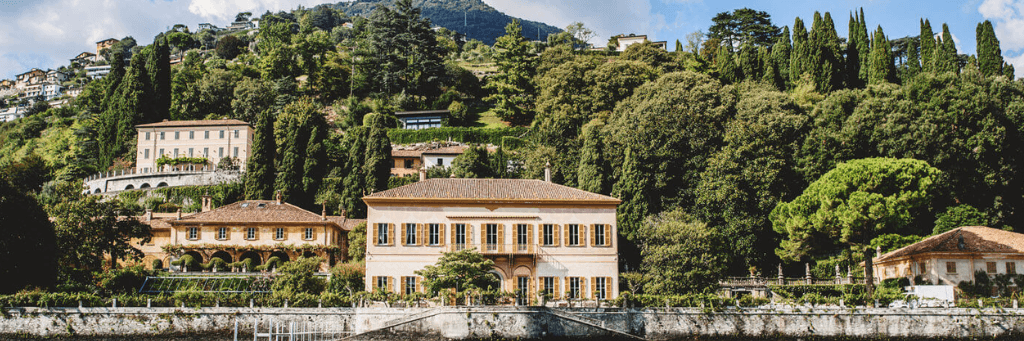
A villa, hotel, or estate sells its own bundle: the space, in-house catering, and a set of preferred vendors. These are the most common packages in Tuscany and Umbria and the ones most couples picture when they search.
You usually take exclusive use of the property for two or three nights, pricing is tight, the venue’s coordinator manages the day, and you are buying that venue’s suppliers and that venue’s way of doing things. Guest counts run from 40 to around 120 depending on the property, and the wedding package is almost always priced separately from the rooms.
Romantic Italian Weddings, an Umbria operator with two villas near Lake Trasimeno, is a useful example. Its Classic, Charming and Luxury tiers are published for 2027 at roughly €17,000 to €29,000 depending on villa and tier, designed around 40 guests, with VAT and legal fees included and guest accommodation priced separately. The upper tier bundles photography, video, hair and makeup, a five-hour open bar and seven nights in the wedding suite, which shows that a well-specified venue-owned package can be more comprehensive than the label suggests.

An Italian wedding planner assembles a package around partner venues in a given region.
The planner is the contract holder and manages every vendor: venue sourcing, ceremony, reception, flowers, photography and video, music, beauty, and on-the-day management, presented as a single price for a stated guest number. These are more flexible on venue and style, usually offer a bespoke upgrade path, and tend to start from roughly €35,000 for 50 to 80 guests. They suit couples planning from overseas with limited time, and couples who want a professional managing every supplier rather than a venue coordinator managing the venue’s own.
The watch-out is substitution: some packages reserve the right to swap named vendors for equivalents.

A tour operator, often based in the United States or Australia, packages the wedding together with flights, hotel blocks, and group transfers for guests.
The wedding itself is subcontracted to an Italian planner and is normally a modest ceremony-and-reception bundle; the operator’s value is in moving a group of 20 to 60 people in and out of Italy. Perillo Tours, for example, tiers its Italy offer from a ceremony with a short photography session, through ceremony plus reception dinner, up to an all-inclusive tier that adds live music, video and bridal makeup, alongside its custom travel arrangements. If your guests are travelling together from one city, this removes a layer of logistics you would otherwise manage yourself, and it sits naturally alongside Wedded Wonderland’s own wedding and honeymoon travel services.
The watch-out is that wedding quality depends on the subcontracted local planner, whom you may not meet until you arrive.
For roughly 10 to 30 guests, any of these providers may offer a restaurant, boutique hotel or small villa bundle with a symbolic or civil ceremony followed by a long lunch or dinner.
Photography is often capped at four to six hours and music is typically a single musician. These are the easiest packages to budget because the per-head component is small, but check for minimum spend: a restaurant package may require a minimum guest count or food and beverage figure that pushes a 12-guest wedding to the same price as a 25-guest one.
Two further points apply across every model.
First, “all-inclusive” in Italy does not mean what it means at a Caribbean resort. There is no model where you check in and everything from the ceremony to the bar is on one bill. An Italian all-inclusive package is a coordinated bundle of separate vendors presented as one price. Venue-owned and planner-led providers both use the term, and the €35,000 figure above is a planner-led convention, not a floor for the label.
Second, almost every Italian package is priced as a base fee plus a per-guest rate. The base fee covers the venue, planning, and fixed items like ceremony setup and photography. The per-guest rate covers catering, drinks, seating, and often transport. Packages are quoted for a set guest number (40, 50, or 80 are common), with a per-head charge for each guest above that and, importantly, no reduction if you come in below it.
The table below sets out the line items you will see across most Italy wedding packages, with a note on how often each is actually included. Items that are usually add-ons are priced in the next section.
Category | Item | Typically |
|---|---|---|
Planning | Planner consultations (a set number of hours or calls) | Usually included |
On-the-day coordinator | Usually included | |
Full vendor sourcing and management | Standard in planner-led, limited in venue-owned | |
Ceremony | Ceremony setup (chairs, arch or structure, aisle) | Usually included |
Celebrant for a symbolic ceremony | Usually included | |
Town hall booking, civil fee, interpreter, document handling | Booking usually included; fees and documents see costs below | |
Venue | Exclusive use of the venue on the wedding day | Usually included |
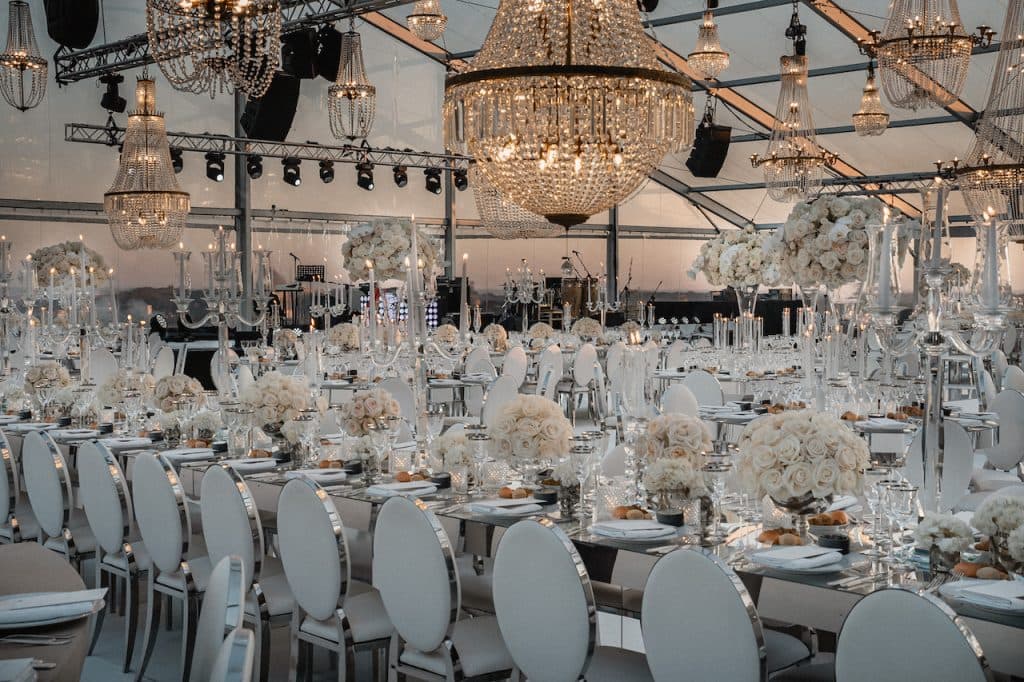
Tables, chairs, linens, tableware, basic lighting | Usually included | |
Reception until midnight or 1am | Usually included; extra hours see costs below | |
Food and drink | Aperitivo with canapés, seated multi-course dinner | Usually included |
House wine and water with dinner, prosecco toast, wedding cake | Usually included | |
Open bar after dinner | Upper tiers only; otherwise see costs below | |
Flowers | Bridal bouquet, boutonniere, ceremony arrangement | Usually included |
Table centrepieces and styling concept | Basic included, upgrades extra | |
Photo and video | Photographer (6 to 10 hours) with edited gallery | Usually included |
Videographer and highlight film | Standard in upper tiers | |
Music | Ceremony musician, sound system and microphones | Usually included |
DJ | Sometimes | |
Live band | Usually an add-on | |
Beauty | Hair and makeup on the day | Standard in upper tiers |
Hair and makeup trial | Usually an add-on | |
Accommodation | Wedding night suite for the couple | Usually included (one to seven nights) |
Guest rooms | Priced per night, see costs below | |
Transport | Shuttle between ceremony and reception | Sometimes |
Airport and hotel transfers for guests | See costs below |
If a quote does not state an item explicitly, treat it as excluded. Italian providers are precise about what they list, and the gaps are rarely accidental. On beauty, decide early whether you want a trial, since the logistics change if you are flying in a few days before the wedding. Wedded Wonderland’s guide to bridal hair and makeup trials covers that decision.
This is the section most package pages skip, and it is where budgets go wrong. Price these separately before comparing offers.
Legal fees and documents: Town hall fees, sworn translations, apostilles and consular declarations for a legally binding marriage are rarely bundled. Budget €250 to €900 for the town hall fee (more in the showpiece halls of Florence, Rome or Venice), plus €300 to €1,000 for translations and document handling depending on nationality.
Guest flights and accommodation: Unless you are buying a travel-bundled package, guest travel is your guests’ responsibility or yours. Villa rooms are priced per night, and if a villa requires you to book every room, the accommodation line for three nights across 20 rooms can rival the wedding package itself.
Extra reception hours: Most packages end at midnight or 1am. Expect €500 to €1,500 per extra hour at a private villa, which may trigger extra staffing and noise-permit costs, and check whether there is a hard curfew that cannot be extended at any price.
Premium bar and late-night food: House wine with dinner is standard; an open bar after dinner usually is not outside upper tiers. Planners commonly quote around €12 per guest per hour, or a flat €50 to €100 per guest for the evening. A pizza station or midnight snack adds €15 to €30 per guest.
Welcome dinner and next-day brunch: Multi-day villa weddings almost always involve both. Each is a separate event at roughly €60 to €120 per guest.
Guest transport from airports and hotels: Coach hire runs €400 to €900 per transfer depending on distance.
Gratuities: Not customary at US levels, but budget modestly for key staff rather than ignoring it.
VAT: Italy’s standard rate is 22 percent. Published villa packages often include it; planner quotes often exclude it or apply it to some line items only. Always ask, in writing, whether the quoted price includes VAT. A €20,000 package quoted before VAT is a €24,400 package.
Payment timing and currency: Expect a deposit of 20 to 30 percent to secure the date, instalments, and a final payment four to eight weeks before the wedding, all in euros. Couples budgeting in US or Australian dollars should allow for currency movement between booking and final payment.
The ranges below reflect published pricing for 2027 dates and current Italian planner cost guides. They exclude guest accommodation and travel.
Package type | Guests | Low | Typical | High |
|---|---|---|---|---|
Intimate (restaurant or small villa) | 10 to 30 | €8,000 | €15,000 | €30,000 |
Venue-owned villa and estate (event only, rooms extra) | 40 to 80 | €15,000 | €25,000 | €50,000 |
Planner-led all-inclusive | 50 to 100 | €35,000 | €60,000 | €120,000+ |
Travel-bundled (wedding portion) | 20 to 60 | €5,000 | €12,000 | €25,000 |
Once you add accommodation, welcome events and extras, a high-quality wedding of 80 to 100 guests in Tuscany runs well into six figures. Packages sit at the lower end of that range because they trade customisation for efficiency.
There are several factors capable of moving the price of any given Italy wedding package:
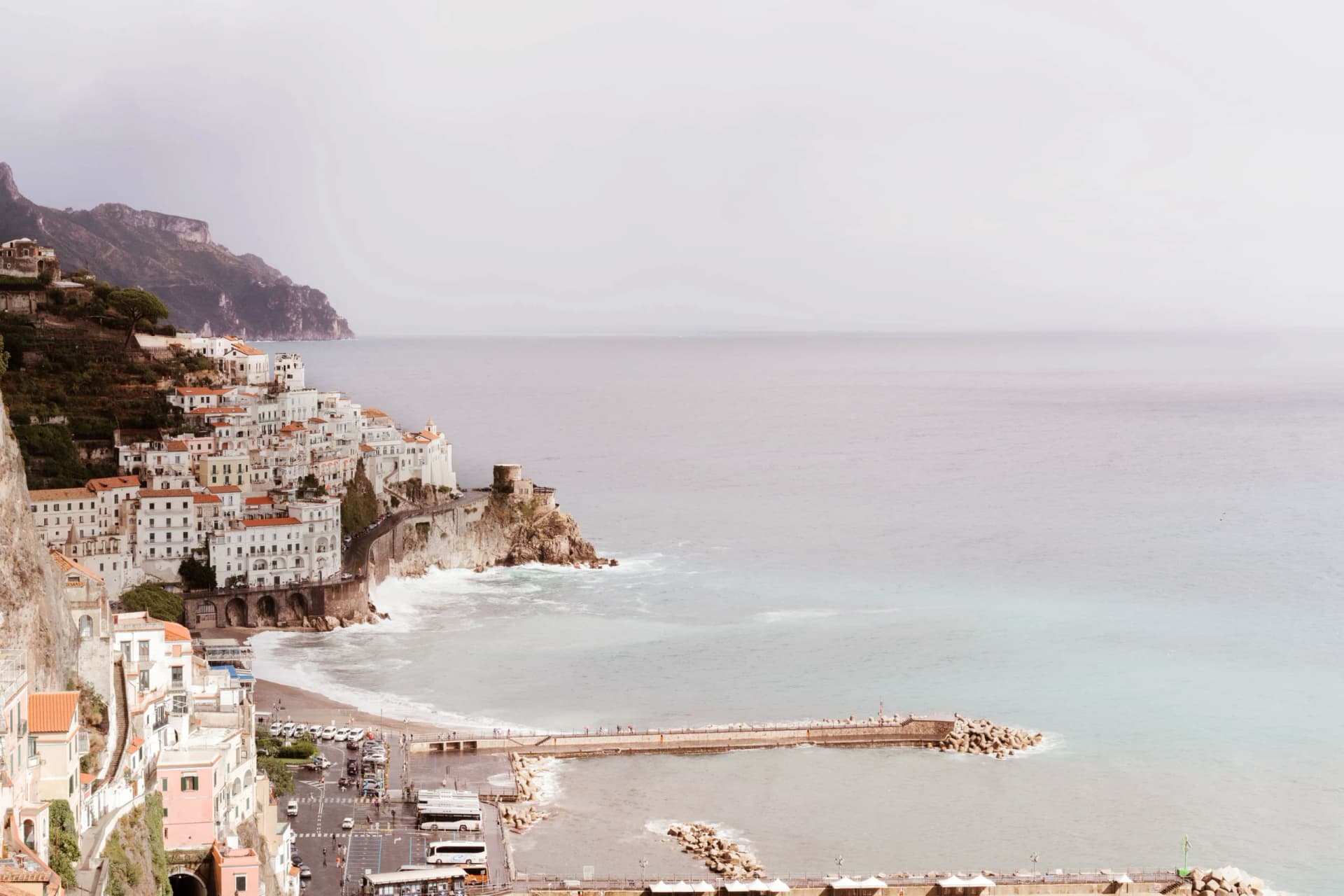
Region: The Amalfi Coast and Lake Como command the highest venue fees; Tuscany and Umbria sit in the middle; Puglia, Sicily and inland regions are the most accessible. The same specification can vary by 30 to 50 percent between the Amalfi Coast and Puglia.
Season: May, June, September and early October are peak. July and August are hot and some venues discount slightly; April and late October are shoulder season with real savings but weather risk. Winter can be 20 to 40 percent cheaper but many villas close.
Guest count: The per-head rate is the largest variable. Catering alone runs from €110 to €150 per guest at the accessible end, €150 to €220 for a strong destination-wedding standard, and €220 to €300 or more for premium service. Every additional guest moves the total by that much plus drinks, seating and transport.
Exclusive use: Taking the whole property for the weekend costs far more than a single-day hire. A full borgo for 60 to 80 guests over three nights in Tuscany is commonly quoted in the high twenties of thousands of euros before the event fee, which adds several thousand more.
Day of the week: Saturday is standard. Friday or Sunday can reduce the venue component by 10 to 20 percent at properties that offer it.
Couples often assume a package saves money on the venue. It rarely does. Venue fees are fairly fixed, and a package venue charges roughly what it would charge a bespoke client.
The savings come from two places. The first is the planner fee: a full-service Italian planner charges €5,000 to €15,000 flat, or 10 to 15 percent of the budget, and a package folds most of that into the bundle at a lower effective rate because the planner is running a repeatable event. The second is vendor pricing: package providers negotiate volume rates with photographers, florists and caterers that an individual couple cannot match.
Against that, a package limits your choices. Packages win when your guest count is under about 80, the standard inclusions already match what you want, you are planning from overseas with limited time, and you need the cost locked at booking. Bespoke wins above 80 guests, where package per-head rates often exceed what a planner can negotiate for a large event, and whenever you have strong preferences for specific vendors, want a multi-day event across more than one venue, or want an unusual venue that does not sell packages.
Many couples take the middle path: a package as the base with three or four selective upgrades, such as a better photographer, a live band instead of a DJ, or a floral designer rather than standard arrangements. Most providers support this, and it usually lands at a lower total than full bespoke planning.
Legally binding, performed by the mayor or a registrar at a town hall or authorised civil venue, in Italian, with two witnesses present and an interpreter if either of you does not speak the language. A declaration of intent is signed at the town hall before the wedding, which usually means arriving in Italy a few days early. Most non-EU citizens need a Nulla Osta or equivalent sworn declaration confirming they are free to marry; for US citizens this is signed at the US consulate in Italy and legalised at the local Prefettura. US citizens also need an Atto Notorio, a sworn statement made with witnesses at an Italian consulate in the United States or at an Italian court, which is valid for six months and so cannot be done earlier than that. Packages typically include booking and coordination of the civil ceremony; the fees and document preparation are usually yours, though many planners handle documents for an additional charge.
Catholic weddings in Italy are legally recognised, so no separate civil ceremony is needed, but the paperwork runs through your home parish and diocese and takes several months. Other religious ceremonies usually need a civil ceremony alongside them. Few standard packages include religious coordination by default; it is normally a tailored addition.
Not legally binding, which is exactly why most packages default to it. You complete the legal marriage at home and the Italian ceremony can be held anywhere, officiated by anyone, and written entirely to your preference. No paperwork, no interpreter, no town hall schedule. For most couples buying a package, this is the practical choice.
Two packages are almost never directly comparable on their headline prices. Use this method to put them on an equal footing:
Normalise to your actual guest count: Add the per-head rate for every guest above the number the base price covers.
Add back the exclusions: Price each item you want that is not included, and add VAT if the quote excludes it.
Check coverage hours: Six hours of photography and ten are different products; the same applies to reception end times and planner hours.
Compare the planner’s role: A venue coordinator managing the venue’s own suppliers is not the same as a dedicated planner managing every vendor for a year.
Then divide by guest count: A per-guest figure for the complete, normalised package is the only number worth comparing.
Two villa packages for a 50-guest wedding in Tuscany.
Package A: €16,000. Covers 40 guests, €130 per additional guest. Six hours of photography, no video. House wine with dinner, no open bar. Venue coordinator on the day. Two nights for the couple. VAT included.
Package B: €22,000. Covers 50 guests. Ten hours of photography plus a highlight film. Four-hour open bar. DJ. Dedicated planner for the full engagement and on the day. Three nights for the couple. VAT included.
Normalising Package A for 50 guests and the inclusions in Package B:
Item | Package A | Package B |
|---|---|---|
Base price | €16,000 | €22,000 |
10 extra guests at €130 | €1,300 | included |
Open bar, 50 guests at €60 | €3,000 | included |
Four extra photography hours plus video | €2,200 | included |
DJ | €900 | included |
Third night for the couple | €350 | included |
Normalised total | €23,750 | €22,000 |
Per guest | €475 | €440 |
Package B is cheaper once the two are brought to the same specification, and it includes a full planner rather than a venue coordinator. Package A was never the better deal; it was the lower headline.
Written so you can paste them into an enquiry email.
Can you send the full inclusions list in writing, with the guest count the price is based on and the per-guest rate above that number?
Does the quoted price include VAT, and if not, which items does VAT apply to?
If my guest count comes in below the package number, is the price reduced?
Which vendors in the package are named, and do you reserve the right to substitute them?
What is the reception end time, what does each extra hour cost, and is there a hard curfew?
What is the deposit, the payment schedule, and the cancellation and postponement policy?
What is the wet weather plan, and is there an extra cost to activate it?
Are the photographs on your website from this package tier, or from upgraded or bespoke weddings?
Regional planners based in the area you are considering are the most flexible route if you have not settled on a venue, since local relationships drive both pricing and problem-solving. Venues direct give the tightest pricing for that property but no comparison across venues.
On Wedded Wonderland, browse all-inclusive destination wedding packages across Italy and other destinations, or use the venue directory and vendor directory. If you want a shortlist built for you, Wonderland Concierge matches couples with vetted planners and venues based on budget, guest count and style.
How to vet a provider. Check Google and wedding-directory reviews for the last two years specifically, look for real wedding galleries with credited photographers rather than stock imagery, confirm how long they have operated, and ask for their VAT registration number (partita IVA), which any legitimate Italian business will provide without hesitation. A provider who is vague on any of these is a provider to pass on.
The decision rule is simple: if the standard inclusions already cover most of what you want, a package will save you both money and months of planning. Either way, decide on your guest count and your must-have vendors first, since those two choices drive every other number.
To take the next step, Wedded Wonderland’s destination wedding quiz can help you confirm whether Italy is the right fit, and the regional guides to Tuscany, the Amalfi Coast and Lake Como, along with the Italy destination hub, cover venue styles and timing by region. The free destination wedding guide covers the planning timeline from engagement to departure, and once the wedding is booked, the honeymoon packages page is the natural place to plan what comes after.
Written by

SEO Specialist
Ayrton Christian Braga is an SEO Specialist at Wedded Wonderland, where he writes optimized articles and web pages that center on destination weddings, cultural wedding traditions, and guides for everything in between.