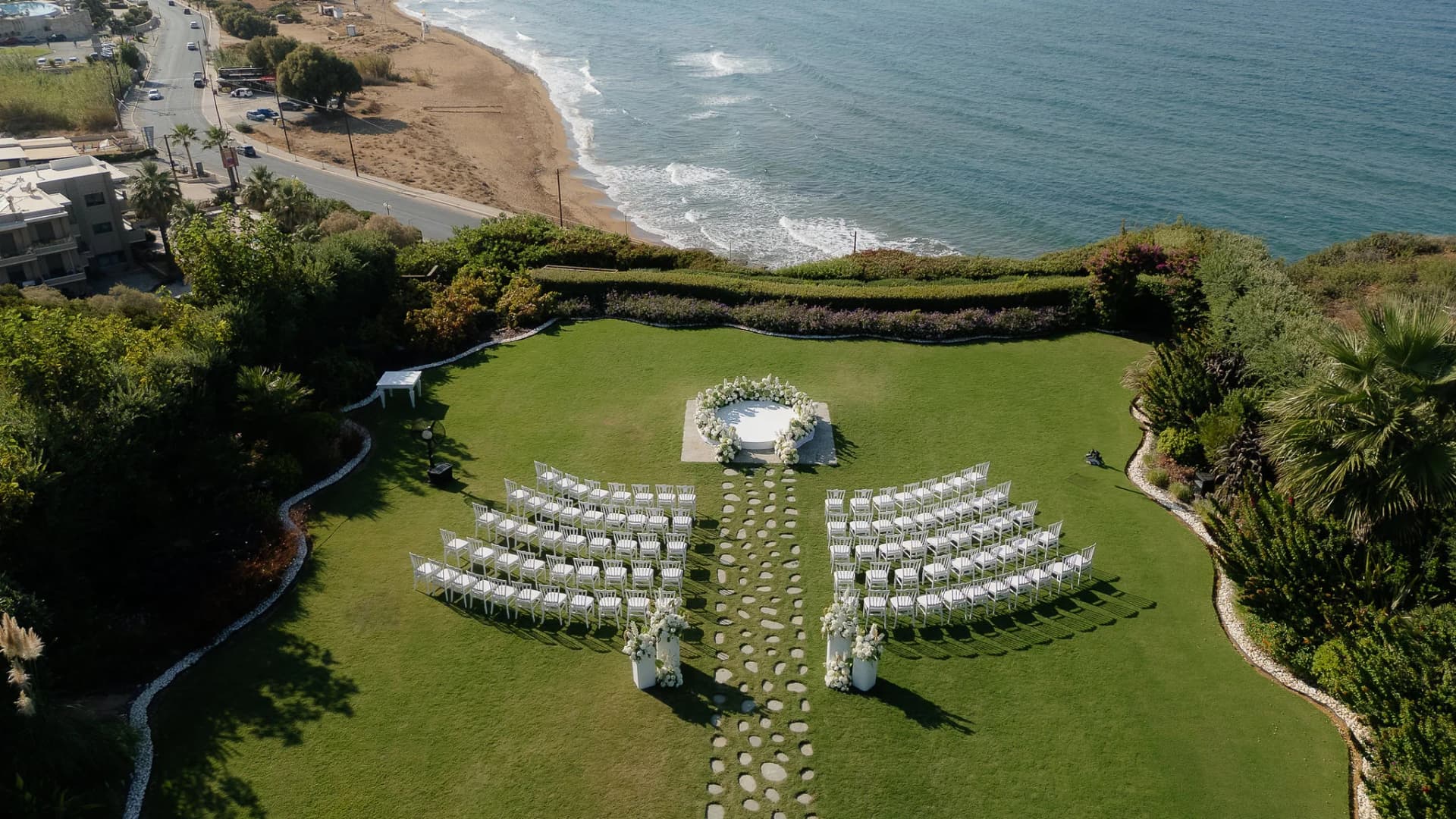
A legal wedding in Greece starts with a Greece marriage licence, or a document from home that can stand in for one. Gov.gr says the licence takes eight days, but that timeline belongs to couples who live in Greece. If you live in Australia, your route may look quite different. Wedded Wonderland explains the licence, the documents and the wait as you plan your wedding in Greece.
Greek law requires a licence from the mayor of each partner's last place of residence before a civil wedding or a wedding in the Greek Orthodox Church, says the gov.gr civil licence entry. For foreign nationals who live in Greece, the foreign-resident licence is issued by their municipality, costs EUR 18 (about AUD 29, 12 November 2026) and is valid for six months. Town halls apply national rules in their own way, so confirm each requirement for your own passports with your town hall, DFAT and the Australian Embassy in Athens (sources checked 12 November 2026).

If you live in Australia, that changes the picture. A 4 January 2019 Interior Ministry circular indicates that a foreign document confirming you are free to marry can stand in for the licence when it also names the person you are marrying.
Australia's version is a Certificate of No Impediment to Marriage (CNI) from DFAT. The Australian Embassy in Athens says Greek municipal and religious bodies both require it. The open question is whether your CNI names your partner, so confirm that with DFAT and your town hall before you plan around the shorter route.
Two town halls on Crete publish lists for couples living abroad that fit this approach. Chania asks foreigners living abroad for their own country's licence naming the other partner, and will not accept one that leaves the partner out. Heraklion asks non-residents for a home-country licence, translated and apostilled. Neither list mentions a Greek licence, a newspaper notice or a week's wait.
The Municipality of Athens publishes a route only for its residents and for Greek citizens registered there, and we could not find an official page for Santorini (Thira) or Mykonos.
Here is how the three ways to marry in Greece compare.
Route | Legal in Greece? | What you need | Worth knowing |
|---|---|---|---|
Civil | Yes | Mayor's licence, or for couples living abroad a foreign certificate naming your partner, where the town hall accepts it | Open to same-sex couples under Law 5089/2024 |
Greek Orthodox | Yes | The same licence or its equivalent, plus the church's own requirements | Ask the parish priest early |
Symbolic | No | Nothing legal in Greece; marry legally in Australia first | Full freedom of venue and wording |
Yes, on one official page. The gov.gr civil licence entry, updated 5 November 2026, lists a completion deadline of eight days: a seven-day wait for objections, then one day to grant the licence. The foreign-resident entry describes the same one-week wait with the licence granted straight after it, and Athens says its licence is issued seven days after your documents are submitted and verified.
What starts the clock matters most. The week runs from the day the town hall accepts a complete application. Staff first check that every document is there and that your newspaper notice has been published; only then is your file given a protocol number, its official reference. If anything is missing, the file is returned with instructions and the process starts again.
If a third party lodges a written objection, the mayor invites you to answer it and decides after hearing you, and if you do not marry within six months of the newspaper notice, the notice must be published again. For couples living abroad, the Chania and Heraklion lists show no Greek licence and so no week to wait. If your town hall does run the licence for you, count eight days from the day your complete file is accepted, never from the day you land.
For the residents' licence, gov.gr says documents from Hague Convention countries such as Australia are accepted only with an apostille (the Hague Convention certificate one member country uses to accept another's documents) and a Greek translation. Ask your town hall which of your documents need one.

Document | Issued by | Apostille | Greek translation | Notes |
|---|---|---|---|---|
CNI | DFAT: Passport Offices, missions overseas or by mail | Ask your town hall whether it wants one | Yes | AUD 181 per CNI (2026 fee); the Embassy says each non-Greek partner needs one |
Birth certificate | Your state or territory BDM registry | DFAT, AUD 105 (2026 fee) | Yes | Athens wants documents issued within the last six months; Chania says "recent" |
Divorce certificate or former partner's death certificate | The court or BDM registry | DFAT, AUD 105 (2026 fee) | Yes | Only if you were married before |
Passport | Australian Passport Office | Ask your town hall | Ask your town hall | Proof you are lawfully in Greece; Heraklion's list also mentions a residence permit or visa, so ask |
At least one of you must be an Australian citizen or permanent resident. You sign the application in front of an authorised witness, such as a Justice of the Peace, and apply by mail or in person, paying DFAT's fee when you submit. DFAT fees rise with CPI each 1 January, so a 2027 wedding will pay the 2027 rate.
The Embassy says the acceptable place of issue for a CNI "can differ significantly between organisations", and that you can lodge the application in Australia for issue in Greece. Smartraveller's CNI guide adds that DFAT cannot advise on another country's process, so settle this with your town hall, or your priest for an Orthodox wedding, before you apply.
Apostilles are booked at any Australian Passport Office, where someone can attend for you, or sent by registered post. DFAT publishes no fixed processing time and warns of delays at the end of the school year and in peak holidays, so if you are applying over an Australian summer for a June wedding, start early.
Greek town halls need your documents in Greek, and the rules on who can translate them changed in 2021. Names and spellings need just as much care, because every document has to match.
The Australian Embassy's page still says Greece accepts only translations by the Greek Foreign Ministry's Translation Section or a Greek consulate. That has changed. On 1 September 2021 the Greek Foreign Ministry replaced its in-house service, under Law 4781/2021, with a Register of Certified Translators.
You find a translator at metafraseis.services.gov.gr and contact them directly, and your documents must carry their apostille first. Today's routes are a certified translator from that register or a Greek consulate; the Chania and Heraklion lists also name a Greek lawyer and graduates of the Ionian University's translation department. No Greek official source we read mentions NAATI, the Australian accreditation, so do not assume an Australian translation will be accepted in Greece.
Heraklion writes names on the application and in the newspaper in Greek letters, and Athens also prints a foreign partner's details in Latin characters. The civil licence entry says details on the birth certificate, ID and notice must match, so check every spelling against your passport before translation.
The newspaper notice, published in a local daily, is part of the residents' licence: gov.gr, Athens and Heraklion's resident list all require it.
The licence fee is paid as an e-paravolo, an electronic fee code you pay online or at a Greek bank or post office. Wedded Wonderland Concierge can coordinate deposits, payments and currency across borders, and the free Wonderland Studio planner has a multi-currency budget for euro and Australian dollar costs.
From Australia, start in writing (Chania accepts documents by email) and keep every reply with your file. Ask:
Will you accept our CNI in place of a Greek licence, and must it name my partner?
Does the CNI need an apostille, and which other documents do?
Which translators do you accept?
Do we need a newspaper notice?
Do we need an interpreter at the ceremony?
Which ceremony days and times can we book?
How do we have the marriage certificate apostilled before we fly home?
Both routes need the mayor's licence, or its equivalent for couples living abroad, and the Embassy says religious bodies require the CNI just as town halls do.

An Orthodox wedding brings the church's own conditions, which we have not seen set out on an official church page. Speak to the parish priest and the local Metropolis (the diocese) before you book anything, and confirm the CNI's place of issue with them.
If the paperwork does not suit your timeline, marry legally in Australia and hold a symbolic ceremony in Greece; an Australian celebrant cannot legally marry you overseas.
Here is an illustration, never a promise, built on the Chania and Heraklion lists for couples living abroad.
Well before you travel: Chania wants documents early enough to be checked and signed before a date and time are set, so send them as soon as your translations are back.
On arrival: take your originals to the town hall; Chania does not accept photocopies. Bring your passports, which show you are lawfully in Greece, a condition the 2019 circular sets for every foreign couple.
Ceremony day: Heraklion asks each partner to bring an adult witness with ID (a passport for foreigners), and a witness may be a relative. Its ceremonies are held in the Municipal Council Hall, and its page lists EUR 100 (about AUD 162) for Tuesday or Thursday at 12:00 and EUR 150 (about AUD 243) for Wednesday or Friday from 18:00. The fees come from a 2007 council decision, so confirm them. With a large guest list, you might keep the legal ceremony small on the weekday and celebrate with everyone at the weekend.
After the ceremony: the marriage is registered at the registry office (lixiarcheio) of the municipality where it took place. Certificate copies are free, with a 10-day completion deadline. Digital copies need Greek tax-system log-ins, which visiting Australians may not have, so plan on asking in person.

Before you fly home, have the certificate apostilled, because the Australian Passport Office asks for foreign certificates, where it accepts them, to be legalised. Guest arrivals, rooms and the welcome dinner can sit in the same plan through our wedding and honeymoon travel service.
Smartraveller's advice on marrying overseas says that in most cases an overseas marriage is legally recognised in Australia if it was valid where it happened and would have been valid under Australian law. It is not recognised if either of you was already married, under age, too closely related or forced to marry. The rules sit in Part VA of the Marriage Act 1961, and Smartraveller suggests a lawyer if you want certainty.
You cannot register an overseas marriage in Australia: your Greek certificate is your proof. For the general steps, see what to do with a marriage certificate issued overseas.
Changing your name takes one extra step, though you can keep travelling on your current passport. For a new one in your married name, the Australian Passport Office asks an Australian-born applicant who married overseas for a change of name certificate from their state or territory registry. Some states and territories do not accept overseas certificates for a name change. NSW, for example, wants foreign documents translated in full by a NAATI-accredited translator, so in New South Wales at least, NAATI is the route for documents used at home; check your own registry.
Much of this you can do from Sydney or Melbourne: birth certificates, CNIs and DFAT apostilles. Help on the ground earns its place on the Greek side: town-hall correspondence, translations, timing appointments around your guests and the certificate's apostille before you leave.
That is the role of your concierge, who acts as your advisor through the sourcing and decision-making. Depending on your wedding, your concierge may recommend a partnered planner, or help you move forward confidently without one. You keep one point of contact, with the wedding and travel under one roof. If you are still weighing countries, see how the Italian legal process compares.
A free Discovery Call with a Wedded Wonderland advisor is a quick way to test your shortlist. To meet the team in person, see Wedded World for upcoming events.
Written by

SEO Specialist
Ayrton Christian Braga is an SEO Specialist at Wedded Wonderland, where he writes optimized articles and web pages that center on destination weddings, cultural wedding traditions, and guides for everything in between.
Search real weddings, venues and vendors from around the world.
Search Wedded Wonderland