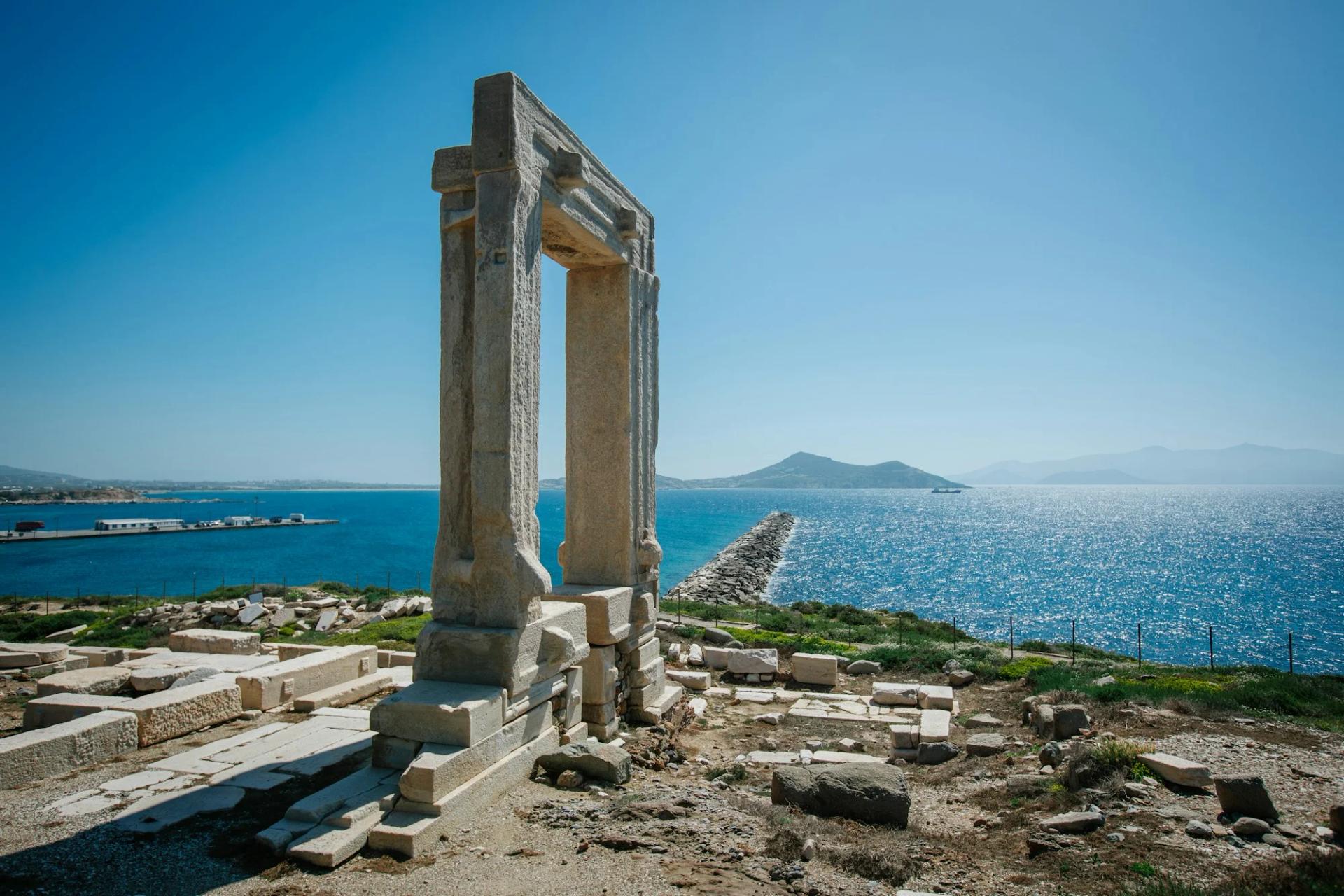
No single month suits every Greek wedding. The right one depends on your island, your guests’ heat tolerance, a church ceremony and how long everyone will stay. This Wedded Wonderland guide sets out the weather, venue seasons and Orthodox dates from April to October. Use it to narrow your shortlist to two or three months.
Figures are long-term Hellenic National Meteorological Service station averages, not forecasts, labelled by station. For the Cyclades, Naxos, at 3 metres above sea level, is the reference station for Santorini, Mykonos and Paros, so Cyclades figures are labelled Naxos. Read the “rain days” column as the average number of days in the month with rain. At Naxos, 0.4 rain days in July means a wet day is rare, not impossible.
The stations are Naxos for the Cyclades, Heraklion and Chania Souda for Crete, Rodos for Rhodes and Kerkyra for Corfu. Each cell reads average maximum temperature / average rain days.
Month | Naxos | Heraklion | Chania Souda | Rodos | Kerkyra |
|---|---|---|---|---|---|
April | 18.7°C / 6.0 | 20.1°C / 7.6 | 20.0°C / 7.7 | 20.0°C / 7.4 | n/a |
May | 22.1°C / 3.6 | 23.6°C / 4.6 | 24.5°C / 4.2 | 24.1°C / 4.4 | 24.0°C / 7.7 |
June | 25.9°C / 1.1 | 27.3°C / 1.3 | 28.9°C / 1.2 | 28.3°C / 1.1 | 28.2°C / 4.8 |
July | 27.1°C / 0.4 | 28.9°C / 0.3 | 30.7°C / 0.4 | 30.4°C / 0.2 | 31.2°C / 3.3 |
August | 27.0°C / 0.3 | 28.8°C / 0.5 | 30.4°C / 0.6 | 30.7°C / 0.1 | 31.5°C / 3.3 |
September | 25.1°C / 1.9 | 26.6°C / 2.8 | 27.4°C / 3.2 | 28.1°C / 1.7 | 27.5°C / 7.4 |
October | 21.9°C / 5.5 | 23.6°C / 7.5 | 23.5°C / 9.3 | 24.5°C / 6.5 | 23.2°C / 11.4 |
About these figures. Source: Hellenic National Meteorological Service station averages, with Kerkyra shown for May to October only.
Rodos, Heraklion and Kerkyra cover 1955 to 2010, and Chania Souda 1958 to 2010; the Naxos station page gives no data period. Heraklion sits on the north coast of Crete at 39 metres, and Chania Souda in the west at 148 metres.
The planning notes that follow from the table are simple. June to August is the dry core at every station except Kerkyra, which keeps three to five rain days a month through summer. Rodos, Chania Souda and Kerkyra all average above 30°C at the height of summer, while Naxos stays near 27°C. October brings rain back to every station, most of all at Kerkyra.
Each month below pairs the station figures with the venue and calendar checks that matter most. Read the months either side of your favourite too, since a two-week shift can change the heat, the rain and the church calendar.

April is the coolest month in this guide. Naxos averages a maximum of 18.7°C and Heraklion 20.1°C, with six to eight rain days at the Cyclades, Crete and Rhodes stations. Evenings are cool too: Naxos averages a minimum of 12.5°C and Chania Souda 11.4°C, so an outdoor dinner needs wraps, heaters or a room to move into.
Smartraveller notes that dust storms from the Sahara are increasing in frequency across Greece, particularly in spring, reducing air quality and visibility. For an April date, give the photographer a covered or indoor fallback as well as a rain plan.
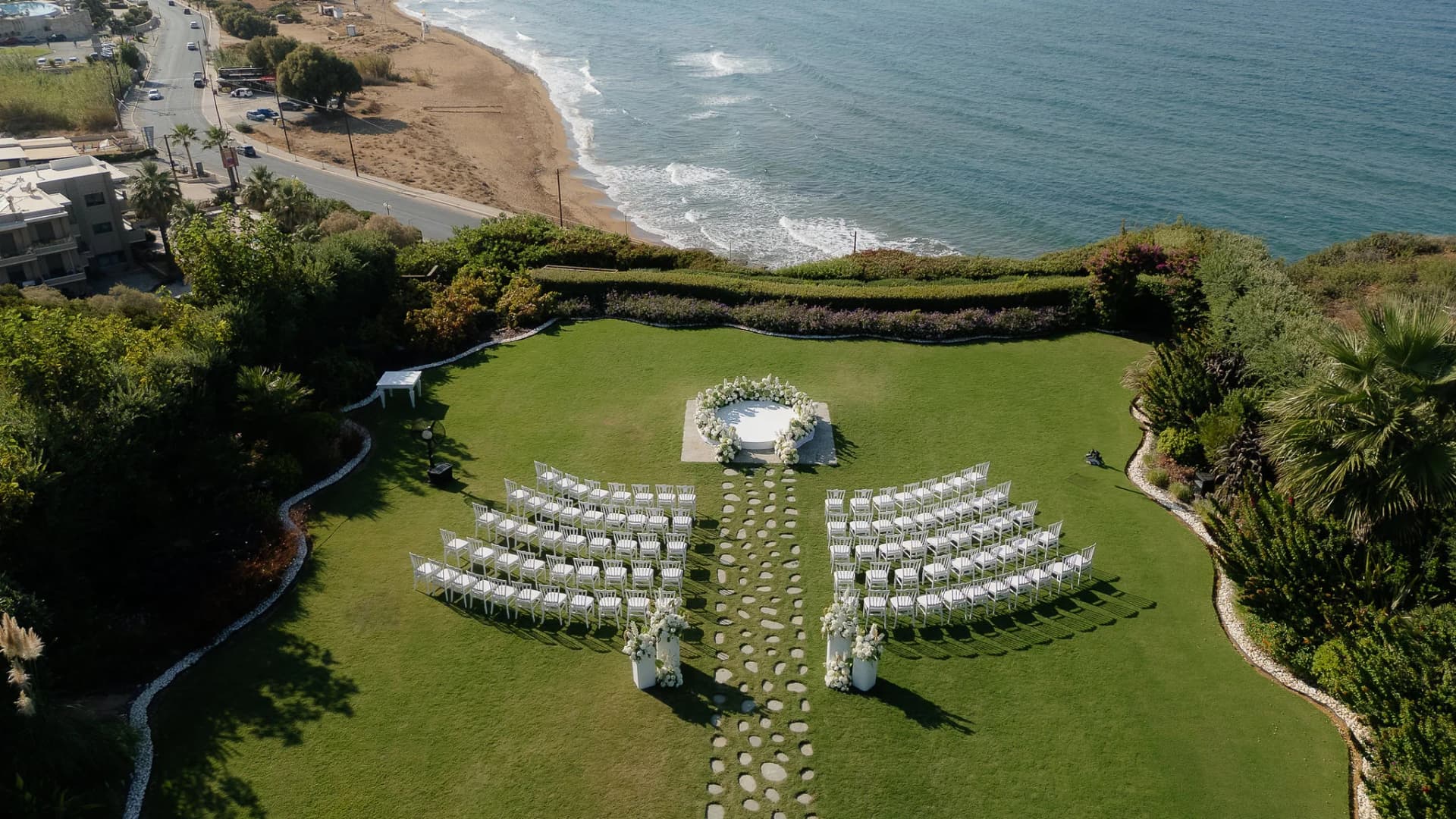
Venue windows are the other check. At Angsana Corfu, outdoor spaces open in stages: Oribu Garden takes ceremonies from April, while Vertigo Sky Bar waits until mid-May. Minos Palace describes eastern Crete as pleasant from April to November, with spring at around 18 to 24°C. For an Orthodox ceremony, check any spring date against Great Lent, which runs until Easter Sunday and is closed to weddings, with dates that vary each year.
May is when the islands warm up properly. Maximums average 22.1°C at Naxos, 24.1°C at Rodos and 24.5°C at Chania Souda, and rain days at those stations fall to around four.
Corfu runs a little wetter. Kerkyra averages a 24.0°C maximum but 7.7 rain days in May, so an outdoor Corfu ceremony this month needs a covered plan B.
Venue windows show how staggered the season is. On Corfu, Angsana Corfu’s Oribu Garden runs from April to October, its Vertigo Sky Bar opens for ceremonies from mid-May and for receptions from the end of May, and Oribu Restaurant takes indoor and outdoor receptions in April, May, September and October. If you want the whole property to yourselves, ask the venue whether it can be held in your month, and how far ahead.
June is the first dry month across the Aegean stations. Naxos, Rodos, Heraklion and Chania Souda all average just over one rain day.
The heat climbs fast. Chania Souda averages a 28.9°C maximum and Rodos 28.3°C, against 25.9°C at Naxos.
June is also the start of the wildfire period. Smartraveller says wildfires occur in Greece from June to September, including near cities and tourist locations; they can start with little warning and travel quickly, so avoid affected areas and follow local authorities’ advice. In practice, that means guests should know how to reach you if plans change on the day.

July and August are the driest months in the table, with rain days averaging 0.4 at Naxos, 0.3 at Heraklion and 0.2 at Rodos. It is also hot. Kerkyra averages a 31.2°C maximum, Chania Souda 30.7°C and Rodos 30.4°C, and the nights stay warm: Naxos averages a minimum of 22.0°C.
As at November 2026, Smartraveller says heatwaves are frequent in Greece over the summer months and can cause heat exhaustion, heat stroke and death. It advises drinking water, wearing a hat and light clothing, and staying in air-conditioned buildings or shaded areas, and notes that many major tourist sites have little shade. For a July wedding, that shapes the day: an evening ceremony, shade for pre-dinner drinks, water at every seat, and shorter excursions for older guests.
The Cyclades add wind. The Naxos station records a prevailing north wind in every month, and its monthly mean wind power is higher from July to October than in May and June. Smartraveller notes that ferry services can be delayed or cancelled in bad weather, mainly because of strong winds, so reconfirm departures.
August mirrors July, with the hottest averages in the table at two stations: Kerkyra at 31.5°C and Rodos at 30.7°C. Rain is close to absent on the Aegean side, with Rodos averaging 0.1 rain days.
The Orthodox calendar matters more in August than in any other summer month. The Greek Orthodox Archdiocese of Australia lists 1 to 15 August (the Dormition of the Theotokos) and 29 August among the dates when marriages are not permitted.
These closures apply to an Orthodox church wedding. If yours is in the second half of the month, check the date with your priest before you send save-the-dates.
September keeps summer’s warmth with the edge taken off. Maximums average 25.1°C at Naxos, 26.6°C at Heraklion and 28.1°C at Rodos, and Naxos, Heraklion and Rodos average under three rain days.
Two cautions apply. Smartraveller’s wildfire period runs to the end of September, and the north wind at Naxos stays as strong as in high summer. Corfu also turns earlier than the other islands: Kerkyra averages 7.4 rain days and 87.8 mm of rain in September, compared with 21.7 mm in August.
On the church calendar, the Archdiocese lists 14 September as a closed date. At Angsana Corfu, Vertigo Sky Bar takes weddings until the end of September, so check your venue’s window.
October is the month of trade-offs. Days are still mild, with maximums of 21.9°C at Naxos, 23.6°C at Heraklion and 24.5°C at Rodos, but rain returns: Naxos averages 5.5 rain days, Heraklion 7.5, Chania Souda 9.3 and Kerkyra 11.4, with 140.4 mm of rain at Kerkyra over the month.
The north wind at Naxos is still in its stronger season. A clifftop ceremony in the Cyclades needs a sheltered alternative, and guests travelling by ferry need a buffer day.
At Angsana Corfu, Oribu Garden and Oribu Restaurant still take weddings in October, and Minos Palace describes early autumn in eastern Crete at around 20 to 27°C.
Each island has its own rhythm, and our Greece wedding venues guide shows where the venues sit. The island guides below go deeper on each.
The Naxos station gives the Cyclades the mildest summer in this guide, with an average July maximum of 27.1°C. The trade-off is wind: a prevailing north wind in every month, with monthly mean wind power higher from July to October than in May and June.
On Santorini, Santo Wines in Pyrgos says its Wine Tourism Center, beside the winery with a view over the volcano, is open all year round. That is the centre’s opening, not a wedding season, so ask the winery which months it takes weddings.
For island detail, read how to plan a Santorini wedding, our Mykonos wedding guide to venues, seasons and paperwork, and the venue guides to Santorini wedding venues with caldera views, Mykonos wedding venues and Paros wedding venues.

Crete runs warmer than the Cyclades, and the two stations differ. Chania Souda in the west averages a 30.7°C maximum in July, Heraklion 28.9°C. In October, Chania Souda averages 9.3 rain days against 7.5 at Heraklion.
At Heraklion, the prevailing wind is north-west from June to September and south from October to May. Minos Palace, in Lasithi, describes eastern Crete as pleasant from April to November.
Start with planning a wedding in Crete, then browse Crete wedding venues.
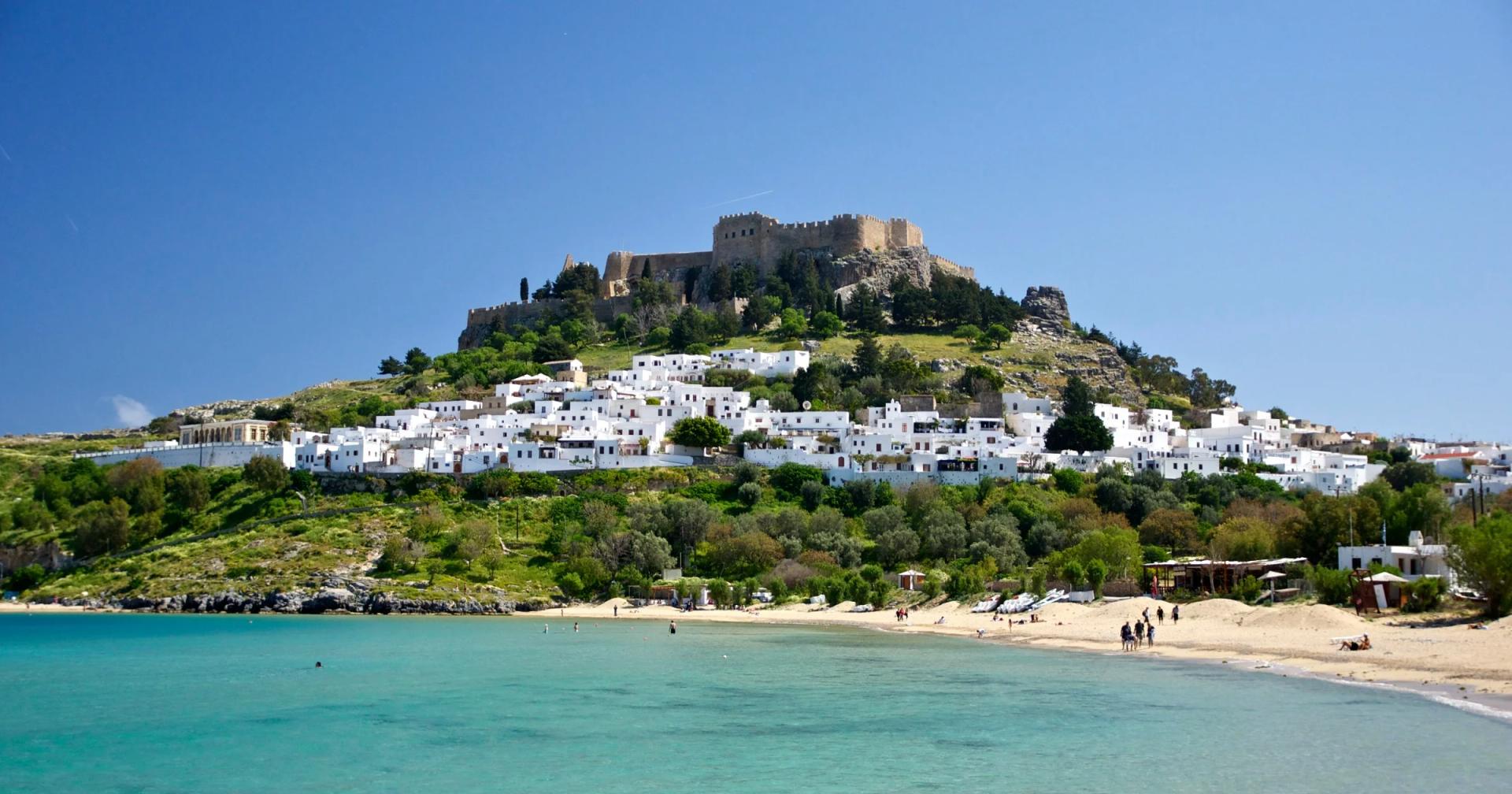
Rhodes has the driest summer in the table. The Rodos station averages 0.2 rain days in July and 0.1 in August, with maximums of 30.4°C and 30.7°C. Humidity is at its lowest in July, at 58.9 percent.
The prevailing wind at Rodos is westerly from January to November, with the strongest readings in July and August. See Rhodes wedding venues from Lindos to Rhodes Town.

Corfu is the wettest island in this guide. Kerkyra keeps three or more rain days in every month from May to October, and September and October bring the heaviest rain. It is also the hottest station in August, at 31.5°C.
Humidity rises into autumn, from about 62 percent in July and August to 74.9 percent in October. At Angsana Corfu, outdoor spaces run from April or mid-May to the end of September or October, depending on the space. See Corfu wedding venues with sea views, or step back to our Greece wedding collection for the wider picture.
The weather is only half of the calendar. Church closures and public holidays can rule out a date before the forecast even matters.
If you plan a Greek Orthodox ceremony, the church calendar comes before the weather. The Greek Orthodox Archdiocese of Australia lists these dates when marriages are not permitted:
13 December until Christmas Day
5 January, the eve of Epiphany
From Great Lent until Easter Sunday, with dates that vary each year
1 to 15 August, for the Dormition of the Theotokos
29 August
14 September
Those are the Archdiocese’s dates in Australia. For a church wedding in Greece, ask your priest and the local Metropolis. Orthodox Easter moves each year, so confirm the Great Lent window for your year with your priest before you hold a spring date.
Check public holidays for your date with your venue and the municipality before you hold it.
There is no month that suits every wedding. These scenarios match common priorities to the figures above.
A Greek Orthodox church ceremony. Work from the closed dates first. June, July and the second half of September sit clear of the Archdiocese’s August and 14 September closures, and spring dates need checking against Great Lent for your year. Your priest in Greece has the final word.
Older guests, or anyone who struggles in heat. May and October keep average maximums between 21.9°C (Naxos, October) and 24.5°C (Chania Souda in May, Rodos in October). In July and August, Smartraveller’s heat advice applies: shade, water and air-conditioned rooms.
A sunset ceremony in the Cyclades. The Naxos station shows the mildest summer maximums in this guide, at 25.9 to 27.1°C from June to August, and almost no rain. Plan for the north wind, which strengthens from July.
A long guest stay with island hopping. June and September give warm, mostly dry weeks at Naxos, Rodos and Heraklion, either side of the hottest stretch. Leave a buffer day before the wedding, since Smartraveller says strong winds can delay or cancel ferries.
A green setting on Corfu or in Crete. May and October bring cooler days, with more rain at Kerkyra and Chania Souda, so choose a venue with a covered space.
Long, warm evenings outdoors. July and August are the hottest and driest months at every station, with the trade-off of Smartraveller’s heat and wildfire advice.
Written by

SEO Specialist
Ayrton Christian Braga is an SEO Specialist at Wedded Wonderland, where he writes optimized articles and web pages that center on destination weddings, cultural wedding traditions, and guides for everything in between.
Search real weddings, venues and vendors from around the world.
Search Wedded Wonderland