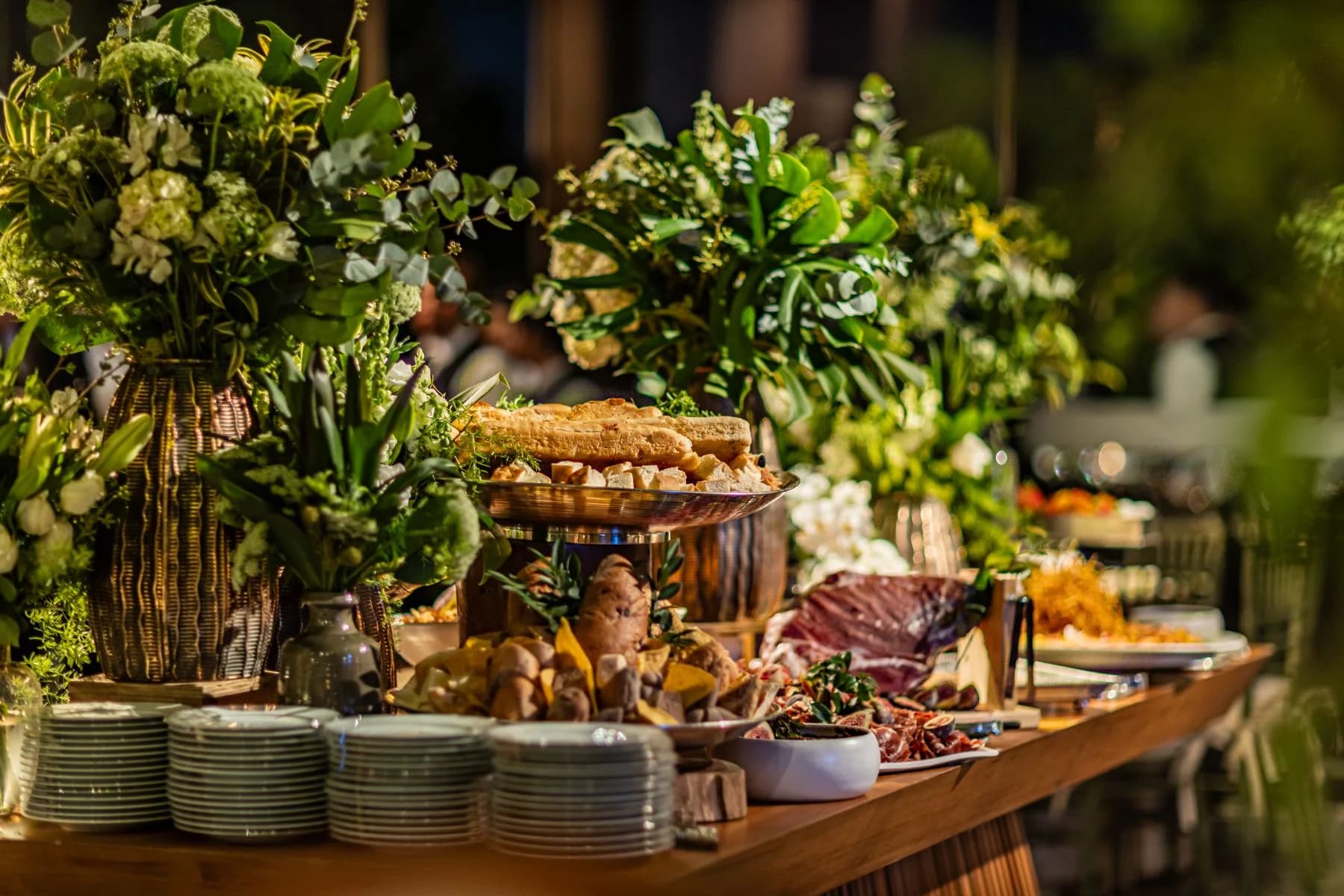
Guests forget the centerpieces. They forget the favors, and if we're honest they forget most of the speeches. They do not forget the wedding menu: the risotto that was still talked about at the next family wedding, or the three hours with nothing but a bread roll.
A wedding menu is one of the few parts of the day every single guest experiences, which is why it's worth more thought than "chicken or fish". This guide covers how to choose a service style, how many courses to serve, seasonal menu ideas, how to look after guests with dietary needs, and how to pair drinks with each course. We'll also show how to plan your wedding menu dish by dish in Wonderland Studio, Wedded Wonderland's planning suite, so your caterer gets one clear brief instead of a chain of emails.
Decide this before you pick a single dish. The service style shapes your wedding menu, your seating, your timeline and your budget.
Style | How it works | Good for | Watch out for |
|---|---|---|---|
Plated | Guests choose in advance, food is served at the table | Formal dinners, tight timelines | Needs meal choices on RSVPs and a seating chart |
Buffet | Guests serve themselves from a spread | Relaxed weddings, lots of choice | Queues, and tables called up one by one |
Family-style | Shared platters on each table | Warm, generous, conversational | Needs bigger tables for the platters |
Food stations | Separate stations (pasta, carvery, raw bar) | Variety, movement, mingling | More staff and space |
Cocktail / canapé | Substantial canapés and small bowls, no seated meal | Shorter or later receptions | Guests need enough food to count as dinner |
Many weddings mix them: canapés during cocktail hour, a plated main, then a dessert station and a late-night food truck.
Three courses after canapés is the classic shape for a wedding menu: starter, main and dessert, with the wedding cake as a fourth sweet moment. Italian-style weddings often add a pasta or risotto course between starter and main. Shorter receptions can drop the starter and serve generous canapés instead.
As a rule of thumb, plan your wedding menu around:
Canapés: 4 to 6 pieces per guest for a one-hour cocktail hour, more if dinner is late.
A starter: one choice, or alternate drop (two dishes served to every other guest).
A main: two choices plus a vegetarian or vegan option.
Dessert: one plated dessert, or let the cake be dessert.
Late-night food: for any reception that runs past 10pm.

Seasonal food tastes better and usually costs less, so let the season lead your wedding menu. Use these as conversation starters with your caterer.
Spring:
Canapés: pea and mint crostini, asparagus wrapped in prosciutto.
Starter: burrata with heirloom tomatoes and basil oil.
Main: herb-crusted lamb, or a spring vegetable risotto.
Dessert: lemon olive oil cake with berries.
Summer:
Canapés: watermelon and feta skewers, tuna tartare on cucumber.
Starter: chilled gazpacho, or a peach and prosciutto salad.
Main: grilled fish with salsa verde, or a seafood grazing station.
Dessert: pavlova, gelato cart.
Autumn:
Canapés: mushroom arancini, fig and goat's cheese tartlets.
Starter: roasted beet carpaccio with hazelnuts.
Main: slow-braised beef cheek with polenta, or wild mushroom ragù.
Dessert: spiced pear tart, sticky date pudding.
Winter:
Canapés: mini beef wellingtons, truffle croquettes.
Starter: roasted pumpkin soup in small cups.
Main: duck with cherry jus, or a root vegetable pithivier.
Dessert: dark chocolate tart, a hot chocolate bar.
Ask once, ask early, and keep the answers attached to each guest. This is where most wedding menus go wrong: the information exists, scattered across text messages, and nobody gives it to the kitchen.
Ask on the RSVP. Add a meal choice and a dietary needs field to your RSVP form. In Wonderland Studio, the RSVP form on your wedding website collects both, and the answers land in your guest list against each guest.
Tag every dish. Mark each dish vegetarian, vegan, gluten-free, dairy-free, nut-free, halal, kosher or pescatarian where it applies, and list its allergens.
Check coverage. Make sure every course on your wedding menu has something for every dietary need on your guest list, not just the main.
Offer a true alternative. A plate of steamed vegetables is not a vegan main. Give alternatives the same care as the headline dish.
Send it by table. Your caterer plates by table, so give them dietary needs by table. The table-by-table export in Wonderland Studio's seating chart prints meal counts and allergies for each table.
Feed your vendors. Your photographer, band and planner need meals too, and they have dietary needs like anyone else.
You don't need a sommelier, but a pairing per course makes the wedding menu feel considered. Some starting points:
Canapés: sparkling wine, a spritz or a signature cocktail.
Seafood and light starters: crisp whites like Chablis, Sancerre or a dry riesling.
Risotto and pasta: a light red such as pinot noir, or a rich white.
Beef and lamb: structured reds like Barolo, cabernet or shiraz.
Vegetarian mains: match the weight of the dish; mushrooms love pinot noir.
Dessert: Moscato d'Asti, a late-harvest wine or an espresso martini.
The cake: Champagne, of course.
Always have a good non-alcoholic option for every course too, not just water and juice.
Wonderland Studio's Menu tool turns your wedding menu into a brief for your caterer, built dish by dish.
Add each dish to a course. Name the dish, pick its course (first course, main course, side, buffet, dessert, wedding cake, sweets table, drinks, open bar, late night or kids menu) or create your own, like "Aperitivo" or "Family-style sharing". You can also note which event it's for, such as the reception or the after-party.
Describe it and tag it. Add a short description, toggle the dietary tags that apply, and list allergens. Each dish card shows its tags and a "Contains" line, so allergens are impossible to miss.
Mark alternatives. Toggle "Alternative option" for a dish that's a swap for guests who can't have the main.
Add a pairing. Note a wine, cocktail or service note beside each dish.
Check the coverage bar. At the top of your wedding menu, a dietary-coverage bar rolls up every tag across all your dishes, beside counts of dishes, courses, alternatives and dietary options. In our sample menu of 12 dishes across seven courses, it showed seven dietary options covered: vegetarian, gluten-free, dairy-free, vegan, pescatarian, halal and nut-free.

Import a menu you already have. If your caterer sends your wedding menu as a spreadsheet, "Import Menu" bulk-uploads dishes from a CSV, with columns for dish name, course, description, dietary flags, allergens and pairings.
Good to know: your wedding menu lives in your planning dashboard and can't be exported as a PDF or shared by link yet, so for now, screenshot it or copy it into your caterer brief.
Can we see and taste the dishes exactly as they'll be served on the day?
How do you handle severe allergies in the kitchen?
What's included per head: staff, crockery, linen, cake cutting, corkage?
How many staff will serve, and how long does service take for our number of guests?
What happens to leftover food?
Do you provide vendor meals, and at what price?
When do you need final numbers and dietary needs?
The menu is one of eleven tools in Wonderland Studio. RSVPs from your wedding website feed your guest list, which feeds your seating chart, so meal choices follow each guest all the way to their table. Read our guide to wedding planning tools to see how they connect.
Written by

Content and Creative Manager
Joseph Joshua is the SEO & Content Manager at Wedded Wonderland, bringing an editorial and search strategy perspective to the publication’s coverage of luxury weddings, destination celebrations and bridal lifestyle. His approach to content centres on helping readers move from inspiration to informed decisions, with attention to the design, craftsmanship and personal details that give a celebration its character.
Search real weddings, venues and vendors from around the world.
Search Wedded Wonderland