Dolly Parton's wedding dress was discovered in 2024 inside her late husband Carl Dean's old National Guard trunk. At Wedded Wonderland, we explore its remarkable rediscovery, the couple's intimate wedding and how to preserve an heirloom gown for generations to come.
Dolly Parton's wedding dress resurfaced in 2024, nearly six decades after she last wore it. It had been in the family all along, tucked inside a trunk that belonged to Carl Dean.
Rebecca Seaver grew up treating her aunt's closet as a playground, and years later returned to it as director of the Dolly Parton Archive. Among the sequins and rows of heels, she came across a small, worn military trunk from Carl's years in the National Guard. She brought it back to the archive without giving it much thought.
In 2024, Seaver's archive manager was sorting through storage when Seaver heard a scream from the next room. She assumed a mouse. Instead, her colleague was sitting with a dress laid across her lap.
Steve Summers, Dolly's longtime creative director, has since explained how it got there. On the wedding day, Dolly changed out of the dress to head to a recording studio, slipped it into a grocery bag and put it in Carl's trunk. It stayed there, undisturbed, while Dolly spent years telling people it was long gone.
Seaver told her aunt only that she had something to verify. She set a garment box on Dolly's kitchen counter, and Dolly lifted the dress by its straps, held it to herself and, as Seaver told Vogue, "squealed her sweet little Dolly squeal." She had not seen it since her wedding day.
The dress was only part of what the trunk preserved. The family now calls it the "time capsule," and it held nearly every keepsake from the couple's wedding day.
Alongside the dress were the short veil Dolly wore and the Bible she carried in place of a bouquet. There was also a letter from the pastor who married them, offering advice for a long and happy marriage, since he had not had the chance to counsel the couple beforehand.
The trunk also held private photographs, including a photobooth strip of Dolly and Carl that no one outside the family had seen. Dolly herself had not seen it since the day it was taken. For a man who kept almost entirely out of public view, those images show a rare, playful side of Carl.
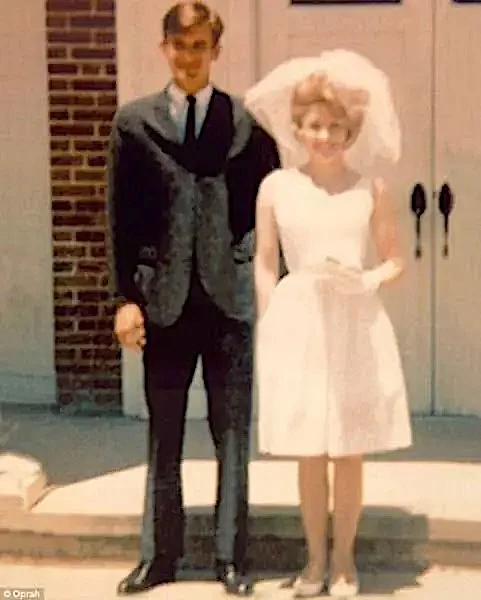
Dolly Parton's wedding dress is a short, simple A-line with thin straps and a hem that falls just below the knee. She wore it with a short, lightweight veil over her already teased hair.
There are no crystals, fringing or sequins, none of the signatures that would later define her on stage. In 1966 she was 20, and her career was only beginning.
The simplicity suited the day. Dolly later said she missed having a long wedding gown the first time around, a wish she would fulfil half a century later.
Dolly's record label was wary of the wedding, worried that marriage would draw a young artist away from her career. She married Carl anyway, quietly, across the state line in Georgia.
Dolly met Carl on her first day in Nashville in 1964, outside the Wishy Washy Laundromat. Two years later, on Monday 30 May 1966, they married at a small Baptist chapel in Ringgold, Georgia, chosen so the news would stay out of the Tennessee papers.
The only guests were Dolly's mother, Avie Lee Parton, the pastor and the pastor's wife. Dolly carried a Bible in place of flowers, and the newlyweds were back at work the following day.
Their marriage lasted nearly 59 years, until Carl's death in March 2025. It remains one of the most private love stories in modern music.
Dolly Parton's wedding dress is on display at Dolly's Life of Many Colors Museum, on the third floor of her SongTeller Hotel in downtown Nashville. It sits in a case designed to recall the Ringgold chapel where she married.
When Seaver showed her the dress, Dolly's first instinct was that it belonged in the new museum. Seaver, who is also the museum's executive director, created the display with Summers.
The museum opened at the end of September 2026, weeks after Dolly's death on 25 August. Short video messages Dolly recorded guide visitors through the exhibits, and a replica of the laundromat where she met Carl tells the beginning of the story the dress continues. Tickets are available through the museum's official website.
For their 50th anniversary in 2016, Dolly and Carl renewed their vows, and this time she wore a long gown designed by Steve Summers. Together, her two dresses mark the start of the marriage and its half-century.
The renewal let the couple dress up, take the photographs they never had and celebrate on their own terms.
True to form, Dolly gave the milestone a purpose beyond the couple themselves, releasing the official photographs from the ceremony to the highest bidder. The money raised was set aside for children's charities, making even their most private day an act of generosity.
A vow renewal is often where an heirloom gown finds a second chapter, whether it is reworn, restyled or displayed.
Dolly Parton's white dress survived because it sat in a closed, dark trunk that no one opened. A grocery bag is far from ideal, but the darkness and stillness of that trunk did much of what conservators recommend.
Spills that seem invisible on the day, such as champagne, sugar or perspiration, can darken and weaken fabric over the years. Have the dress cleaned soon after the wedding by a specialist experienced with bridal fabrics, and ask what methods they use.
Store the dress in an acid-free or inert archival box, lined and padded with acid-free tissue. Roll tissue into soft "snakes" to fill the bodice and sleeves and cushion every fold, so the fabric never creases sharply.
Avoid plastic bags, vacuum seals and ordinary cardboard. Plastic traps moisture and encourages mould, and cardboard releases acids that weaken fibres over time.
Light fades fabric, and swings in heat and humidity weaken it. Keep the box in a stable room in the main living area of your home, away from attics, basements, garages and external walls.
Check on it once a year, handling it with clean hands or cotton gloves, and refold it along different lines so creases do not set.
Part of what makes Dolly's find so moving is that nothing was separated. Store the veil, accessories, invitations, letters and photographs with the dress, each wrapped in acid-free tissue, alongside a note recording the date, the venue and who made the gown.
For a vintage or inherited gown, or any dress with stains, tears or fragile beading, a textile conservator is the right first call. They can clean, stabilise and pack the dress to museum standards, documenting each step.
An heirloom dress found in a wardrobe or trunk deserves the same care Seaver gave Dolly's. Before anyone tries it on, confirm its story, assess its condition and decide whether it should be worn, reworked or kept as it is.
Seaver's first step was to have Dolly verify the dress. Do the same with family members, comparing the gown with wedding photographs and writing down what you learn while the people who remember the day can still tell it.
Look for weak seams, splitting silk, rust marks from old pins and set-in stains. Fragile fabric can tear under the strain of a fitting, so have a conservator or experienced atelier assess it first.
Some gowns can be worn almost as they are after cleaning and minor repair. Others are better reworked by a couturier, who can reshape the bodice or turn the veil into a new piece while keeping the original's character.
A dress too fragile to wear can still be part of the day, displayed at the reception or carried as a panel of fabric wrapped around the bouquet. When a couple brings an heirloom into their planning, we coordinate the styling around it, from hair and makeup to the setting, so the piece feels considered.
Dolly's three-guest ceremony is a reminder that many of the most memorable weddings are small ones. An intimate chapel wedding today can be just as private and considered, in settings she might never have imagined.
A small wedding asks for more precision. With fewer guests, every detail is noticed, from the officiant and the music to the meal that follows, and our destination wedding packages bring those elements together to the same bespoke standard as a far larger celebration.
Archival box: A storage box made from acid-free board or inert plastic that will not release chemicals into fabric over time.
Acid-free tissue: Tissue paper without the acids found in ordinary paper and cardboard, used to pad folds and protect fabric from creasing and discolouration.
Textile conservator: A trained specialist who cleans, stabilises and repairs historic or delicate fabrics using reversible, museum-standard methods.
Provenance: The documented history of an object, including who owned it, where it was kept and the photographs or letters that confirm its story.
Vow renewal: A ceremony in which a married couple repeat or rewrite their vows, often to mark a milestone anniversary.
Written by
Editor & Content Writer
Jillian Arambulo is the Editorial and Content Writer at Wedded Wonderland, specialising in branded content strategy. Her writing spans luxury lifestyle, travel, culture, beauty and emerging trends, bringing together comprehensive guides and features that connect readers with the places, ideas and experiences worth discovering.
Search real weddings, venues and vendors from around the world.
Search Wedded Wonderland