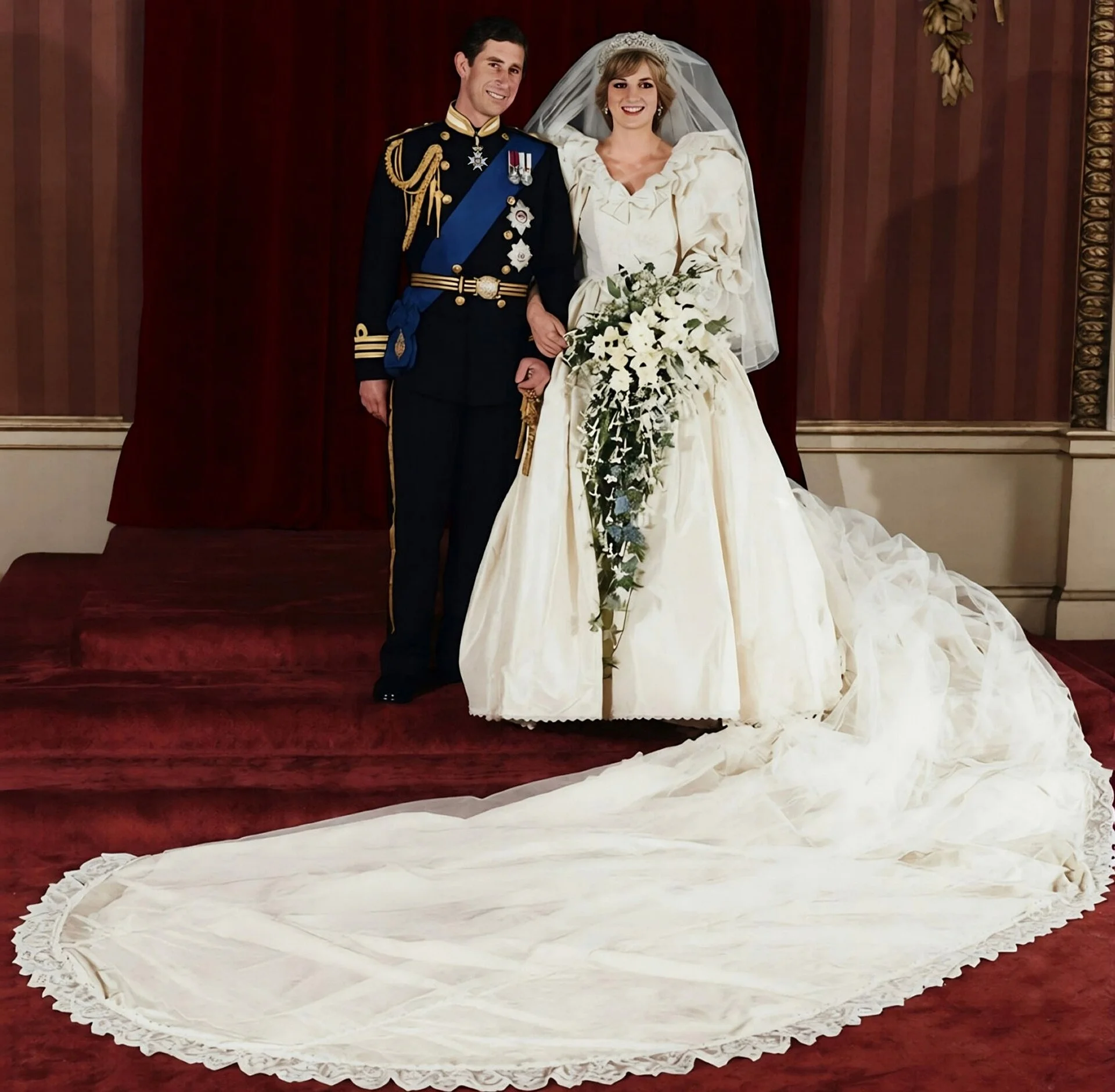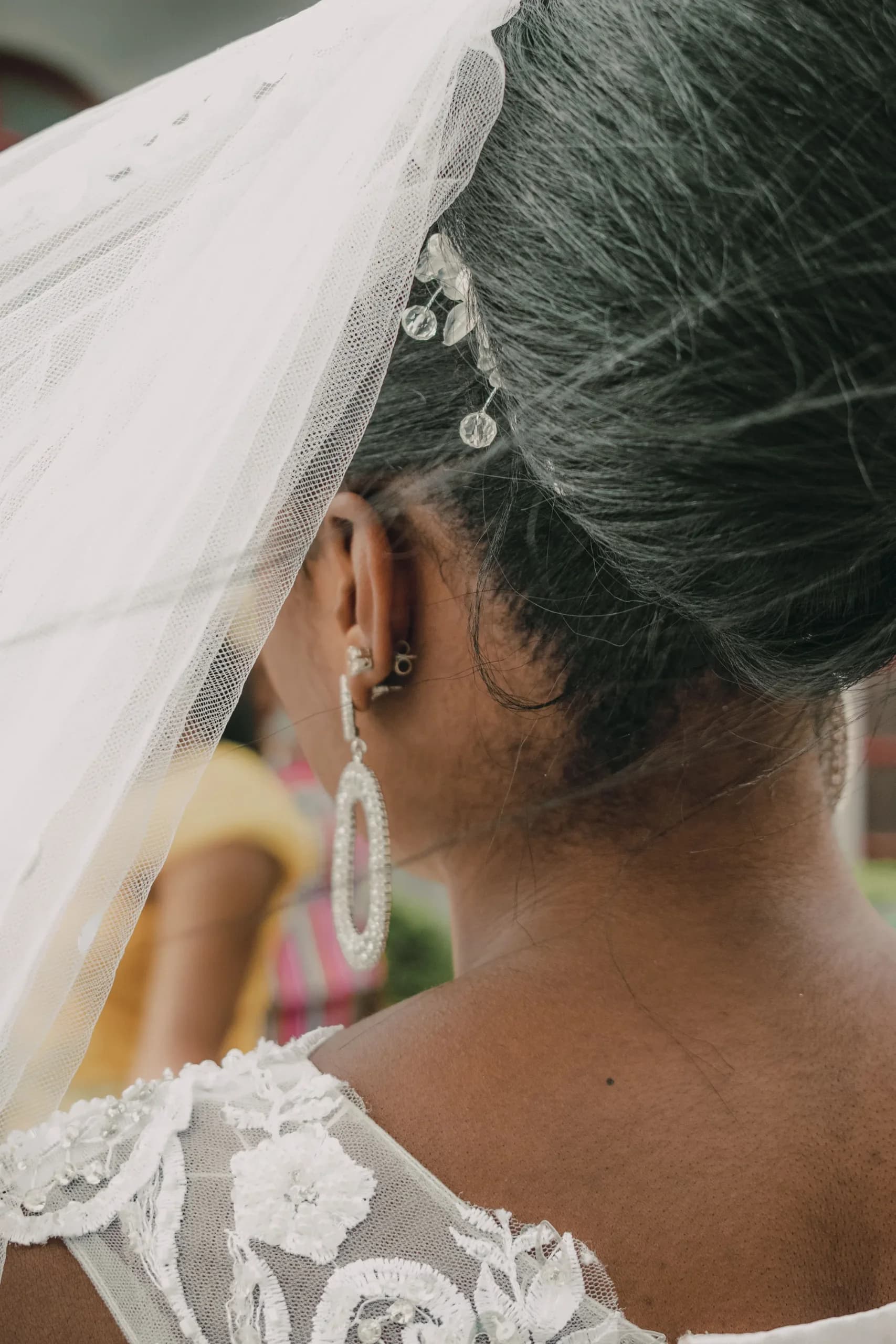
Wedding jewellery works when you choose it in order. Start from your neckline, fit the wedding band to your engagement ring, pick one piece to lead, and test everything with the dress, hair and veil at one fitting before the day.

If you already wear your engagement ring, the band is the first order to place, so start there. Through Wedded Concierge, your Wedded Advisor puts the band order on your timeline, with the fittings and the hair trial beside it.
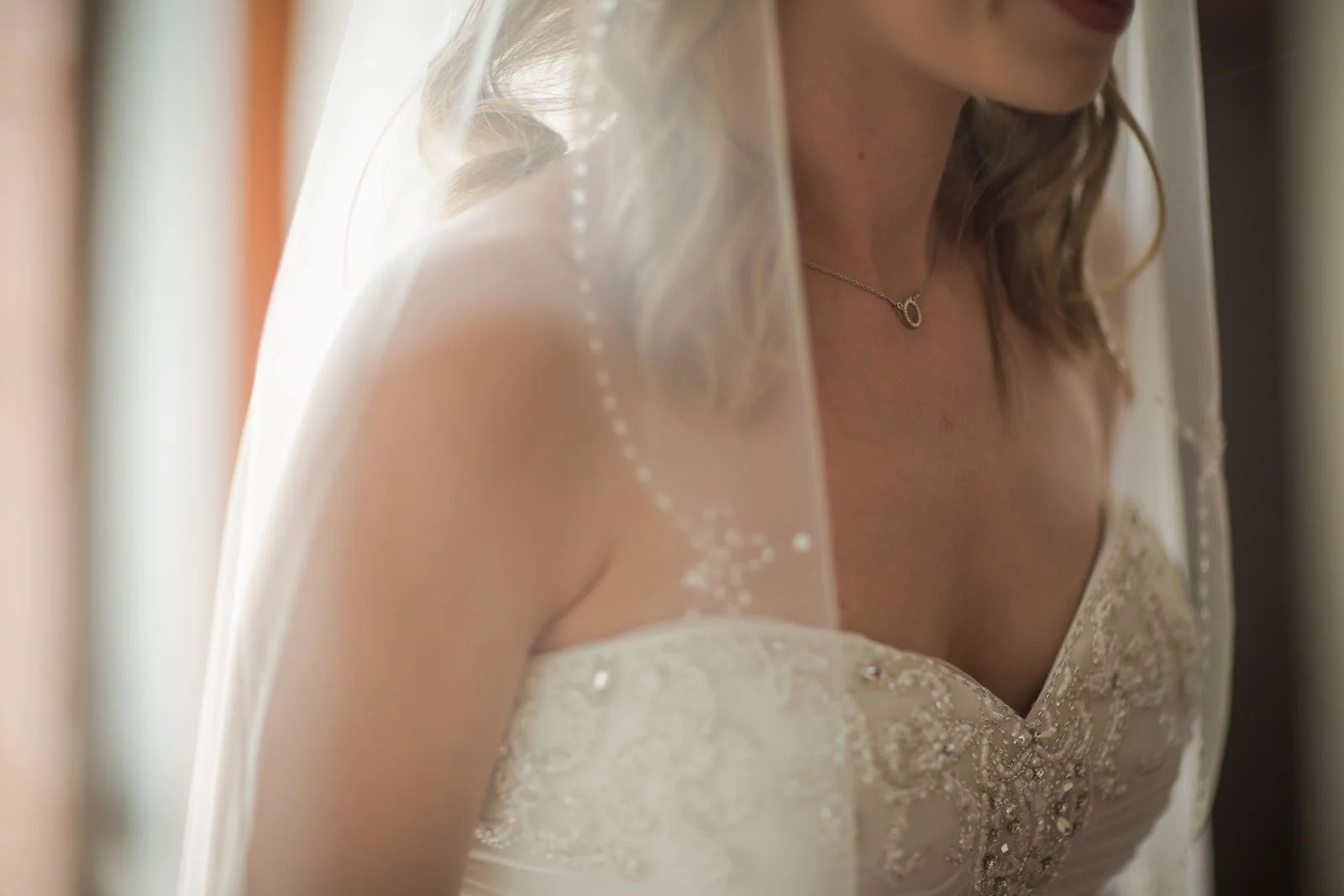
The neckline decides whether there is a necklace at all, and our guide to choosing jewellery that suits your dress and neckline covers the wider choice of pieces. Hair comes next, because an up-do shows a drop earring and loose waves hide most of it. Then the veil: a comb under a chignon sits right where drops swing, so anything near it needs a smooth edge.

Leave the necklace off. A chain cuts a bateau line in half, and a pendant drags on high lace. Let the earrings lead, with a small comb to one side if you want more.

A long drop or a cluster earring frames the face above a covered neckline and still shows under a veil. Check the earrings against the lace at the fitting, because a heavy drop can catch on a high collar when you turn your head.
A V can want nothing at all. A pendant pulls the eye straight down and slides on satin every time you move. If you love pearls, choose a short strand at the base of the neck, clear of the V.

A fine chain that sits flat works better than anything that swings. Ask the fitter to pin the strand in place for photos if the fabric moves.
Usually the beading leads and the necklace stays in the box. Gold gifted by your family is the exception: it leads, and the fitting checks that it sits clear of the illusion edge. Otherwise, keep jewellery to earrings and a bracelet, so nothing competes with the beadwork. Choose stones or metal in the same tone as the embellishment, and check that clasps won't snag the tulle.

An open neckline is where a necklace earns its place. Keep it close to the collarbone and the earrings quieter in return. A choker or a collar-length strand fills the space a strapless bodice leaves open, and it frames the shoulders in portraits. Match the length to the gown’s top edge, so the necklace and the neckline don’t sit at the same height.

The band is the piece you keep wearing, and the one with the longest lead time. Book consultations about 6 months out and order by 4 months, because the makers named below quote 3 to 10 weeks and a fitted band can need a second try. Have it finished before your full fitting.

Makers use these names loosely, so learn the shapes and describe the one you want:
Straight: A flat band that sits flush only when your setting is high enough for it to slot alongside.
Curved: A band with a ready-made dip that arcs around the stone.
Contoured or shaped to fit: A band made from your own ring, so it follows its exact profile.
Notched: A band with a cut-out where the setting sits.
A deliberate gap: A straight band worn with space between, so each ring also looks finished alone. It reads as designed when the space is even and the two widths match.

Some studios use curved, contour and fitted for the same band, so ask whether yours is a stock curve or made from your ring.
A straight band slots in beside a ring only when the setting sits high enough, and a curved one suits a low setting. A hidden halo is less predictable. Frank Jewelers notes that a straight band can leave a small gap, which many people keep, and that a notched band gives the tightest fit.

For a low-set oval diamond or tapered baguettes, ask the maker to hold a straight band against the ring at the first appointment. If it tilts the stone, spins or catches, you need a band made from your ring.
Queensmith advises a band of similar width to your engagement ring, or slightly narrower. It also says a plain polished band keeps the centre diamond the focus and a pavé engagement ring is matched by a pavé band. The same width rule holds for an emerald cut, and beside coloured side stones a plain or fine pavé band lets them stay the feature. Beside a fine engagement ring, Fenton suggests starting at 2mm.

With a platinum engagement ring, a platinum band is advised so the two rings do not damage each other. A gold band worn against platinum wears away gradually, which makes mixing metals a style choice with a cost: the gold wears first. Ask the maker where the band, and any band you stack, will touch your ring, and have that point checked along with the claws, which Timothy Roe advises every 6 months to a year on a ring worn daily.

Karat tells you how much gold is in the metal, not its shade. Rose gold reads redder with more copper, so two 18K rose golds can differ, and an older ring develops a muted patina as its copper oxidises. Whatever the colour, ask the maker to match your ring's alloy and hold the two together in daylight. On finish, a polished band shows fine scratches first and a matte one wears to shiny patches.
Ask first whether the maker scans your ring or keeps it. Some take a 3D scan within an hour; others may need the ring during the fitting, so ask for how many days, set that window well before the wedding and get the ring's condition in writing. On an old setting, a good answer includes testing a wax model against your ring before casting, and checking with you before anything is cleaned or polished.

Most curved bands can be resized within a range set by each design, so ask for that range before you order. Fingers shrink in the cold and swell in heat, so have the size taken in your wedding season.
There is no set rule on hands. Wear both rings on the left, with the band made to sit beside the ring you already own, or move the engagement ring to the right for the day, as many traditions around the ring's hand do. Order the groom's band at the same appointment, in your band's metal and finish, so both are ready together. For more makers, see our profile of five bridal jewellery brands making rings.

One piece leads and the rest step back, whether it is the ring, the earrings, a necklace, a hair piece or family gold. A strong engagement ring is already leading, so earrings sit quietly beside it (see the 2026 wedding jewellery trends for where statement earrings are heading), and quieter still beside a coloured stone or three stones. Photograph your ring hand near your face at the fitting. If your eye goes to the earring first, go smaller.

Earrings and necklaces never touch your ring, so their metal is a choice for the photograph, and pearls sit beside any metal. Beside family gold, new 18K, at 75 per cent gold against 87.5 for 21K or 91.6 for 22K, reads a shade paler. Wear the family gold at the neck and the new piece at the ear, or choose the new piece in the higher karat.
Decide before the day what comes off first: bracelets before the dancing, the hair piece with the veil, a statement necklace after the formal photographs, earrings last. Family gold reverses this and may stay on all night.
Once your hair has settled studs or drops, check each pair for these before you buy:
Screw or locking backs where offered, since a loose butterfly back is the one lost in a line of hugs.
A weight your lobe can carry all day, or ear supports and a lighter pair for the reception.
A locking fitting on a detachable drop, shaken over a tray before you pay.
Closed or low-profile settings, such as a bezel, rather than raised claws that catch tulle and lace.

Paspaley sells its pearl earrings online to Australia, the UAE, the UK and the US, and allows 1 to 2 weeks for international delivery, with local duties yours to pay outside the US.
Treat any piece older than you as fragile until a jeweller says otherwise. Have it checked under magnification 4 to 6 months out: clasp, safety catch, claws, loose stones and worn links. Ask for the findings in writing, because that report is your evidence for a claim.

Reinforce only in ways that can be undone, such as a safety chain or ear supports, and keep the original parts. Mikimoto recommends restringing pearls regularly, so ask for it at the same visit.
A borrowed bracelet is the piece most likely to snag or shed a stone. Wear it for the ceremony and portraits, then hand it to a named person who puts it away.
Before you wear anything valuable, ring your insurer and ask:
What is the single-item limit, and does this piece need to be listed?
Am I covered abroad, and from the day I buy it?
Are one lost earring and a lost stone covered, or only theft?
Who covers a borrowed piece: me or the owner?
Buy everything except the band 3 to 4 months out, and fit it all together 1 to 2 months out. Made-to-order pieces need that margin: Jennifer Behr ships pre-orders within 4 to 6 weeks. Bring your stylist, your hair person and someone to watch the back of the veil.

With the dress, veil and every piece on, run these tests:
Turn your head fully both ways and feel for the veil catching.
Lift your arms as if for a hug, then check every back and clasp.
Shake each earring over a tray.
Take a flash photo, because high-polish gold and mirror-cut stones can flare white.
Wear the real hair piece at your hair trial, so your hairdresser can plan how it anchors.
Hair, make-up, hairspray and perfume come first. Mikimoto's advice for pearls is to put them on as a final touch, after make-up and styling hair, and the same order keeps hairspray off every stone. If the dress goes over your head, drops go in after it; if you step into it, studs can go in first.

Give one person the pouch, the backup studs and a soft cloth for pearls. When you travel, keep every piece on you in a lockable hard case with the jeweller's report and receipts, and check the customs rules where you marry.
The order above works anywhere. What changes from market to market is the makers you visit and the rules at the border. Prices are in local currency and change, so confirm them when you visit.
Larsen Jewellery in Sydney's Strand Arcade lists curved bands from AUD 2,190 to AUD 5,610. Its FAQ adds that shaping a band to your own ring usually costs about AUD 100 to 300 more. Cushla Whiting on King Street lists its Sage curved band from AUD 2,090. Its FAQ says every curved or open band can be made to fit your ring, in 18K gold or platinum, in 8 to 10 weeks.

Sydney's long-term mean daily maximum is 25.3°C in December and 26.0°C in January, so schedule the fitting in the morning. Some couples serve lamingtons or a pavlova instead of a tiered cake, so take bracelets off before dessert. Goods bought overseas worth more than AUD 900 in total, gifts included, must be declared on arrival, so keep a band's receipt.
Cartier's 1895 band is AED 3,450 in rose or yellow gold. Near the Gold Souk in Deira, Jewelebrate makes bands in 18K gold or platinum in about 3 to 4 weeks, from a 3D design you approve. Take your ring and ask for the band to be modelled against it.

In the heat, book a clean the week before, since sunscreen and sanitiser film over stones. Carrying more than AED 60,000 in cash, precious metals or stones in or out of the UAE means declaring it to ICP through the Afseh app. With a hijab or shayla, a brooch or bangles over the sleeve can lead; our guide to Arab and Levantine wedding traditions covers each night.
Queensmith in Hatton Garden makes wedding rings to order in about 4 to 5 weeks and matches the profile to your engagement ring, wherever it came from. Plain bands start at about £350; in platinum, the 2.4mm Montez Eternity is £1,925 and the 1.8mm Wishbone Scallop Diamond £2,200. In Chichester, Timothy Roe makes shaped-to-fit bands from a 3D scan taken within an hour, so your ring is not away for long.

Under the UK hallmarking rules, only gold under 1 gram and platinum under 0.5 gram may go unmarked. Check the band's hallmark, and ask for the metal and purity on the invoice for anything that carries none.
British summer is the most thundery season, so keep a dry case for your pieces between photographs. The Royal Mint describes the sixpence in her shoe as a sign of prosperity and financial security in marriage.
In Manhattan's Diamond District, Mike Nekta New York at 74 West 47th Street makes bands that follow the exact contour of your ring. Allow at least 6 to 8 weeks before the wedding for the whole process, final fitting included; it publishes no price. For the heirloom check, Doyle and Doyle in New York specialises in antique jewellery repair, by appointment. Blue Nile lists its 3mm Matte Classic platinum band at USD 705.

In June, Central Park's average high is 79.7°F (26.5°C) and summers run humid. The American bouquet toss is thrown back over the bride's head, so test your bracelet clasp with a full arm swing.
The TSA asks you to keep jewellery with you, not in checked bags. For an heirloom made outside the US, register it at a CBP office on Form 4457 before you leave, and show the form each time it comes back.
Your Wedded Advisor puts your jewellery on the wedding timeline, so the band consultation and the heirloom check each get a date. The same plan sets the fittings and the hair trial, and names who takes the borrowed bracelet.
The Wedded Marketplace lists jewellery and photography vendors. If you marry away from home, your Wedded Advisor also plans your guests' travel and the honeymoon, and our guide to planning a destination wedding shows how.
Tell us your date and where you are marrying through Wedded Concierge. For more reading, browse our jewellery stories.
Written by
Content and Creative Manager
Joseph Joshua is the SEO & Content Manager at Wedded Wonderland, bringing an editorial and search strategy perspective to the publication’s coverage of luxury weddings, destination celebrations and bridal lifestyle. His approach to content centres on helping readers move from inspiration to informed decisions, with attention to the design, craftsmanship and personal details that give a celebration its character.
Search real weddings, venues and vendors from around the world.
Search Wedded Wonderland