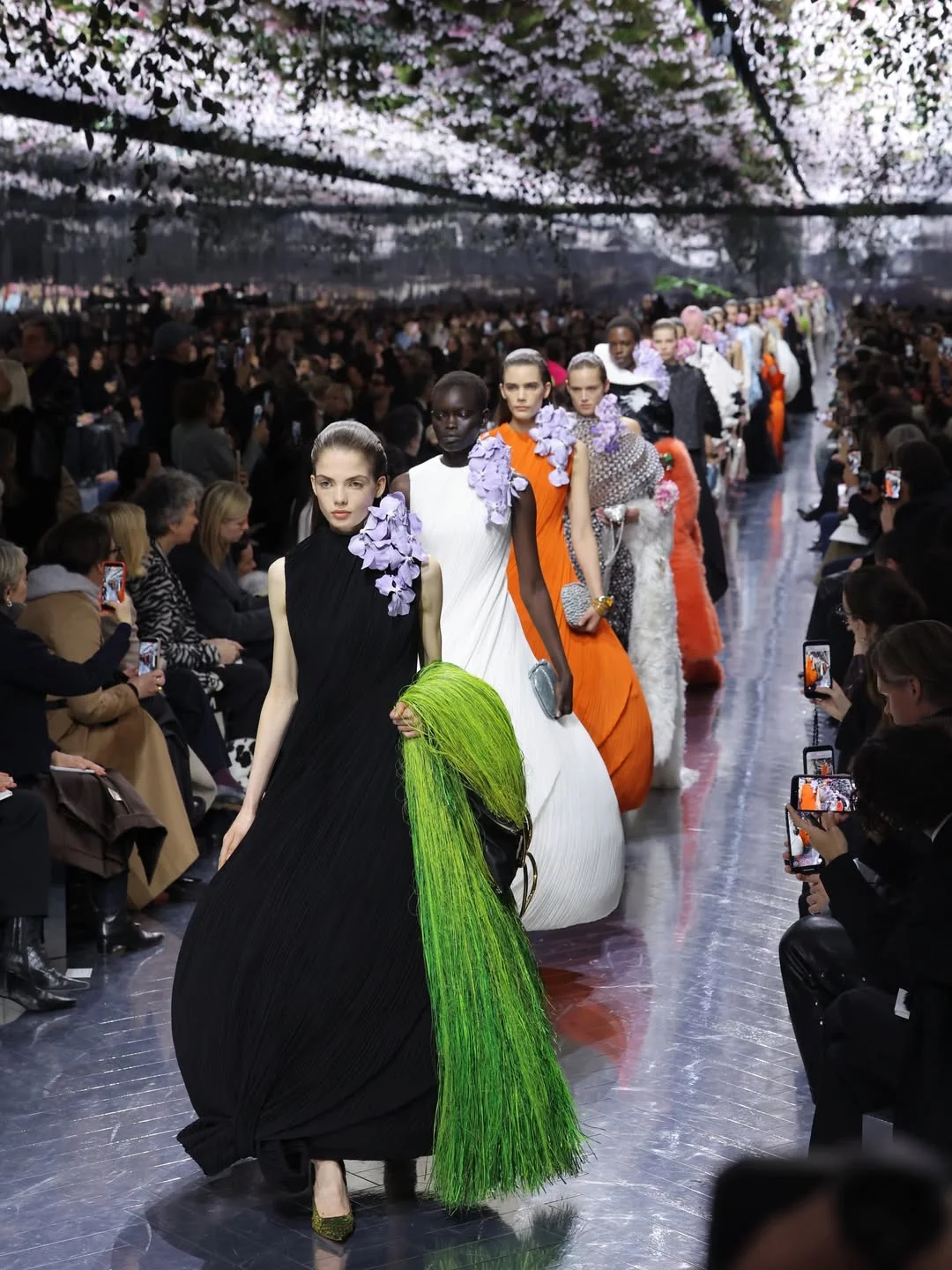
Jonathan Anderson’s first haute couture collection for Dior didn’t arrive with theatrics, shock value, or a manifesto. And somehow, that’s exactly why it matters.
Presented at the Musée Rodin for Spring 2026, Anderson’s debut marked a quiet but deeply consequential shift for one of fashion’s most storied houses. Instead of announcing a new era, he approached couture as something far more interesting: a space for thought, experimentation, and process.
In an industry obsessed with “moments,” Anderson chose meaning.
Photography | @patricksawaya
From the outset, this collection resisted finality. Rather than delivering a singular statement, it unfolded like a personal archive, a careful assemblage of influences drawn from nature, art, and objects imbued with memory. It felt less like a proclamation and more like an exploration, guided by curiosity rather than ego.
This wasn’t couture as spectacle. It was couture as making.
Every look seemed to ask a question instead of answering one, positioning haute couture not as a static heirloom, but as something living, evolving, and emotionally resonant.
Photography | @patricksawaya
Dior’s iconic hourglass silhouette, first introduced by Christian Dior in 1947, made a return, but not in its traditional, architectural form. Under Anderson’s hand, it softened.
Pleats spiralled around the body. Dresses expanded and contracted with movement. Structure gave way to pliability. The result was unmistakably Dior, yet subtly destabilised, familiar forms rendered just strange enough to feel new.
Tactility ran through the collection like a quiet hum. Inspired by the work of Kenyan-born British ceramicist Dame Magdalene Odundo, silhouettes curved and ballooned like hand-thrown vessels. Surfaces appeared smoothed, pinched, and shaped, as though still warm from the maker’s hands.
In a world of hyper-polished perfection, Anderson foregrounded touch. Craft wasn’t decorative. It was foundational.
Nature, too, appeared, but filtered through Anderson’s more ambiguous lens. Florals recalled Raf Simons’ 2012 couture debut for Dior, though here they were abstracted and sculptural. Petals clustered densely. Stems curved across shoulders and hemlines, creating tension rather than romance.
Jonathan Anderson didn’t attempt to rewrite Dior couture, and that may be his most radical move yet.
Instead, he expanded its language. He acknowledged that couture is not built in a single season, but layered over time, shaped by many hands and many minds. His debut honoured continuity while leaving space for evolution.
In an era where fashion often mistakes noise for impact, Anderson chose something braver: restraint.
This collection didn’t chase virality, it didn’t beg to be understood instantly. It trusted the audience to slow down. And in doing so, Jonathan Anderson reminded us of something essential: Couture doesn’t need to shout to be radical.
Sometimes, the most powerful shift happens quietly, when someone treats history not as a weight, but as a living material.
And that may be the most Dior thing of all.
From the best in bridal fashion to world’s biggest planners, elevate your wedding planning with Wedded Concierge. Begin today!