Percentages give a wedding budget its starting shape: roughly how much of the total usually goes to the venue, the food, the photos and everything else. From there, you move money toward the parts of the day you'll remember and away from the ones you won't.
To work with your real figures as you go, put them into our free wedding budget planner.
There's no official split. The percentages below come from three published budget guides: Paperlust, Greenvelope and WalletHub. None names a survey behind its figures, and they don't always agree. For each category, we give the range across the guides that cover it.
Your own numbers will move with three things: where you marry, how many guests you invite, and what matters most to you. Paperlust notes that the venue alone can reach 40 to 50 percent of the total in high-cost cities.

Photo: Matheus Bertelli on Pexels
The venue, the food and the drinks are the biggest line in each guide. WalletHub puts venue and catering together at 35 percent, Greenvelope at 30 to 50 percent including the cake, and Paperlust at 55 to 60 percent once the bar is included. Catering is charged per head, so your guest count moves this category more than any other.
WalletHub suggests 11 percent, Greenvelope 12 to 15 percent, and Paperlust 10 to 12 percent for photography plus 4 to 6 percent for video. If photos are a top priority, plan for the upper end of the range.
This covers ceremony and reception flowers, styling and décor hire. The guides range from 6 to 10 percent (Paperlust) to 10 to 15 percent (Greenvelope). If your venue comes with its own styling, this line can sit at the low end.
The wedding dress, the suit or tuxedo, alterations, accessories, and hair and makeup. Greenvelope puts the lot at 5 to 10 percent and WalletHub at 7 percent. Paperlust splits it into attire at 5 to 8 percent and hair and makeup at 2 to 4 percent.
A DJ, a band, or ceremony musicians. Paperlust suggests 5 to 8 percent, WalletHub 7 percent and Greenvelope 8 to 10 percent.
Only two of the guides cover a planner, and they sit far apart: WalletHub allows 10 percent, while Greenvelope suggests 2 to 3 percent. Decide early whether you want full planning or help on the day only, and budget the line to match.
These add up quickly, so give each one a line of its own:
Greenvelope and WalletHub each set aside 5 percent for surprise costs, and Paperlust recommends holding back 10 percent before you allocate anything else. It covers vendor tips, overtime, insurance, last-minute alterations and price rises between booking and the day.
One way to divide $50,000, with a planner, a full photo and video package and a 5 percent buffer:
Category | Share | Amount |
Venue and catering | 43% | $21,500 |
Photography and video | 12% | $6,000 |
Flowers and décor | 10% | $5,000 |
Attire and beauty | 8% | $4,000 |
Music and entertainment | 7% | $3,500 |
Wedding planner | 5% | $2,500 |
Contingency | 5% | $2,500 |
Cake and desserts | 2% | $1,000 |
Invitations and stationery | 2% | $1,000 |
Wedding bands | 2% | $1,000 |
Transport | 2% | $1,000 |
Officiant and ceremony fees | 1% | $500 |
Favours and gifts | 1% | $500 |
Total | 100% | $50,000 |
To use the same shape for a different total, multiply your budget by each percentage. Fixed fees such as the officiant don't grow with a bigger budget, so check those lines against real quotes.
Start with your top three priorities and fund them at the upper end of their range. If photography matters most, it might take 15 percent; if you'd rather spend on the food, catering takes more and décor takes less. Decide what you'll trim at the same time.
If family are contributing, agree who covers what before you set the split. Our guide to who pays for the wedding covers the usual arrangements.
Guest count moves several lines at once. Fewer guests shrinks catering, drinks, stationery and favours, which frees money for the photographer or the dress. Our guide to micro wedding costs shows how far a smaller list stretches.
A destination wedding shifts the shape again. The venue often bundles food, drinks and styling into one package price. Our guide to all-inclusive wedding costs covers what those packages include.
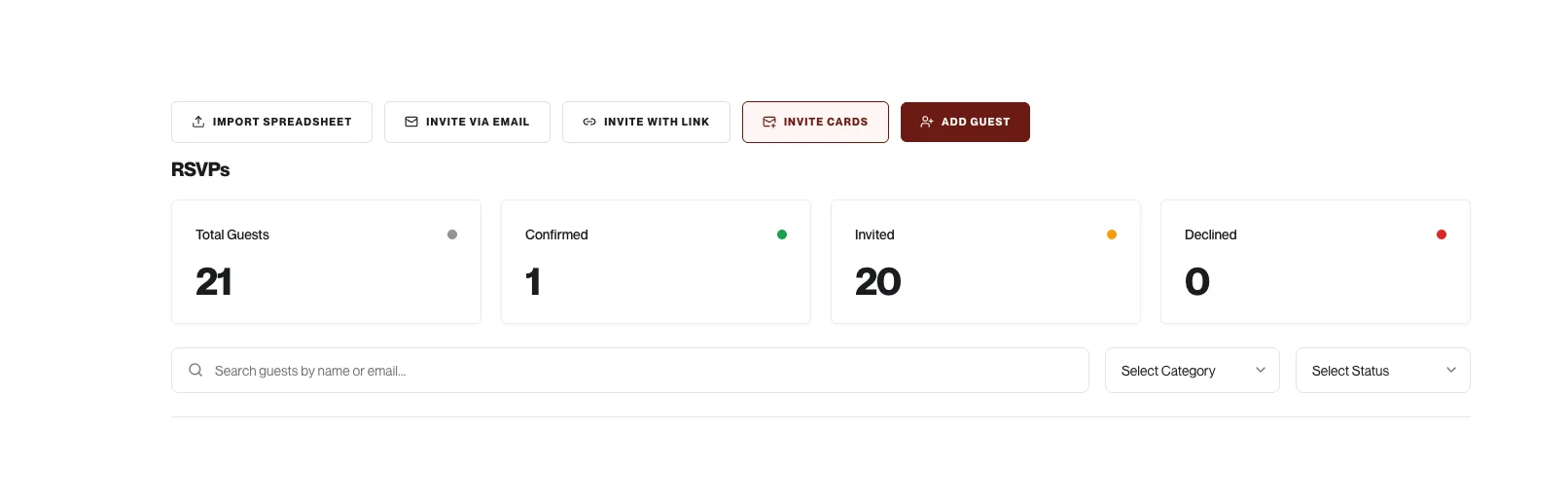
Once you have a split, track it. In our free wedding budget planner you set a total, allocate it across categories, record what you've spent in each category and see what's left. Studio's Vendors tool adds the deposit and balance due on every contract, so a line that's about to run over shows up before the final invoice. Our round-up of wedding budget apps compares other tools, and our guide to saving money on a wedding shows where a category can shrink without guests noticing.
Cover photo: Ylanite Koppens on Pexels
Written by

Senior SEO Specialist, Wedded Wonderland
Mark Tuason is the Senior SEO Specialist at Wedded Wonderland, where he writes and refreshes the brand's guides to destination weddings and cultural wedding traditions. He starts with the questions couples search for, checks the answers against trusted sources, and shapes each guide to help them plan, compare and book with confidence. Based in the Philippines, he specialises in content strategy and on-page SEO.
Search real weddings, venues and vendors from around the world.
Search Wedded Wonderland