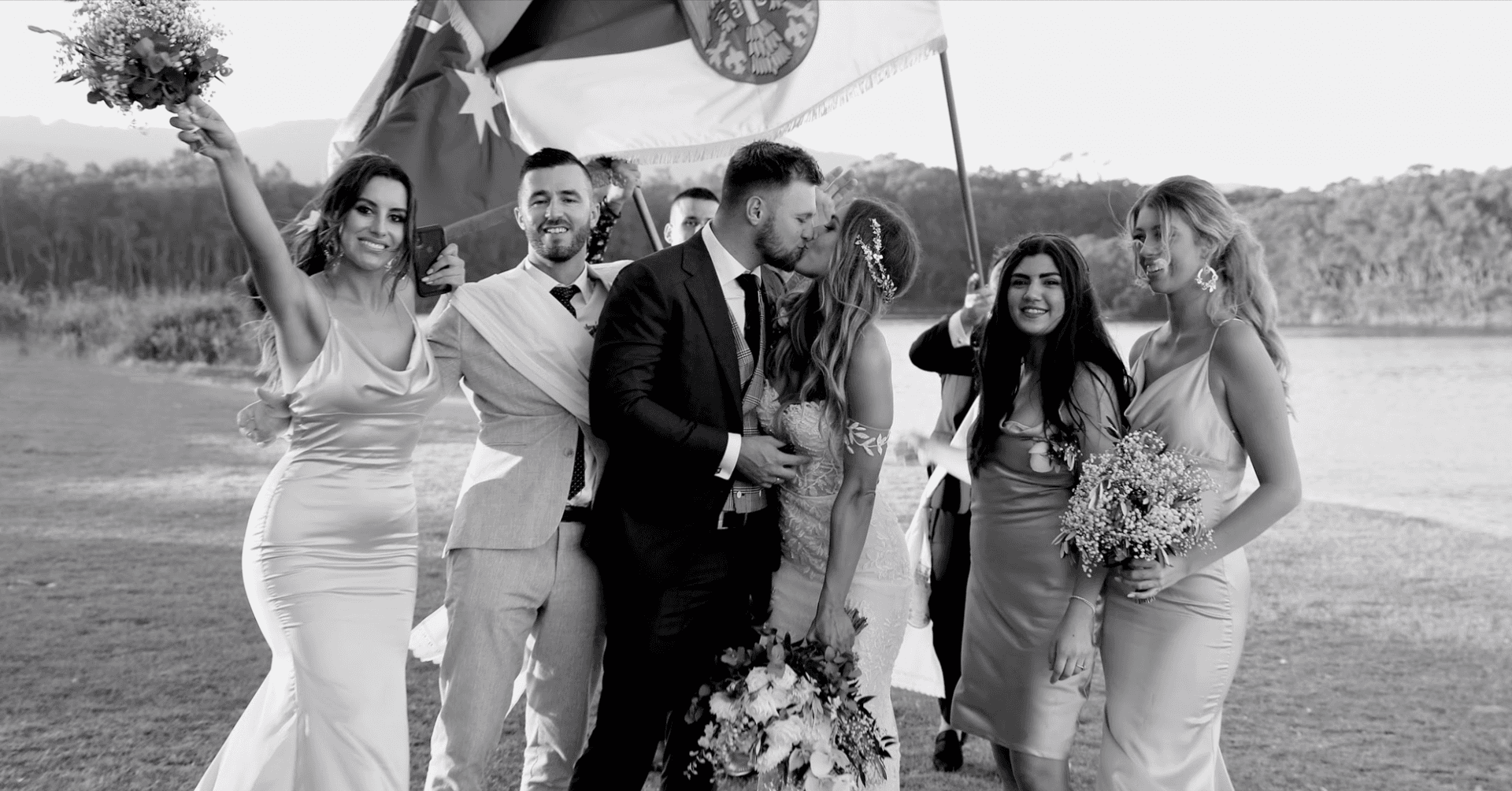
A Serbian wedding is a sequence of customs, from asking for the bride's hand to welcoming her at her new home. Seen in order, each tradition makes far more sense. This Wedded Wonderland guide walks you through them, alongside our wedding traditions worth keeping. It also covers marrying in Serbia or carrying the customs home to Australia.
The current exhibition at the Ethnographic Museum in Belgrade, "Serbian weddings 125 years ago", follows the wedding through its phases: the prosidba (the visit to ask for the bride's hand) and preparations, leading the bride out of her family home, the wedding itself, and her arrival at her new home. The museum presents it as a major family, social and ritual event.
It also shows customs from several regions, including Šumadija, Vojvodina and the Pirot area, a reminder of how much practice varies. The museum's English page says wedding customs brought families and communities together and marked the move from one stage of life and family status to another.
So one framing line for everything below. The church rite is set by the Serbian Orthodox Church. The folk customs around it belong to families, and no two families keep them in quite the same way. Where a custom is passed on by word of mouth rather than documented, we say it is "often told".
The first seven customs run from the proposal visit to the end of the church service. Most belong to families, while the last two are set by the Serbian Orthodox Church.
The prosidba, the proposal visit to ask for the bride's hand, opens the sequence. It is a family occasion first, and the tone is set by the two households rather than by any rule.
What follows, the engagement or veridba, is where family habits diverge. As it is often told, gifts pass between the households, and the bride is offered an apple or a ring. How much of this a family keeps is a question for the grandparents, not a guidebook.
If there is one person who holds a Serbian wedding together, it is the kum. As the Serbian Orthodox parish of Gabba in Brisbane explains, the Serbian Orthodox Church requires two witnesses at the wedding: the kum and the stari svat. Their larger role comes before the day, at the pre-marriage examination (predbračni ispit), where they attest that there is no impediment to the marriage and sign the record.
That is why "best man" undersells the role. The kum is a witness to the sacrament, and during the service he exchanges the rings between the couple. Later, he and the stari svat hold the couple's candles until the service ends.
As it is often told, the kuma is the kum's female counterpart, often his wife, beside the bride. Calling her the "maid of honour" is a loose translation, not a description the church uses.
Families often speak of kumstvo, the bond between the couple and their kum, as lasting well beyond the wedding, with the kum seen as the natural choice to baptise the couple's children. Treat that as family tradition rather than rule, and ask what yours expects.
Choose your kum early. The Church of Saint Sava in Belgrade, for one, asks for his church baptism certificate as well as yours, so this is not a decision to leave until the invitations go out.
As it is often told, on the wedding morning the groom's party (the svatovi) sets out to collect the bride, the barjak leading. The barjak is a wedding flag, and the man who carries it is the barjaktar.
Families decorate the barjak in their own way, some with flowers, a towel or an apple tied to the staff, and many give the role of barjaktar to a relative or close friend.
Leading the bride out of her family home is one of the phases the Ethnographic Museum names. Around that moment sits one of the most playful customs.
When the svatovi arrive, as it is often told, the bride's family makes them "buy" her rather than hand her over, with the dever, usually the groom's brother or a close male relative, doing the bargaining. Some families add a "fake bride", a relative in a veil presented first to tease the groom's side.
It is theatre, not commerce, and the haggling is the point.
The apple is the custom people most often ask about. As it is often told, an apple is set high, sometimes on a tree or a pole, and the groom or a member of his party tries to hit it before the bride is led out.
The details vary widely from family to family. If your family wants to include the apple, talk it through with them and with your venue well ahead, since what suits a village courtyard will not suit a city hotel.
Across the Orthodox Church generally, as the Orthodox Church in America explains, the marriage rite is a service of prayer and blessing. The couple is led into the church in a procession, and there are no vows or oaths. This is not a juridical contract either.
The service begins with the betrothal (obručenje) in front of the altar doors. After the priest places the rings, the kum exchanges them between the couple, and they are worn on the fourth finger of the right hand as a sign of fidelity. The couple hold candles here, which the priest then hands to the kum and the stari svat to hold until the end of the service.
At the Church of Saint Sava in Belgrade, the couple's and the kum's church baptism certificates go to the priest, along with confirmation of the groom's free marital status. The church asks for the pre-marriage examination about three weeks before the wedding, so the marriage can be announced at three Sunday Liturgies. Requirements differ between dioceses and parishes, so for your own wedding, ask your parish priest.
After the betrothal, everyone moves to the centre of the church. The couple's right hands are bound with a white cloth, often kept afterwards, and wreaths or crowns are placed on their heads. That gives the service its name: venčanje, from venac, a wreath.
Then, the couple share red wine in a cup, taken in three sips. The Gabba parish in Brisbane explains that the wine recalls the wedding at Cana of Galilee.
Finally, the priest leads the couple three times around the table holding the cross. The parish describes the circle as the eternal bond of the spouses and the three rounds as honouring the Holy Trinity. If you have read about the crowning in a Greek Orthodox wedding, much of this will feel familiar.
Once the couple leave the church, the day turns to family and friends. These four customs carry it from the church steps to the dance floor.
As it is often told, the kum throws coins, and sometimes sweets, for children outside as the couple leave the church. What it means is a question for the family that keeps it.
The museum's sequence ends with the bride's arrival at her new home. The customs at the door are among the most varied of the day.
The bride is welcomed with bread, and a small child is placed on her lap. What each gesture means is best heard from the family keeping it. For a wedding in Australia, the welcome can move to the reception venue, with bread at the entrance.
UNESCO inscribed "Kolo, traditional folk dance" for Serbia on its Representative List of the Intangible Cultural Heritage of Humanity in 2017. It describes a collective dance in which dancers link to form a chain, usually moving in a circle holding hands with their arms down, performed to music at private and public gatherings.
According to UNESCO's listing for the kolo, it is danced at celebrations of the most important events in people's and communities' lives. UNESCO does not name weddings; a wedding is often told as the place many guests first join one.
The kolo is learnt mainly by joining in, with skilled dancers encouraging others to step in and improve. For overseas guests, a few steps practised before the trip are enough.
Live music runs from the morning procession to the end of the night, with brass bands or folk musicians leading the svatovi and the kolo. UNESCO describes the kolo as performed to the accompaniment of music. Which songs belong to which moment is family and regional knowledge, so ask an older relative and brief your musicians early.
Two more customs come up often. Neither is church practice, and both vary so much that they are best treated lightly.
As old folk belief has it, a bride might carry a small mirror or a clove of garlic for protection on her wedding day. These are stories families tell, not something anyone needs to do, and we make no claim that they work.
At some receptions, the bride's shoe is often told to go missing, taken by guests or the groom's party, and the groom's side wins it back. If you want the game, decide in advance who runs it, so it stays playful.
For Serbian-Australian couples, a wedding in Serbia can mean family close by, and paperwork across two countries. What follows is general information as at November 2026, not legal advice.
The Smartraveller advice for Serbia, updated 27 October 2026, is "Exercise normal safety precautions", one level for the whole country. Its landmine warning applies only to the southern area bordering Kosovo, where it advises using well-known roads and paths.
Australians can visit as tourists without a visa for up to 90 days in a 6-month period, though entry conditions can change at short notice. You must register with local police within 24 hours of arrival, and your hotel or host normally arranges it. If guests are staying with family or in a private villa, confirm the host will register them.
For older or less mobile guests, ask early about transfers and step-free access at the church and venue. Smartraveller notes medical facilities are below Australian standards and Australia has no reciprocal healthcare agreement with Serbia, so take out travel insurance.
Smartraveller also asks travellers to declare currency and high-value items, such as jewellery and cameras, above a set threshold on arrival. Mention it to anyone carrying wedding jewellery or camera gear.
Some countries ask you to prove you are not already married, and each decides what proof it accepts. A Certificate of No Impediment to Marriage (CNI) is a common one. DFAT can issue a CNI in Australia, but some local authorities only accept one issued in their own country.
The Australian Embassy in Belgrade lists CNIs and apostilles among its notarial services; fees apply for most services, and appointments are booked online.
Build the paperwork backwards: Ask the Serbian authorities whether they accept a CNI issued in Australia, and whether it needs an apostille or authentication, before you book anything. The Smartraveller guide to getting a CNI notes that at least one of you must be an Australian citizen or permanent resident, and that non-English supporting documents need a professional English translation.
Back home, you can't register an overseas marriage in Australia, but in most cases it is recognised if it was valid where it took place and would have been valid under Australian law. The foreign certificate is usually accepted as proof of marriage but may not work for a name change, so check with your registry.
Smartraveller's page on getting married overseas suggests talking to a lawyer to confirm validity. If Serbia is one of several places you are weighing, see how we plan weddings abroad.
Many Serbian-Australian couples marry at home, in their parish, and carry the folk customs into a reception venue. The church side starts with your parish priest.
Meet the priest to set the date before you book a reception venue. The Gabba parish does not hold weddings during fasts, on Wednesdays and Fridays, at Easter or in Bright Week, or on 18 January, 11 September and 27 September. A Saturday you love may simply not be available.
The parish will also ask couples to bring rings, candles and a white cloth. The number of candles differs between churches, so confirm it with yours. Give the kit to a named person on the day.
The folk customs travel well. A barjak at the head of the bridal party, bread at the reception door, the kum's coins on the church steps and a kolo once the music starts all work in a hotel ballroom or a vineyard. If the wedding blends families, our guide to Macedonian wedding traditions shows how close many of these customs sit across the region.
A Serbian wedding rewards couples who know which customs matter to their family before they book a single venue. If you would like help shaping the day around them, in Serbia, in Australia or somewhere in between, you can speak with a Wedded Advisor.
Search real weddings, venues and vendors from around the world.
Search Wedded Wonderland