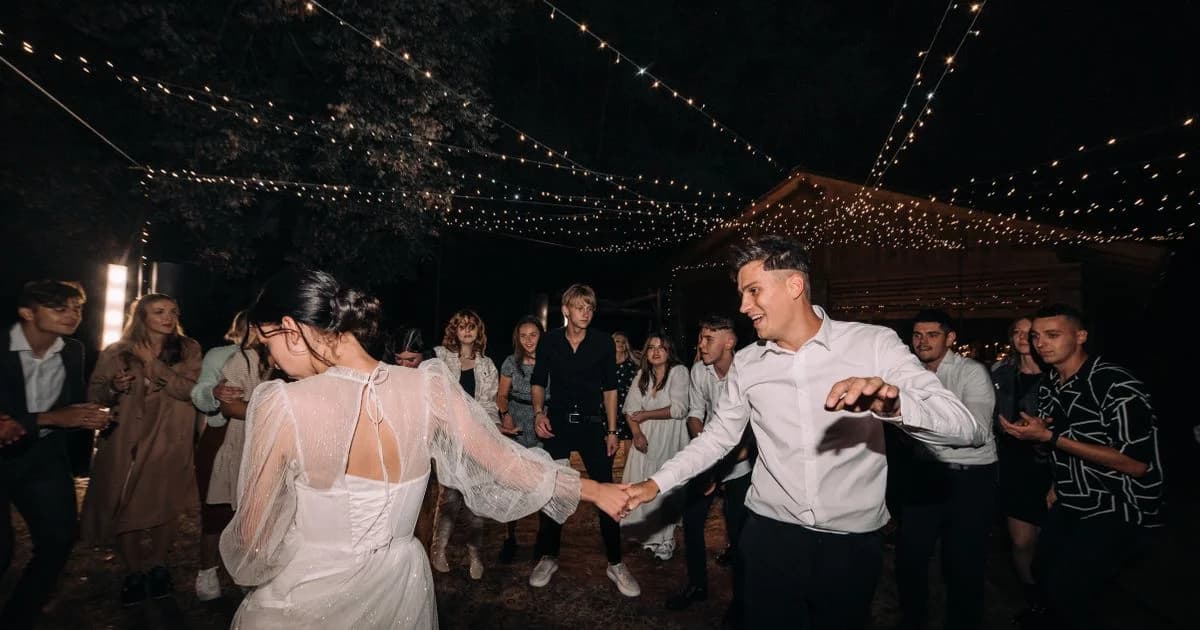
A Brazilian wedding usually starts long before the ceremony. Wedded Wonderland walks you through Brazilian wedding traditions in the order they tend to happen, from the noivado to the sweets handed out as guests leave. It says plainly which meanings are documented and which are simply often told. It also covers marrying legally in Brazil as an Australian.
Brazil is a large country, and its weddings are not one national style. Customs vary by region, by faith (Catholic, Protestant and evangelical, Afro-Brazilian religions, or none) and, above all, by family.
The same is true in Brazilian-Australian families, where a grandmother's expectations in Sydney may differ from a cousin's in Salvador. Treat everything below as a menu to discuss with both families, not a checklist that every wedding follows.
The first customs arrive long before the ceremony itself. They cover the engagement, the gifts for the new home, the chosen sponsors and the ceremony or ceremonies. Each one varies by family, so use them as conversation starters.
In Portuguese, noivado means the relationship between two people who are going to marry, the time it lasts, and the occasion when the commitment is made official, generally with a party.
That last sense matters for planning. Many Brazilian families expect an engagement celebration of some kind, so it is worth asking early whether one is planned, especially if relatives will travel for both.
The ring itself is the aliança, a word the Michaelis dictionary defines as a ring used as a symbol of engagement or of marriage. One band can therefore carry through from noivado to wedding day.
It is often told that couples wear their alianças on the right hand while engaged and move them to the left hand during the wedding, and that the move marks the moment the promise becomes a marriage. Matching bands, so both partners wear one through the engagement, are often mentioned too.

The chá de panela is a gathering, usually of women, at which a bride about to marry receives gifts for her new home from her friends. It is also called chá de cozinha, a kitchen tea.
For a wedding abroad, the chá de panela is normally held at home before anyone travels, so it rarely touches the destination schedule. A mixed version with both partners and their friends is an option too, and the guest list is entirely a family decision.
Padrinhos and madrinhas are among the most personal Brazilian wedding customs. The Priberam dictionary defines a madrinha as a woman who serves as a witness at a baptism or a wedding.
The groom's padrinho even has a formal name, paraninfo, so the honour is a witnessing role rather than a decorative one.
It is often told that couples ask several pairs, often married couples, to stand with them, chosen from both sides of the family. Because the role is formal, decide early who will sign as a legal witness at a civil ceremony and who will stand as an honorary padrinho. The number of legal witnesses is something to confirm with the cartório, not to assume.
The words come from the same Portuguese language as the customs of Portugal, and you can compare them with our guide to Portuguese wedding traditions.
Brazilian couples may hold two ceremonies, a civil marriage and a religious or spiritual ceremony, sometimes on the same day and sometimes weeks apart, or choose only one.
Whether to hold a church wedding is a family and faith decision. Couples marry in Catholic and Protestant churches, in evangelical congregations, with Afro-Brazilian religious ceremonies, or with a celebrant and no religious element at all.
Saint Anthony was born in Lisbon in 1195, died on 13 June 1231, and his feast day is 13 June. Britannica describes him as the patron saint of Portugal and Padua, famously invoked for the return of lost things.
In Lisbon, the festival around 13 June includes matchmaking traditions, such as giving a basil plant that carries a love message, and a televised wedding ceremony for dozens of couples.
In Brazil, Santo Antônio is often described as the marrying saint. It is often told that people hoping to find a partner ask for his help in June, and the small rituals for doing so differ from family to family.
June is also the month of the Festas Juninas, and it is often told that many of these festivals stage a playful mock country wedding, with a bride, a groom and a crowd that joins in the joke. It is a festival entertainment, not a real ceremony.
If you are considering a June date in Brazil, those festivities can be a joy for guests. They can also add demand for transport and rooms, so plan around them.

It is often told that some brides write the names of unmarried friends inside the hem of the dress or on the sole of a shoe, and that whoever's name has worn away by the end of the night will be the next to marry.
The party is where many of the best-known customs appear. They include the sweets, the groom's tie, the music and a late finish. Some are documented and others are simply often told, as the notes below make clear.
The Priberam dictionary defines a bem-casado as a small cake of soft sponge made from eggs and wheat flour, composed of two halves. The name translates as "well married".
It is often told that couples wrap each one individually and hand them to guests as they leave. It is often told that the two halves joined by a sweet filling stand for the couple, and that eating one wishes them a good marriage.
Bem-casados usually sit alongside docinhos, the small sweets that fill a Brazilian dessert table. Brigadeiros are one familiar example.
Outside Brazil, find a baker who has made bem-casados before and taste a batch well ahead.

It is often told that at some receptions friends playfully cut the groom's tie into small pieces and hand them round as keepsakes, and that guests offer a small token for the couple in return, but it is a light-hearted moment, and many families leave it out.
Music at a Brazilian wedding follows the region and the family. Two forms recognised by UNESCO are worth knowing if you want a regional thread in the celebration.
The Samba de Roda of the Recôncavo of Bahia was inscribed on UNESCO's Representative List of the Intangible Cultural Heritage of Humanity in 2008. UNESCO describes it as music, dance and poetry that developed in the Recôncavo region of Bahia from the seventeenth century, drawing on the traditions of the region's enslaved Africans and on Portuguese elements.
UNESCO notes that it is performed at popular Catholic festivities and Afro-Brazilian religious ceremonies, as well as in more spontaneous settings. Participants gather in a circle, the roda, and everyone present, beginners included, is invited to join.
Frevo, the performing arts of the Carnival of Recife, was inscribed in 2012. UNESCO describes music and dance with a quick, vigorous rhythm played by bands and fanfares, and a dance called the passo.
Neither is a wedding custom in UNESCO's description. They are music a couple with roots in Bahia or Pernambuco might choose to honour that region, ideally with performers who know the form well.

It is often told that Brazilian receptions keep dancing late into the night, and that guests expect a meal or snacks well after the main dinner.
When you choose a venue, ask for its music curfew, last finish time and late-food options in writing. For a wedding outside Brazil, this is a detail that often differs from what Brazilian guests expect.
This section reflects official sources as at November 2026. It is general information, not legal advice, and requirements can change.
In Brazil, start with the cartório de registro civil (the civil registry office). Check with the cartório what makes your marriage legally valid there, and whether a religious ceremony can also carry civil effect once registered.
Before a civil marriage comes a process called habilitação. The steps, any public notice period and how long the result stays valid are set by the cartório applying Brazil's law, so check with the cartório and the Australian Embassy in Brasília, including any fees.
Same-sex couples can marry in Brazil. A 2013 resolution of Brazil's National Council of Justice (CNJ Resolution 175) provides that authorities may not refuse the habilitação, the celebration of a civil marriage, or the conversion of a stable union into marriage between people of the same sex. A refusal must be reported immediately to the supervising judge.
Ask the cartório what it needs before you book anything with the Embassy. The Australian Embassy will not advise which documents are needed; you must ask the receiving authority directly.
Many countries ask foreign partners to prove they are not already married. DFAT issues a Certificate of No Impediment to Marriage (CNI) for this, through Australian Passport Offices, overseas missions and by mail, and at least one partner must be an Australian citizen or permanent resident.
You may not need a CNI at all: DFAT says some authorities accept a Single Status Certificate or a No Record Result Certificate from a state or territory registry instead. A fee applies to a CNI, paid when you apply.
The CNI form must be signed in front of an authorised witness, and supporting documents not in English need a professional English translation. If you are already in Brazil and mailing an application, the Embassy accepts it only if your signature was witnessed by a local cartório.
The Hague Apostille Convention has been in force in Brazil since August 2016, and an apostille authenticates the origin of a public document so that it is recognised there. The Embassy in Brasília and the Consulate-General in São Paulo provide notarial services, including apostilles and CNIs, by appointment only, and fees apply.
Whether the cartório also needs a sworn Portuguese translation of your documents, and which ones, is a question to put to the cartório and the Embassy, including any fees.
How an overseas marriage is treated at home is covered in our guide to registering an overseas marriage at home. For Brazil specifically, check with the Australian Embassy in Brasília and Smartraveller before you marry.
A Wedded Advisor is your single point of contact, with the fee agreed in writing before any work begins and inclusions confirmed in writing before you commit. For the legal side, the cartório and the Embassy remain your best guides. If that sounds useful, speak with a Wedded Advisor.
Brazil is a large country, and conditions differ by region and season. The notes below come from Smartraveller, as at 3 November 2026. Check the advice again before you book and before you fly.
As at 3 November 2026, Smartraveller advises Australians to "Exercise a high degree of caution" in Brazil overall because of the threat of violent crime, with no higher-level areas. The advice was last updated on 27 October 2026.
Smartraveller names drug-trafficking crime along the western and northern borders, in Amazonas, Acre, Rondônia, Mato Grosso, Roraima, Pará and Amapá, and the tri-border area at Foz do Iguaçu. For a wedding, consider places outside those states.
A visa is needed to enter Brazil and must be arranged before arrival, as it is not available at the airport or border. Dual nationals must enter and leave on a Brazilian passport. Smartraveller adds that male dual nationals over 18 may need to do military service.
Same-sex relationships are legal in Brazil but not always accepted, especially in rural areas.
A few more points from Smartraveller shape the planning:
Travel insurance should cover medical costs, including evacuation.
The wet season runs January to July in the north, November to March in the south and south-east, and April to July in the north-east, with possible flooding and flight delays.
Wildfires are common from May to September, which matters for outdoor dates.
Drink spiking and methanol poisoning occur, so serve only branded, sealed drinks.
A yellow fever vaccination certificate may be needed.
The presidential inauguration in Brasília on 5 January 2027 may bring demonstrations and increased security before, during and after.
If older or less mobile relatives are travelling, ask the venue or your planner about step-free access, transfer times and the nearest medical care, and check their travel insurance covers medical costs, including evacuation.
Read the full Smartraveller advice for Brazil before you book anything, and again before you fly, because entry conditions can change at short notice.

Consular assistance comes from the Australian Embassy in Brasília and the Australian Consulate-General in São Paulo.
Notarial services are provided only from Brasília and São Paulo, by appointment; outside São Paulo, you book with Brasília. The Honorary Consulate in Rio de Janeiro offers limited services and is not authorised to perform notarial services. If your documents need witnessing or an apostille, plan the appointment into your itinerary early.
Many Brazilian-Australian couples marry in Australia or in a third country, and carry Brazilian customs with them. The ones that travel best are the ones that need nothing but people.
Padrinhos and madrinhas work anywhere. So do alianças moved from right hand to left during the vows, names written inside a hem, and a table of bem-casados by the door.
If you are weighing a celebration somewhere between both families, our guide to weddings in Latin America and the Caribbean is a useful place to compare destinations.
Brazilian weddings reward couples who decide early which customs belong to them. Talk to both families, choose the traditions that carry meaning for you, and leave the rest without apology. For more customs from around the world, return to our guide to wedding traditions worth keeping.
Written by

SEO Specialist
Ayrton Christian Braga is an SEO Specialist at Wedded Wonderland, where he writes optimized articles and web pages that center on destination weddings, cultural wedding traditions, and guides for everything in between.
Search real weddings, venues and vendors from around the world.
Search Wedded Wonderland