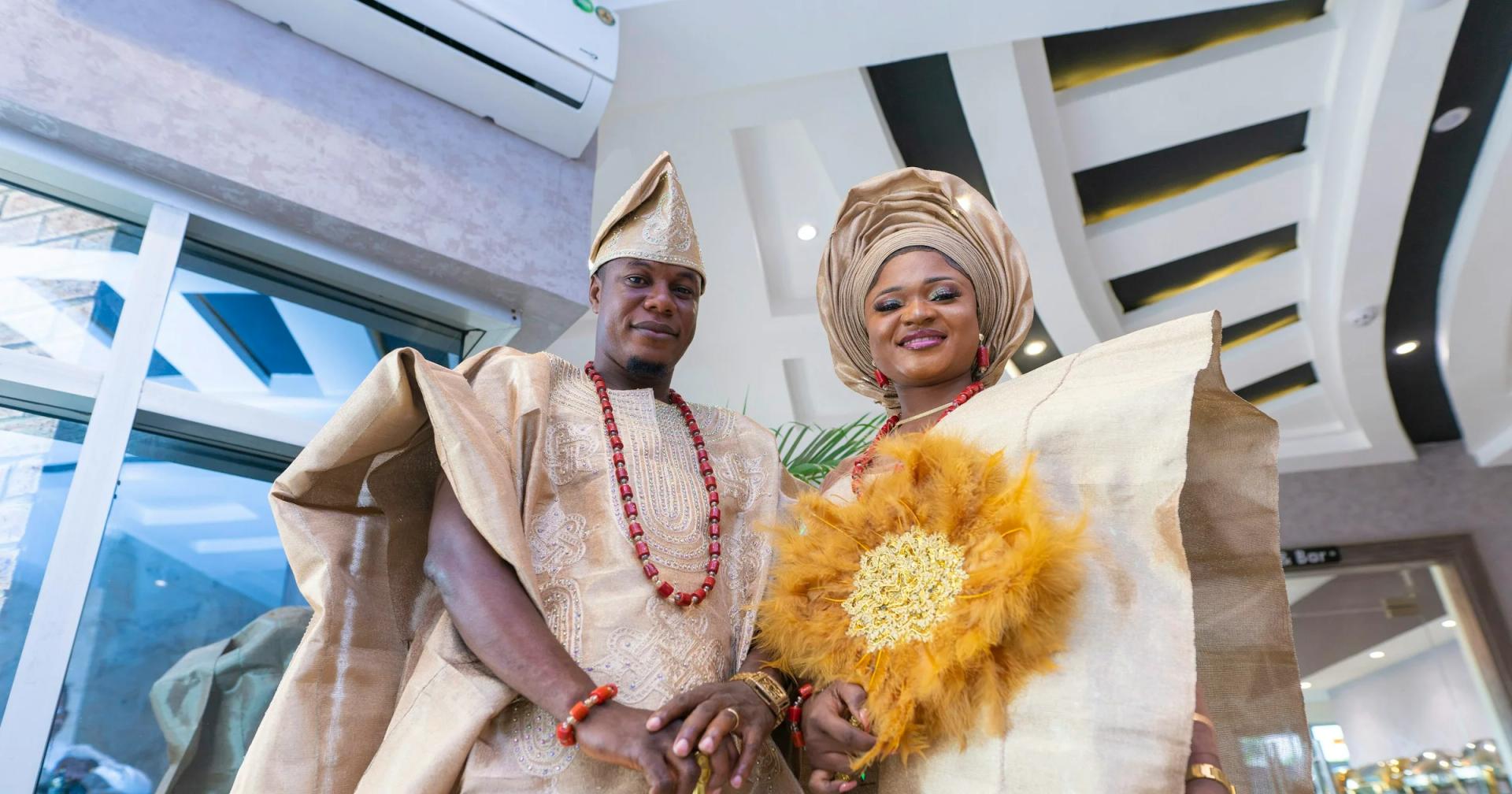
A Nigerian wedding begins long before the big day, when two families meet, present gifts and settle a list. Yoruba, Hausa-Fulani and Igbo families each marry in their own way. This Wedded Wonderland guide walks through their customs, family by family. It closes with how to hold them at a wedding in Australia or abroad.
Nigeria is home to many peoples, and its three largest groups each marry in their own way. The Yoruba are one of the three largest ethnic groups of Nigeria, concentrated in the south-west. The Igbo live chiefly in south-eastern Nigeria and are widely dispersed within Nigeria and across many countries. The Hausa live chiefly in the north-west.
Customs differ between Yoruba, Igbo and Hausa-Fulani families, and from one family and faith to the next. Many Yoruba are Christians or Muslims, while aspects of traditional religion survive. Many Igbo are now Christians. For other cultures, see our guide to wedding traditions from around the world.
Many couples marry twice in the eyes of their families. The traditional wedding belongs to the two families and their customs. The faith or civil ceremony, a church wedding, a nikah or a registry, often falls on another day.
Yoruba weddings are full of ceremony, wit and colour, and of care over who greets whom, and how. Here are three customs you will see at many Yoruba weddings.

In many Yoruba families, the first formal step is the introduction: a meeting at the bride's family home where the groom's family is presented, names are given and the two sides agree to go ahead.
The engagement ceremony, which many families call the idana, follows. This is the traditional wedding itself. Two hosts, the alaga, often lead the day, one speaking for each family, keeping the programme moving with humour and calling each part in turn.
The groom's family brings the bride price and the items on a list the bride's family provides. In many families these include gifts for the bride's parents and relatives, fabric, drinks and food. Families settle the list between themselves, and it varies widely.
At many Yoruba engagements, the groom and his friends lie prostrate before the bride's parents and elders when they arrive. The bride, in turn, kneels to greet her parents and her new family.
The greeting is repeated through the day, and the groom's party may be asked to go down more than once.
Dress carries much of the day. The Yoruba have long been skilled craftsmen whose trades include weaving, and Yoruba women engage in cotton spinning and dyeing.
Aṣọ-òkè is a handmade strip-woven cloth historically produced by the Yoruba in south-western Nigeria, woven by men in narrow strips that are then stitched together. It is worn by both men and women, it is typically striped, and certain pieces are reserved for special religious, communal or family occasions.
A women's set can include a bùbá blouse, an ìró wrapped skirt, an ìpèlé shawl and a gèlè headwrap, all in matching aṣọ-òkè. At many Yoruba weddings, the bride's gèlè is tied high and sculpted, and the groom wears a fila, a soft cap, often in the same cloth as his outfit.

Tying a gèlè takes skill and time. A Nigerian designer created a pre-tied gèlè to make getting dressed easier, and many brides now choose one for a second outfit later in the day.
In northern Nigeria, faith and etiquette shape the wedding. Islamic influence spread among the Hausa from the 14th century and profoundly influenced their belief and customs, and perhaps half of the Fulani in the area have adopted Hausa language and culture. The Fulani are a primarily Muslim people found across West Africa, concentrated principally in Nigeria, Mali, Guinea, Senegal and Niger.
Hausa social ranking is expressed in an elaborate etiquette, and in many families it shows at a wedding: who is greeted first, who speaks for the family and who sits where.

For Hausa-Fulani families, the marriage itself is the nikah, the Islamic marriage contract. Many families also call it the fatiha. It is often held at a mosque or at the family home, usually led by an imam, with the bride's guardian and witnesses present.
The groom gives the sadaki, his marriage gift to the bride. The amount is a matter for the families.
If your families observe other Muslim customs too, our guides to Muslim wedding traditions and the traditions you will see at almost every Muslim wedding cover them in more depth.
The kamu is the evening when the groom's family comes to collect the bride. In many Hausa families, women relatives from the groom's side arrive, the bride is veiled, and she is escorted from her family to her new home, often with songs along the way.
In the days before, many brides hold a henna gathering, the lalle, when their hands and feet are painted in fine dark designs among friends and women relatives. Many families keep these gatherings for women only.
Igbo marriage moves in stages, and palm wine runs through all of them. Palm wine is central to any Igbo traditional ceremony and the preferred drink at weddings, child naming ceremonies, funerals and memorials.
In Ezinifite-Aguata, in Anambra State, marriage moves through five stages: knocking at the door (Ịkụ aka n'ụzọ), presentation of gifts (Ịgbanye ihe), the outing ceremony (Ịkpọta nwaanyị), paying of the bride price (Ime ego) and the public traditional marriage ceremony (Ịgba mmanya ọha niile), with palm wine used to communicate at each stage. Palm wine customs differ between Igbo communities, so ask both families which stages they keep.
Knocking at the door is the first stage in most communities in Igboland. In Ezinifite-Aguata, the suitor and his father visit the woman's family with palm wine to register his interest, and the hosts present kola nut as a sign of welcome.
There, the daughter is given a cup of palm wine. If she consents, she sips it and hands the rest to her suitor.
In Ezinifite-Aguata, at the later stages of presenting gifts and the outing, the bride-to-be hands the palm wine to her fiancé while kneeling on one knee as a sign of respect, signalling her public acceptance.
In Ezinifite-Aguata, at the bride price stage, Ime ego, the groom's kinsmen go with him to the bride's family. After kola nut and palm wine, he offers the bride price to his father-in-law, who takes part of it and returns the rest, saying he is not selling his daughter. Other items for the ceremony are then presented.
The bride's kin have their own requests too. There, at the public ceremony, the bride's father and kinsmen examine the groom's palm wine, and the married daughters of the kindred (ụmụada) and the young daughters (ụmụagbọghọ) ask for their entitlements before the ceremony begins.
Every family's list is its own, so settle it well ahead of the day.
The public ceremony is the one most guests will see, and many families call it igba nkwu, the wine carrying. In Ezinifite-Aguata, the bride's father pours her a cup of palm wine and asks her to show the gathering her husband ("gosi anyị onye bụ di gị").
She sips the wine and walks through the guests in search of the groom, then offers him the cup. He drinks, and together they return it to her father. Eating, drinking, dancing and gifts to the couple follow.

The search is the moment the room waits for. In many families, friends of the groom hide him among the guests, and the bride takes her time.
Some customs travel across Nigerian weddings, whatever the family's group or faith. Here are three you will see at many of them.
Aso ebi is the fabric chosen for a wedding and worn by family and close friends. At many Nigerian weddings, the couple or their families pick one fabric or colour, and each guest who takes part has an outfit made from it.
The effect is a room in blocks of colour, one for each side. Women often wear a matching gèlè, and men a matching fila or cap.

Guests usually buy their own fabric from the family and arrange their own tailoring. Agree early who on each side collects the orders and hands out the fabric, so no guest is left without cloth. Send the details early, with the colours, the fabric and the date the outfits should be ready.
At many Nigerian receptions, guests dance up to the couple and place notes on them, one at a time, while the band plays. The couple are usually sprayed together, and parents and close family take their turn on the floor.
Friends of the couple often gather the notes from the floor as the dancing goes on.
Many Nigerian couples also hold a white wedding: a church ceremony with a white gown, a suit and a reception, held on a separate day from the traditional wedding. Many Muslim couples hold the nikah in its place.

The traditional wedding is in aṣọ-òkè, lace or the family's chosen fabric, with the families leading. The white wedding follows a church service, then a reception with speeches and dancing.
For Nigerian-Australian and mixed-heritage couples, the question is how to hold these customs well, far from the family home, with guests who may be meeting them for the first time. These notes cover travel, fabric, timing and the reception room.
As at November 2026, Smartraveller advises Australians to "Reconsider your need to travel" to Nigeria overall, including Abuja, and "Do not travel" to 26 states and the Federal Capital Territory (excluding Abuja). Read the Smartraveller advice for Nigeria before any family trip.
The Australian High Commission in Abuja and the Honorary Consulate in Lagos provide limited consular and passport services. Families can instead hold every ceremony in Australia, or at a destination where relatives from Nigeria, the United Kingdom and North America can meet. Our guide to weddings across Africa covers other options on the continent.
Aṣọ-òkè is hand-woven in narrow strips, and weaving enough for a single jacket can take around 24 hours over a week. Order family cloth early and confirm lead times with the weaver before you set the date guests need it by.
Questions to settle with both families:
Who chooses the aso ebi, and is there one fabric for each side or one for everyone?
How will guests in Australia and overseas order, pay for and collect their fabric?
Who on each side will sell the fabric, collect the money and keep track of every order?
Which tailors near your guests can make the outfits in time?
Who will tie the gèlè on the day, and how long should the hair and make-up schedule allow?
Decide first whether the two ceremonies share a weekend or sit months apart. Holding the traditional wedding and the white wedding or nikah on consecutive days means relatives who travel need only make one trip.
Before you choose a place, settle the guest questions. Where will everyone stay? How will relatives flying in from Nigeria, the United Kingdom and North America reach the venue? How will older or less mobile guests manage the flights, the transfers and two long days? Which guests will need a visa, and what travel insurance and medical cover should each guest carry?
Igbo families may hold the earlier stages as smaller gatherings, so brief your Wedded Advisor and venue on which stages need a space.
Set up a wedding website for a traditional and a white wedding, with both days, both dress codes and the aso ebi details in one place.
If any part of the marriage takes place overseas, ask a lawyer and your celebrant how it will be recognised. As at November 2026, an overseas marriage cannot be registered in Australia, but in most cases it is legally recognised if it was valid where it took place and would have been valid under Australian law.
The Nigerian wedding party lives on the dance floor, so build the room around it. A few questions for every venue:
Is the dance floor big enough for families to dance in together, and for spraying around the couple?
Can the band or DJ play until the time your families expect, and is there a noise limit?
Will you have an alaga for the traditional wedding, an MC for the reception, or both, and who briefs them on names and order?
For an Igbo ceremony, is there a clear path through the guests for the bride's search, and can you bring in or serve palm wine, with what corkage?
Who will gather the notes during spraying, and where will they be kept safe?

Leave time on the run sheet for the bride to search the room, kneel and return the cup to her father with the groom before the dancing starts. And if the couple are planning an African honeymoon by season, set the dates once both weddings are fixed.
A Wedded Advisor plans the venue, travel, vendors and payments around the parts your families lead, as your single point of contact. They work in your time zone and quote in AUD, the fee is agreed in writing before any work begins, and your advisor confirms the inclusions in writing before you commit. The nikah, the church service, any legal steps and every family custom stay with you, your families, your celebrant and your faith leaders.
A Nigerian wedding begins long before the big day, and its joy carries on long after the last note is gathered from the dance floor. Whether your families keep Yoruba, Hausa-Fulani or Igbo customs, or a blend of them, every greeting, cup of palm wine and length of aso ebi tells the story of two families becoming one. Plan it generously, honour what each side brings, and your celebration will feel like home wherever you hold it.
Written by

SEO Specialist
Ayrton Christian Braga is an SEO Specialist at Wedded Wonderland, where he writes optimized articles and web pages that center on destination weddings, cultural wedding traditions, and guides for everything in between.
Search real weddings, venues and vendors from around the world.
Search Wedded Wonderland