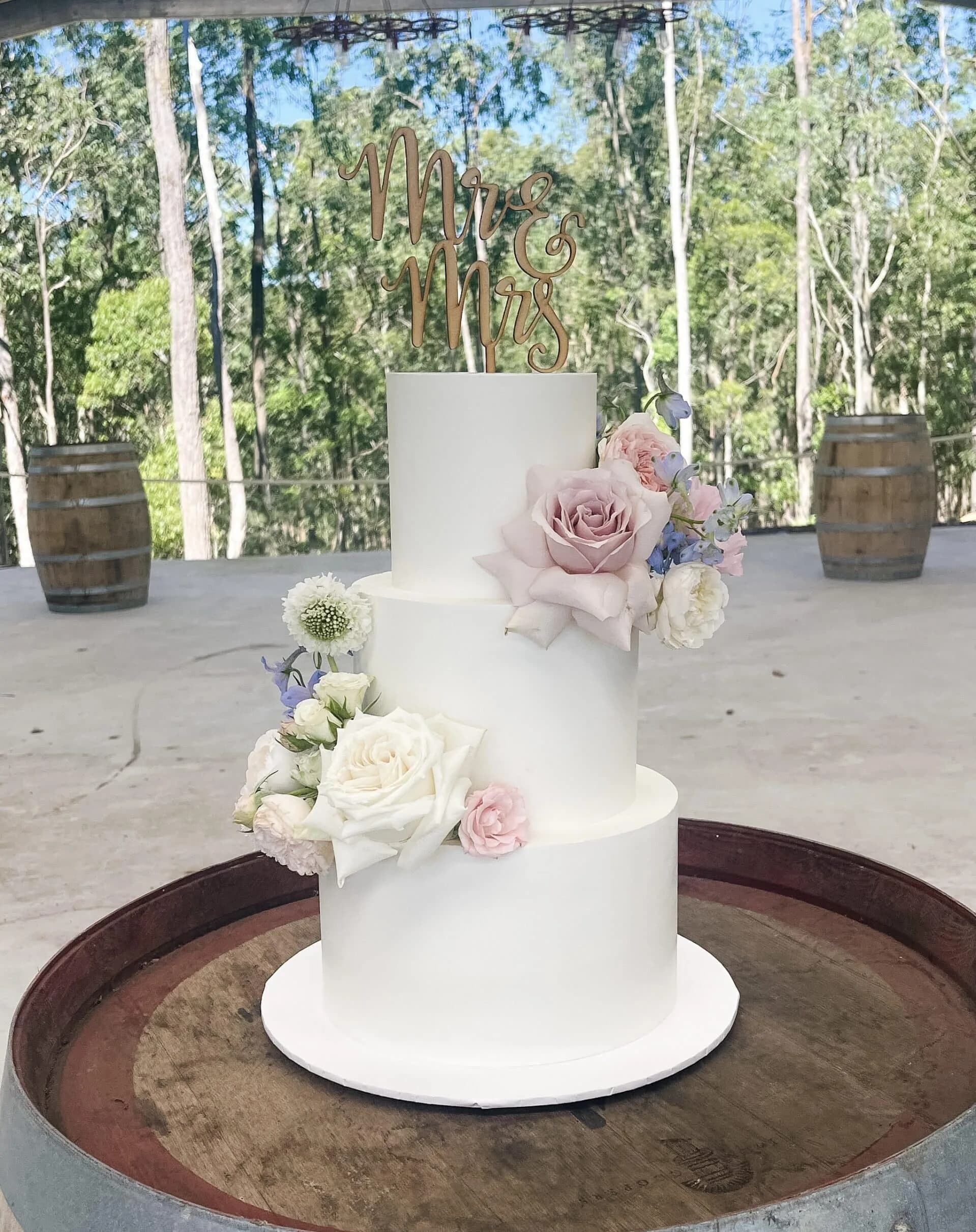
Choose a wedding cake from the room it stands in and the hour it is cut, then the look. An edge that stays sharp in a cooled ballroom can sag in a warm marquee before anyone picks up the knife, and a cake sized from the guest list, rather than from the guests who will eat it, costs more than it should.

Below are 25 wedding cake styles, each with how it looks, how it behaves in heat and on the road, and what to ask your maker. After the list come the rooms each style suits, tier sizes for your guest count, the venue rules to settle first, and makers in Australia, the UAE, the UK and the US.
The first sixteen styles are finishes and decorations, the surface your guests see and photograph. Styles 17 to 25 are structures and serving plans, which decide how the cake stands, travels and feeds the room. For a soft, architectural look, start with 5, 6, 7 and 18; for opulence, 10, 15, 20 and 22; and for heritage, 3, 11, 13 and 23.
Smooth buttercream is butter whipped into a meringue or sugar base, then scraped against a turntable until the sides are flat and the top edge is sharp. It reads as soft and matte, closer to linen than to porcelain, and it tastes the way most guests expect a wedding cake to taste. It is also the least forgiving finish in heat, because a crisp edge shows the first sag before anything else does.

Craftsy calls Swiss meringue buttercream fussy about humidity and suggests the steadier Italian meringue for an outdoor summer party. London's Violet Cakes uses Swiss meringue as standard, with wedding cakes from £540, which suits a cool English room. In a warm venue, ask for ganache beneath the buttercream, and ask the maker in writing how long the cake may stand out of the fridge.
Fondant, called sugarpaste in the UK, is a pliable sugar dough rolled into one sheet and smoothed over the whole tier. The result is porcelain-flat, with no crumb or stroke showing, and it gives the cleanest base for lace, painting, pearls or sugar flowers. Because the sheet seals the cake, the sponge stays moist for longer, and in dry heat it holds its shape better than any buttercream.

Its weak point is moisture: a fondant cake carried from a cold room into humid air can sweat, and Fiona Cairns warns that a fridge makes icing sweat. Ask for ganache under the sheet for a sharp edge. In Dubai, Pink Cakes lists a four-tier smooth sugar paste cake at AED 3,000. Some guests peel the sheet away, so choose a sponge and filling worth eating on their own.
Royal icing is egg white and icing sugar beaten stiff, spread in thin coats over marzipan until it dries to a crisp white shell. It is the classic coat for a rich fruit cake, the finish of the 2011 royal wedding cake by Fiona Cairns, and the surface that takes fine piping best. It stays crisp in heat and keeps best out of the fridge, since Fiona Cairns says chilling dries the middle and makes the icing sweat.

The hard shell needs a long, sharp knife to cut neatly. Marzipan is almond, so note it on the menu for guests with nut allergies. Cake Design by Holly Miller in Somerset offers a rich fruit cake soaked in Somerset cider brandy with marzipan, a natural base for a tier you plan to keep.
Ganache is chocolate melted into hot cream, cooled until it spreads, then set to a firm coat with a sharp edge. Most makers treat it as a base layer rather than the finish: under buttercream or fondant it firms the cake from beneath and gives the crisp edges you see in editorial photographs. Left bare, dark ganache has a glossy, modern look and suits a chocolate or espresso sponge.

Mia's Brooklyn rates ganache low for heat tolerance on its own and says it needs cool storage, so bare ganache belongs in an air-conditioned room. In the Hunter, Flourish Cakes has made a three-tier white ganache cake dressed with fresh flowers. For a summer date, ask for ganache under the finish rather than as the finish, and ask whether it is white, milk or dark, since white sets softest.
Stucco buttercream is spread with a palette knife in short, overlapping strokes, so the sides read as plaster, lime wash or weathered stone. It brings a handmade, architectural feel to a country house, a winery barrel room or a pared-back city loft. Texture also forgives: small marks from transport, or a slight softening in a warm room, disappear into the pattern.

It is still buttercream, so the same heat rules apply, and a ganache base keeps the strokes from slumping. In Sydney, Black Velvet Cakes lists a multi-tier rustic stucco wedding cake at A$375, a useful reference point before sugar work or extra tiers. Textures vary widely between makers, so ask for swatches, look at them in your room's light, and choose the colour beside your table linen.
Ribbed buttercream is combed with a shaped scraper into even vertical or horizontal ridges, and rippled versions curve the ridges into soft waves. The lines catch side light from windows or candles, so the cake looks sculpted without any added decoration. In warm air the ridges keep their line longer than a smooth edge, and when they do soften, they soften together rather than showing one sag.

Flourish Cakes has set up a three-tier rippled cake at Peterson House in the Hunter Valley, and London's Peggy Porschen lists a design called Ripples of Love. The ridges take extra scraper time, so ask whether the quote differs from smooth buttercream at the same size. Ask too whether the ribs run to the top edge or stop short, as that changes how sharp the cake reads from across the room.
A semi-naked cake is iced and then scraped back until the sponge shows through a thin veil of buttercream. It suits a garden, a vineyard or a long-table dinner, and sits well under fresh fruit or garden roses. Because so little icing covers the sides, there is little to slump, which makes it one of the steadier choices for a warm marquee.

The trade-off is the bare edges, which dry in moving air, so ask how the sponge is kept moist. Sydney's Black Velvet Cakes lists a multi-tier semi-naked cake at A$225, and Black Star Pastry sells a tiered semi-naked orange cake at A$550 small or A$1,000 large. Black Star says its cakes can stay out of refrigeration for up to 1.5 hours, depending on conditions, so plan the cut back from your own maker's figure.
A naked cake has no outer icing, so the layers of sponge and filling sit in plain view, often finished with fruit, flowers or a dusting of icing sugar. It looks generous and informal, and suits a daytime garden wedding or a small lunch. Nothing on the outside can slump, but bare sponge dries quickly in warm or moving air, so it belongs on the table close to the cut rather than for the whole reception.

The Pastry Garden in Poughkeepsie, New York, offers a simpler naked cake with fresh flowers. Black Star Pastry in Sydney lists a tiered naked carrot cake, dairy free, egg free and halal, at A$550 small or A$1,000 large, though it delivers only within about 30 km of its Rosebery store and does not customise designs. Ask your maker to set it up late.
Fresh flowers make a plain tier part of the floral design, with garden roses or seasonal stems tucked into the tiers at set-up. They go on during the day because they wilt, and a careful maker keeps cold spares to swap in before the cut. The 2018 royal cake by Claire Ptak, lemon and elderflower under buttercream with fresh flowers, made the look a reference point.

The Miller Library advises only edible flowers, such as calendula, lavender and violet, against the icing, and warns that alstroemeria, a florist staple, can upset skin and stomach. London's Violet Cakes sources its flowers from Rebel Rebel in Hackney and the London Flower Farmer in Walthamstow. Agree in writing whether the maker or the florist places the flowers, and ask for any florist stems to be wrapped or kept clear of the icing.
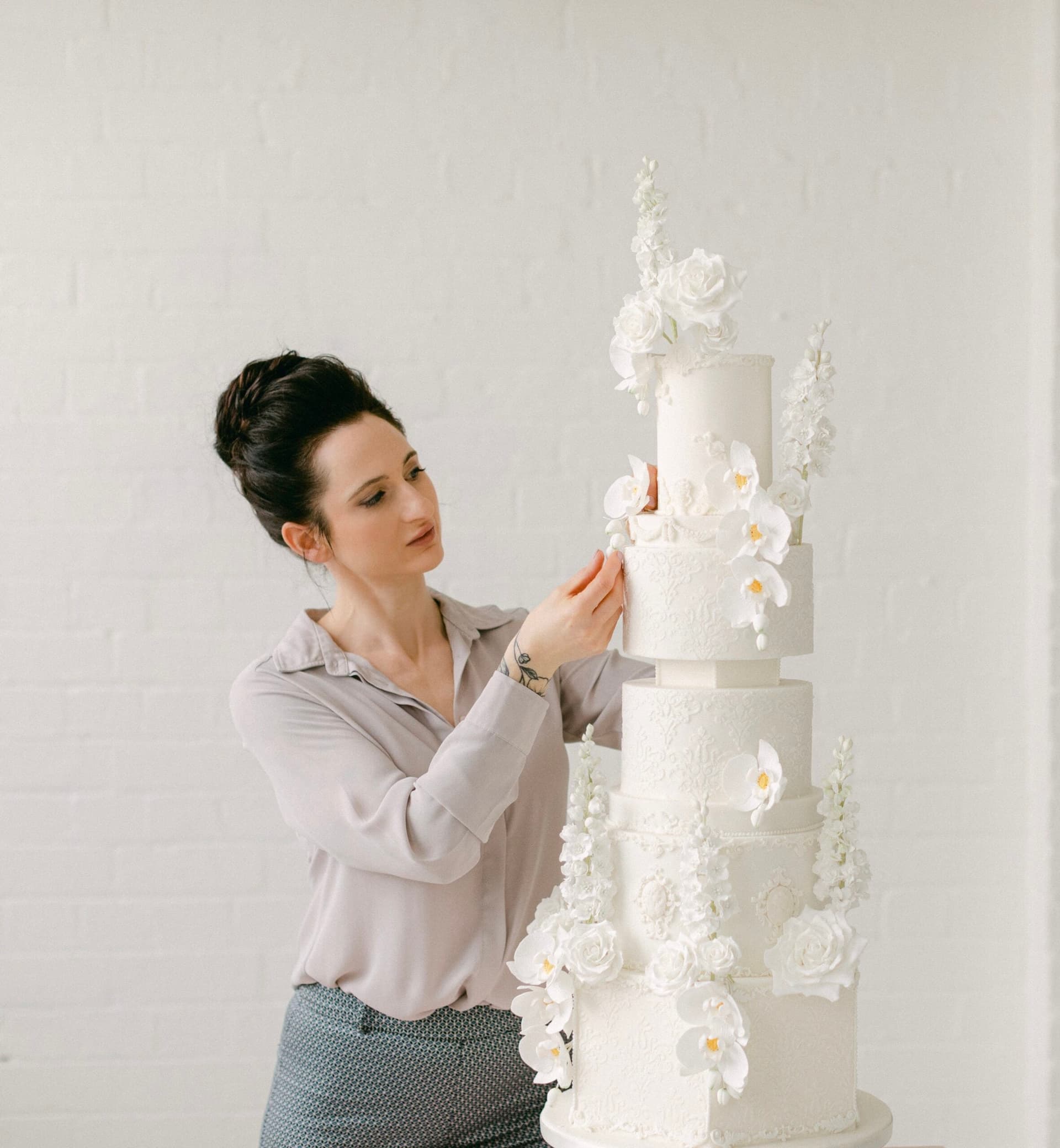
Sugar flowers are shaped petal by petal from sugar paste, wired, dusted with colour and assembled into roses, peonies or sweet peas that can be kept long after the day. They hold their shape in dry heat and can match flowers that are out of season or unsafe against food. Humidity is their weak point, since moist air softens thin petals, so they belong in a cooled room.

Heavy sugar work is one of the largest cost drivers, and Wedding NSW puts elaborate custom cakes with extensive sugar work and four or more tiers at A$3,500 to A$8,000 or more in Sydney. On the Wedded Marketplace, Sweet Designs by Rita in Strathfield makes handcrafted sugar flowers its signature, and Holly Miller shows sugar sweet peas. Book early, and check that every wire comes out before the cake is cut.
Pressed flowers are edible blooms dried flat and laid against the icing like a botanical print, often climbing one side of the cake. They suit a garden or country house wedding, and anyone who wants flowers on the cake without the height of fresh stems. Because they are already dried, heat leaves them alone, but they need a firm surface: they sit flat on royal icing or fondant and can curl on soft buttercream.

The flowers must be sourced as food, not taken from the florist's buckets. Nurtured in Norfolk sells a pressed edible mix of violas, lavender, mini daisies, abutilon and pansies with a six-month shelf life, the kind of product a maker should use. Ask your maker to match the palette to your florist's, and to apply the flowers close to the day so the colours stay bright.
Hand-painted cakes use edible colours brushed onto a firm surface, as a watercolour wash, a botanical study, a pattern taken from your stationery or a single initial. The paint needs fondant, royal icing or well-chilled buttercream underneath, so the finish below decides how the cake behaves in heat. At a small dinner, one painted monogram feels personal without turning into a novelty.

Brooklyn's Lael Cakes paints watercolour cakes, with custom cakes from US$640, quoted at US$16 to US$19 a serving. Holly Miller in Somerset has painted Arabic initials, a detail that suits a Lebanese, Egyptian or Gulf celebration. Painting is slow, skilled work, so send the maker your invitation suite early and ask to see a painted sample before you confirm.
Lambeth piping is the layered overpiping named after Joseph Lambeth, built up in scrolls, swags, shells and beads until the tiers look carved. It reads as vintage and grand, and suits a heritage hotel, a church wedding or a ballroom with ornate ceilings. The 2011 royal cake by Fiona Cairns used elements of the Lambeth technique on a traditional fruit cake.

The piping stays crisp in royal icing but blurs in buttercream, especially in a warm room, so ask which medium you are quoted. In Sydney, Black Velvet Cakes lists a multi-tier white vintage cake with Lambeth-style piping at A$315. Full royal-icing Lambeth work takes far longer, so ask for it to be quoted separately, and ask to see close-up photos of the maker's own piping, not only of finished cakes.
Lace cakes carry sugar lace pressed from moulds or piped by hand, often copied from the fabric of the dress, and pearls are small sugar beads set in lines or clusters. Together they suit a formal church wedding or a ballroom, and they tie the cake to the dress and veil without a word. They hold best on fondant, which gives a smooth, firm surface for fine detail and keeps the lace from sinking.

New York's Ron Ben-Israel Cakes has a Lace and Beading collection, and in the Hunter, Flourish Cakes has made a two-tier cake with sugar pearls. To copy your dress lace, send the maker a fabric swatch or close photographs early, as matching a pattern adds design time. Ask whether the pearls are soft sugar or harder dragées, which some guests find tough to bite.
Edible gold leaf is real gold beaten into sheets so thin they lift on a breath, then laid on as full panels or scattered flakes. It suits an evening reception, a ballroom and the scale of a Gulf wedding, where gold reads well under strong lighting. Heat leaves the leaf alone, so the finish underneath decides how the cake behaves.

Holly Miller works with 24 karat edible gold leaf and Violet Cakes offers gold leaf, while The Perfect Gift in Dubai lists a five-tier Royal Orchids and Gold cake at AED 6,500, though its page does not say the leaf is edible. Ask for the product name to confirm it is sold as food. Slofoodgroup, for example, sells 24 karat edible gold leaf certified by EarthKosher, a kosher mark rather than a halal one, which matters for a halal celebration.
Wafer and rice paper sails are thin edible sheets, tinted or left white, shaped into fins, waves or petals that stand out from the tiers. They give movement and a modern, editorial look, and suit a gallery, a rooftop or a contemporary hotel. Because the sheets weigh almost nothing, they add height without adding load to the tier below.

Heat does not harm them, but humidity does, since moisture from the air or from buttercream softens the sheets until they droop. Holly Miller shows wafer and rice paper sails on her site, and Brooklyn's Lael Cakes shows rice paper sails among its custom cakes. Ask how the sails are kept dry until the cut, whether they are set into ganache or fondant, and whether spares travel separately.
Classic stacked tiers sit directly on one another, each on its own cake board, with dowels pushed through the tier below to carry the weight. It is the traditional wedding silhouette and the most efficient way to feed a room, because every tier is real cake. The stack behaves as its finish does, so a fondant stack holds in a warm room longer than a buttercream one.

Flourish Cakes lists a standard tier at 4 to 5 inches (about 10 to 13 cm) tall and three tiers from A$545, and counts its 15, 20 and 25 cm stack as 75 dessert or 150 coffee portions. Transport is the main risk, as a stacked cake is heavy, so ask whether it travels assembled or is stacked at the venue. Ask too where the caterer starts cutting.
An extended single tier is one tall cake, taller than a standard tier, set on a plinth or a cake stand so it reads as a sculpture rather than a stack. It suits a salon dinner, a small wedding or a bare modern table, and it gives clean space for one painted panel or a single spray of sugar flowers. Its height makes any slump easy to see, so it needs firm internal supports and a firm finish.

Flourish Cakes lists extended-height tiers at 6 to 7 inches with six layers, from A$240. The caterer needs a cutting guide, because a tall tier is cut in two layers rather than in full-height wedges. Ask the maker how many portions it gives at your cut size, and whether it travels finished or is completed on site.
A double barrel is two tiers' height in one, built as two cakes stacked on a hidden board with supports, then iced as a single tall drum. It gives the presence of a much larger cake from a small footprint, and works well as the base of a two- or three-tier design. Because the side is so tall, a soft finish bulges first in heat, so fondant, or buttercream over ganache, is the sensible choice.

Flourish Cakes lists double barrels at 9 to 10 inches with eight layers, from A$300. Ask where the internal board sits, so the caterer can lift off the top half before cutting, and whether the maker will brief the caterer on the day. A double barrel travels best chilled and upright, so confirm the van and who carries it in.
Sculptural cakes break the round stack with offset tiers, hexagons, carved forms, cascading tiers or a shape borrowed from the venue's architecture. They suit a ballroom, a gallery or a modern hotel, where the cake stands as a centrepiece, and they follow the non-traditional shapes in our earlier look at cake trends. Carved and offset forms carry weight in unusual places, so they need cold handling and a level table indoors.

New York's Ron Ben-Israel Cakes says sculpted cakes usually start at US$1,600, above its US$1,000 minimum, and its staff assemble most designs on site. For a ballroom piece, ask for a sketch drawn to scale against the stage or the head table. Ask which parts are cake and which are structure, so the caterer knows what can be served.
Separated tiers are lifted apart on pillars, columns or stands, leaving open space between each tier for flowers, candles or nothing at all. The look is classic and airy, and visible pillars feature among the cake trends we are loving. Separation adds height without extra cake, which helps when you want presence in a large room but are feeding a smaller guest list.

Separated tiers also suit a warm room, because each tier travels on its own and can be assembled late, close to the cut. The pillars need a firm base board and a level table, so check the table before the maker arrives. Ask who removes the pillars and flowers before cutting, and whether the stand belongs to the maker and must be returned.
A display cake carries the scale of a large room, while a matching kitchen cake, kept backstage, feeds the guests. The display tiers you cut are real cake, and any dummy tiers sit above the cut; Sweet Designs by Rita is one maker that offers faux tiers. The kitchen cake should be the same sponge and filling, kept cold until plated, so nobody tastes a difference.

London's Violet Cakes serves backstage round cakes alongside its display cakes, which is the pattern to ask for. The approach suits a large ballroom, where a display tall enough to feed every guest would be too heavy to move safely. Ask for the display tiers and the kitchen cakes as separate lines on the quote, and confirm in writing that the kitchen cake matches the display flavours.
A kept top tier is boxed and labelled for the caterer to leave whole, then taken home to eat later. In Britain the custom favours fruit cake under royal icing: royals have saved tiers for christenings (Reader's Digest), and a fruit top tier is traditionally kept for a first child or an anniversary. Leave the kept tier out of the serving count.

Fiona Cairns says fruitcakes last about three months, then advises wrapping in greaseproof paper and foil, freezing in an airtight box and re-icing once defrosted (Country and Town House). In the US, about half of newlyweds save the top for a first anniversary (Food Republic), but a year in the freezer spoils a frosted sponge, so ask your baker for a small replica instead. Ask your maker whether they will re-ice a kept tier.
A small cutting cake is one or two finished tiers set beside a dessert table of petits fours, tarts or cheese. It keeps the ritual of the cut without asking one cake to feed every guest, and it is easy to keep cold until the moment. It suits a house wedding, or any reception where the caterer already plans a dessert course.

At the smaller end, Black Star Pastry lists its two-tier strawberry watermelon cake, alcohol free and halal, at A$450. Agree the palette with the dessert maker so the table reads as one piece, and decide who styles it. Tell the caterer whether the cake is plated with the desserts or boxed for guests to take home, as that changes how small it can be.
A cake with a different flavour in each tier lets you serve a classic and a statement at once. One sponge, such as vanilla or lemon, can sit under bolder tiers like pistachio with raspberry, which Mia's Brooklyn calls "the clear riser of 2026", or brown butter almond with salted caramel. Guests choose at the cutting table, so the caterer needs a plan showing which tier is which.

In Somerset, Holly Miller's flavours include lemon and elderflower, the 2018 royal choice, alongside rose and pistachio, and miso caramel. Cream and fresh fruit fillings need the coldest handling, so put them in the tier that is cut and served first. Ask how many flavours your tasting includes, and whether a second tasting is charged.
Each room rules some styles in and others out before you see a single photo. Match the finish to the room first, then choose the look from the styles that remain. Use these four rooms as a guide:
A warm marquee: Fondant, ribbed or semi-naked buttercream, each over ganache, or a display cake with a cold kitchen cake behind it. Skip sculptural forms, and keep naked sponge to a short wait. Get the maker's time out of the fridge in writing and plan the cut back from it. With no cool room on site, ask whether the caterer's cool room or the maker's chilled van holds the cake, and who minds it.
A cooled ballroom: Fondant, sugar flowers, gold leaf and tall tiers all hold once inside. The risk is the corridor between cold room and stage, so ask who moves the cake, and when.
A house with a dessert table: Textured buttercream, one tall tier or a small cutting cake, sent cold and finished on site. Announce the cut after the mains, and tell the caterer whether the cake is plated with the desserts or boxed for guests.
A country house garden: Royal icing, pressed flowers and a kept fruit tier. The cake waits indoors on a levelled table until the cut, whether at the dessert course or late in the evening.
Size the cake from the guests who will eat it, not from the guest list, and leave any kept tier out of the sum. Most makers work from a servings chart for round tiers, and the Wedding NSW chart gives a 15 cm (6 inch) tier 12 to 16 slices, a 20 cm (8 inch) tier 24 to 30, a 25 cm (10 inch) tier 38 to 45 and a 30 cm (12 inch) tier 56 to 65. Each step up in size adds more slices than the last, so the bottom tier does most of the feeding. The figures shift with tier height and cut size, so ask your maker which count your quote uses.
A coffee portion is about half a dessert slice, and Flourish Cakes counts the same 15, 20 and 25 cm cake as 75 dessert or 150 coffee portions. If the cake is the dessert course, size it in dessert slices. If a dessert table carries dessert, size the cake in coffee portions and a much smaller cake will do. On the dessert-slice count, typical combinations are:
Up to 45 guests: A 15 and a 20 cm tier give 36 to 46 slices.
60 guests with a dessert table: One 20 cm tier gives 24 to 30 slices, or about 48 to 60 coffee portions.
75 to 90 guests: Tiers of 15, 20 and 25 cm give 74 to 91 slices.
120 guests with a kept tier: Tiers of 20, 25 and 30 cm give 118 to 140 slices, with a 15 cm fruit tier kept on top.
130 to 150 guests: Four tiers of 15, 20, 25 and 30 cm give 130 to 156 slices.
350 guests: The same four tiers plus four 30 cm kitchen cakes give 354 to 416 slices.
Four tiers top out at about 156 slices, so past that point the choice is between a kitchen cake and a dessert table. Wedding NSW puts a plain-sponge supplementary cutting cake, cut and plated by staff, at A$4 to A$9 a person, and a styled dessert table for 100 guests at A$1,200 to A$4,500 or more. A kitchen cake keeps one flavour across the room and one supplier to brief. A dessert table gives guests a choice, but adds a second supplier and lets the wedding cake itself shrink to a cutting cake.
Settle the cake rules with your venue before you pay a maker's deposit, because the venue contract can rule a maker out or add a fee you had not planned for. Some hotels and estates accept outside cake makers only from an approved list, and some charge a cutting or plating fee per guest when the cake does not come from their own kitchen. A venue may also count the cake as the dessert course, which changes the menu price. Ask for each answer in writing, as part of the venue contract.
Cold storage and delivery decide how the cake survives the day. Many venues fix delivery windows around the ceremony and other suppliers, so the maker may have a narrow slot to unload and set up. The table matters too, as it should be level, out of direct sun, away from heaters and lit for photographs. Questions to settle with the venue:
Are outside makers allowed, and is there a cutting or plating fee?
Is there a cool room or chilled space for the cake, and who minds it there?
What are the delivery and set-up windows, and is there a loading dock or lift?
Who moves the cake to its table, and who cuts and plates it?
Is the cake table shaded, level and lit?
Then take the venue's answers to the tasting. Ask the maker whether they deliver in a chilled van and set up themselves, and how long the cake may stand out of the fridge. Ask them to name ingredients and flower varieties in writing, including any gelatin, colourings or liqueur, and whether the kitchen handles nuts and other allergens.
Climate, local custom and supplier rules change the brief from one market to the next. Each section below names makers who publish a price or a lead time. Prices change, so treat them as a starting point for your own quote.
Cessnock Airport, in the Hunter, averages a November maximum of 27.1°C (BOM), yet Cessnock reached 41.9°C on 29 November 2020 (Newcastle Herald). For a late-spring marquee, keep the cake chilled until it goes in after the mains. Peak Sydney dates, October to December and March to May, book 10 to 14 months ahead and off-peak dates 4 to 6, with tastings two to three months out after a deposit (Wedding NSW).

Sydney makers charge higher travel fees to the Hunter, while Flourish Cakes delivers there from A$80, though it cannot cater for life-threatening allergies. On the Wedded Marketplace, Sweet Designs by Rita in Strathfield works in buttercream, ganache and fondant, and Michelle Portelli Cakes makes wedding and celebration cakes in Sydney.
The National Center of Meteorology forecast June 2025's mean maximum at 39.8 to 42.7°C (Aletihad), so a summer cake stays indoors and cold. Dubai studios list four and five tiers from AED 3,000 at Pink Cakes, AED 6,500 at The Perfect Gift and AED 7,500 for 150 portions at House of Cakes. House of Cakes and The Perfect Gift invite you to taste at the shop, and Pink Cakes lists no tasting, so ask.

None of the three states halal, so ask for a certificate from a body the Ministry of Industry and Advanced Technology registers, and about gelatin, alcohol and E120 (Gulf News). Ask your hotel whether it serves an outside cake and what it charges, and size a women's evening cake from its own guests. No page states a sugar flower lead time, so allow six to twelve months.
July 2025, the UK's fifth warmest on record, peaked at 35.8°C at Faversham (Met Office), so keep a summer cake cool even in an English garden. Cake Design by Holly Miller in Somerset, on the Wedded Marketplace, starts at £995, asks for twelve months and takes a £200 booking fee off the balance. She hand-delivers and sets up, regularly in London and the Cotswolds.

In London, Violet Cakes starts at £540, and Em Cakes offers classic and vintage designs with at least eight weeks' notice. Fiona Cairns starts at £900 plus carriage and is not halal certified, so ask early if you need certification. For a Cotswolds house, ask the venue for its supplier list before you book a maker.
Central Park's normal high is 84.8°F (29°C) in July and 64.5°F (18°C) in October (NWS), so a summer estate wedding upstate needs a cold van. Ron Ben-Israel Cakes in New York delivers in cold vans and assembles most designs on site, with a US$1,000 minimum and pricing from US$20 a person, and most couples book it six months to a year ahead.

Lael Cakes in Brooklyn starts custom cakes at US$640, with delivery from US$130, and The Pastry Garden in Poughkeepsie ices every wedding cake in French buttercream. For an October date, Mia's Brooklyn calls carrot cake with cinnamon cream cheese frosting close to unbeatable, and suggests tasting six to nine months out and ordering four to six weeks ahead.
Write down the room, the month, the hour of the cut and the number of guests who will eat cake. Take that note, with the venue's answers on outside makers and cold storage, to two or three tastings. To have the cake planned with the rest of your wedding, Wedded Concierge sources and coordinates trusted local vendors, your cake maker among them.
Written by

Content and Creative Manager
Joseph Joshua is the SEO & Content Manager at Wedded Wonderland, bringing an editorial and search strategy perspective to the publication’s coverage of luxury weddings, destination celebrations and bridal lifestyle. His approach to content centres on helping readers move from inspiration to informed decisions, with attention to the design, craftsmanship and personal details that give a celebration its character.
Search real weddings, venues and vendors from around the world.
Search Wedded Wonderland