The nikah is the Islamic marriage ceremony, and at its heart it is a contract: an offer and an acceptance, made willingly before witnesses, with an agreed gift to the bride recorded in writing. Once those elements are in place, the couple is married in the eyes of the faith. This guide walks through the 4 requirements, the ceremony step by step, the mahr, what to wear, the walima that follows, and how the nikah becomes a legal marriage in Australia and the US.

Key takeaways
The nikah is a contract, not a venue: it is formed by offer (ijab) and acceptance (qabul), witnessed and recorded. It can happen in a mosque, a family home, a garden or a ballroom.
Four requirements sit at its core: the couple's free consent, the mahr (the groom's gift to the bride, hers alone), a wali representing the bride in many traditions, and witnesses.
The religious and civil layers are separate: in Australia and the US the nikah becomes legally binding either through an officiant who is also a registered celebrant, or with a separate civil registration. Confirm which applies before the date is set.
The celebration is flexible by design: some couples hold a quiet nikah weeks before the party; others make it the centrepiece of the wedding day, with the walima feast following.
The nikah is the Islamic marriage ceremony, and its essence is a contract entered into willingly by both parties. It is formed by an offer and an acceptance, the ijab and qabul, spoken in the presence of witnesses. Once the contract is agreed, witnessed and, where required, registered, the couple is married. Everything else that surrounds it, the venue, the flowers, the guest list, the sermon's length, is culture and preference rather than requirement, which is why nikah ceremonies range from 10 quiet minutes in a family living room to the formal heart of a 500-guest celebration.

The ceremony is usually led by an imam, sheikh or authorised officiant (a ma'dhun in some countries), but it is worth understanding that the officiant conducts and validates rather than creates the marriage: the essential elements are the couple's consent and the contract itself. In Levantine communities the same ceremony is often called the katb al-kitab, literally the writing of the book, and it sits inside a wider constellation of celebrations, the henna night, the zaffe procession, the feast, that our guide to Arab and Levantine weddings maps in full. For where the nikah sits within Muslim wedding customs more broadly, start with our Muslim wedding traditions guide; this page goes deep on the ceremony itself.

The ceremony goes by several names depending on language and region: nikah or nikkah across South Asia and much of the English-speaking world, aqd nikah or akad nikah in Malaysia and Indonesia, and katb al-kitab in the Levant. The essentials are the same whichever name your family uses.
In Islam, the nikah is the marriage itself: once the contract is agreed and witnessed, the couple is married in the eyes of the faith. When people ask about the difference between a nikah and a wedding, they usually mean 1 of 2 things: the difference between the religious contract and the civil marriage recognised by the state, or the difference between the nikah and the wider celebrations around it.
In South Asian families, that second distinction has its own vocabulary. The nikah is the religious contract, often small and held first; the shadi is the wider wedding celebration; and the rukhsati is the bride's formal farewell as she leaves her family home with her husband. They can fall on the same day or weeks apart. In Arab and Gulf families, the katb al-kitab may likewise come weeks or months before the wedding party, which our guide to Arab wedding traditions covers in full.
The legal distinction matters most. A nikah is only a legal marriage in Australia or the US when an authorised officiant conducts it and the civil paperwork is completed. The final section of this guide explains how to make sure yours is both.
Ask any officiant what makes a nikah valid and the same 4 elements come back, though their precise application varies between schools of Islamic law, so always confirm details with the imam who will conduct yours.
Requirement | What it means | Worth knowing |
|---|---|---|
Free consent | Both parties enter the marriage willingly; the offer and acceptance (ijab and qabul) are spoken or clearly given before witnesses | Consent is the foundation of the contract; a marriage without it is invalid in every school |
Mahr | A gift from the groom to the bride, agreed beforehand and recorded in the contract; it becomes her property alone | It can be money, jewellery, property or something of personal meaning; part may be deferred by agreement |
Wali | A guardian, often the bride's father, who represents the bride's interests in the contract | Traditions differ: some schools require a wali for validity, others hold that an adult woman may contract her own marriage. Your officiant will advise |
Witnesses | Traditionally 2, present to attest to the offer, acceptance and contract | Requirements about who may witness vary by school; the officiant confirms the composition |
Those 4, plus the officiant's registration paperwork where the ceremony is also the legal marriage, are the true checklist. Everything else on the day is celebration.
Nikah ceremonies vary by culture and community, but the sequence below is the shape most couples will recognise, and it commonly runs 20 to 40 minutes end to end.
The gathering. Families and guests assemble, at a mosque, a family home or the wedding venue. In some traditions men and women sit together; in others, separately. The couple may be in the same room or, in some communities, in adjoining rooms with the bride represented by her wali.
The khutbah. The officiant opens with a short sermon on marriage, its place in the faith and the duties of spouses to one another.
Confirming the mahr. The agreed mahr is stated and recorded in the contract, including any deferred portion.
Ijab and qabul. The offer and acceptance: the officiant asks each party in turn, and each declares their consent, traditionally repeated clearly so the witnesses hear it without doubt.
Signing the contract. The couple, the wali where applicable, and the witnesses sign. Where the officiant is a registered celebrant, the civil paperwork is signed in the same sitting.
The dua. The officiant closes with prayers for the couple, and the room responds. In many communities this is the emotional peak of the ceremony.
Congratulations and sweetness. Dates, sweets or sherbet are shared, families embrace, and depending on the couple's plan, the walima follows immediately or on a later date.
Couples planning the ceremony inside a larger wedding day usually place the nikah before the reception, so the celebration that follows honours a marriage already made. Others hold it weeks earlier, quietly, which is equally traditional; there is no single right order, and the choice usually follows family, country and preference.
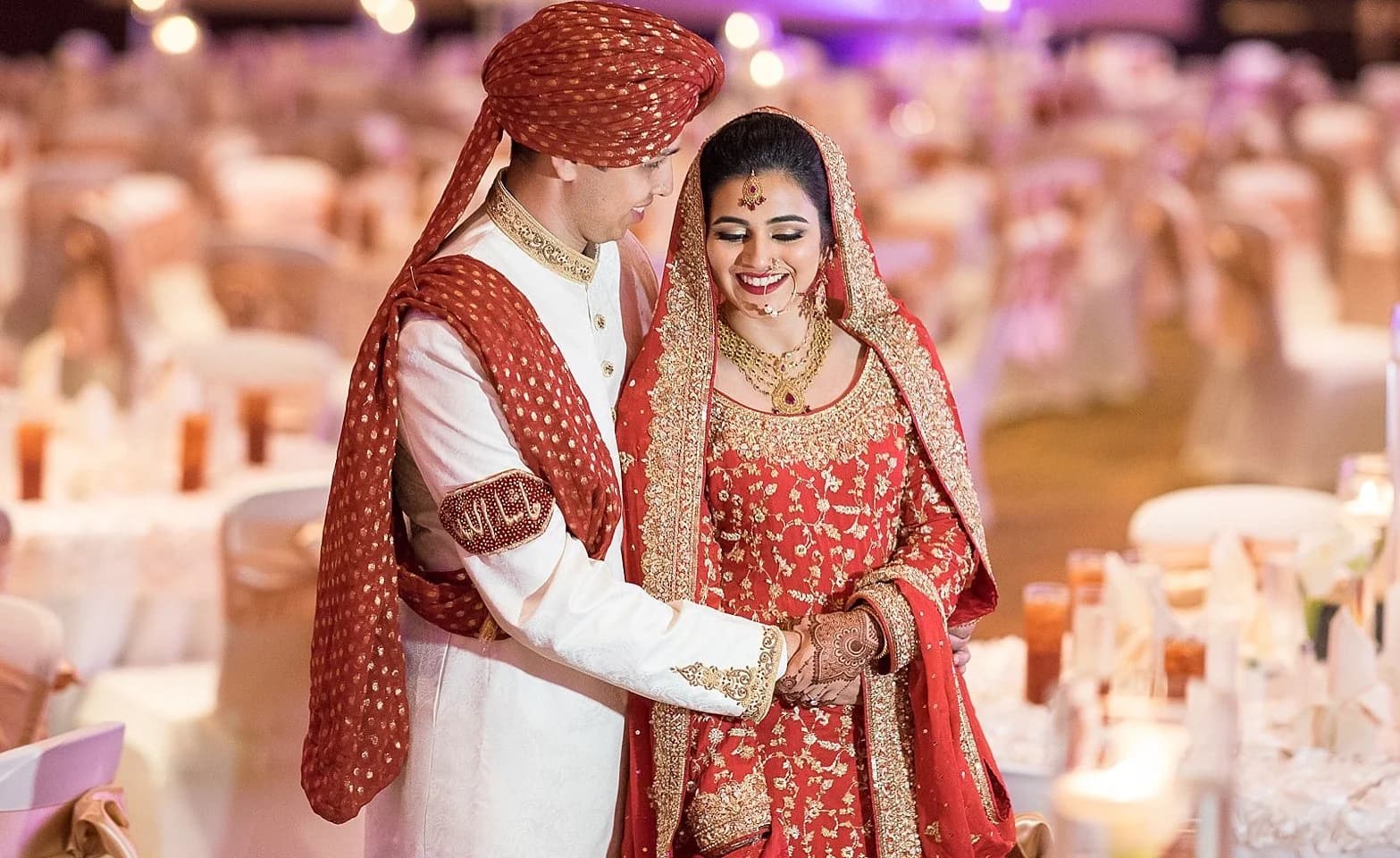
Modesty is the through-line for everyone present; elegance is entirely welcome. Brides most often wear a modest gown, a traditional dress from their culture, or a tailored suit, typically with shoulders covered and, in a mosque setting, a headscarf; many brides choose a veil or scarf styled as part of the look rather than an afterthought. Grooms wear a suit or cultural dress, a thobe, sherwani or kurta depending on heritage.

Guests should dress as they would for an elegant, modest occasion: covered shoulders and knees as the baseline, with women often bringing a light scarf in case the ceremony is held in a mosque, where shoes also come off at the door. Colour is generally welcomed and varies by culture; if you are unsure, ask the couple's family, and when in doubt, dress up rather than down. The rules relax at the walima, which follows the couple's chosen dress code like any reception.
The mahr is central to the nikah and widely misunderstood outside it. It is a gift from the groom to the bride, agreed before the ceremony and recorded in the contract, and it becomes her property alone: not a payment to her family, not a shared asset, and not a transaction. It is a right of the bride built into the marriage itself.

Its form is deliberately open. Money, jewellery, property, gold, or something of personal and symbolic meaning are all common; the amount and form are agreed between the couple and their families beforehand, and vary widely by culture and means. Part of the mahr may be given at the nikah and part deferred to a later date by agreement, and the deferred portion remains her entitlement. Couples navigating the conversation for the first time should treat it the way the tradition intends: openly, respectfully and settled before the ceremony so the day itself is purely celebration. For how the mahr sits alongside the other constants, the traditions in almost every Muslim wedding are a 5-minute primer worth sharing with guests new to it all.
The walima is the celebratory feast after the marriage, hosted traditionally by the groom's side, and it is where the nikah's quiet solemnity turns into a wedding party. It may follow the ceremony the same evening, land the next day, or arrive weeks later as its own event; all are established practice, and the gap is often used to bridge a quiet nikah and a grand celebration.

In scale and style the walima behaves like any reception, from an intimate family dinner to a ballroom celebration, and this is where cultural traditions bloom around the Islamic core: the zaffe drummers of a Lebanese celebration, the sofreh of a Persian one, the mehndi colours of a South Asian one. Gulf celebrations bring their own beloved customs, and our tour of wedding traditions in the UAE shows how the region honours the feast. One planning note travels everywhere: if the walima lands near Ramadan or the Eid periods, set timings with the family elders first, because those weeks reshape everything from menus to start times.
The nikah is the religious marriage; the civil layer that makes it legally recognised runs separately, and the mechanics differ by country. The clean rule: confirm before the date is set whether your officiant carries civil authority, and if not, book the civil step deliberately.
Australia | United States | |
|---|---|---|
The combined path | Many imams are registered marriage celebrants: the nikah and the legal marriage happen in one ceremony, with the Notice of Intended Marriage lodged at least 1 month before | Officiant requirements are set by state; where the imam is authorised, the nikah and legal marriage combine, with the marriage licence obtained from the county beforehand |
The 2-step path | A quiet civil registration before or after the nikah, with the nikah as the religious and family centrepiece | The same: courthouse or celebrant civil marriage alongside the nikah, in either order |
Watch | The 1-month notice period is real; lodge early | Licence validity windows vary by state and can be short; time the licence to the nikah date |
For couples marrying across borders, a nikah abroad followed by home registration, or the reverse, both work; the paperwork order just needs deciding early. And for a destination nikah and walima, the venue question becomes wonderfully open: a private estate, a beachfront lawn at the right modest hour, a heritage ballroom. That is precisely the kind of brief our network was built for. If you are marrying in the Gulf or the wider Middle East, check whether Middle Eastern destination weddings are legally binding before you set the date.
The nikah endures because its essentials are few and profound: consent, a contract, a gift and witnesses. Around that core, every culture builds its own celebration, quiet or resplendent, home or ballroom, and both honour it equally. Understand the requirements, settle the legal layer early, and the rest is the joyful part: deciding how your families will celebrate what the contract makes true. Our guides to cross-cultural weddings, Jewish wedding traditions and Indian wedding traditions continue the journey across the faiths and cultures Wedded Wonderland celebrates.
Wedded Wonderland curates venues and vendors who understand the ceremony's requirements, from prayer-space logistics to halal menus worth celebrating in their own right. Speak with a Wedded Advisor, tell us your traditions, guest count and cities, and the shortlist comes back fluent in all 3.
Written by

Content and Creative Manager
Joseph Joshua is the SEO & Content Manager at Wedded Wonderland, bringing an editorial and search strategy perspective to the publication’s coverage of luxury weddings, destination celebrations and bridal lifestyle. His approach to content centres on helping readers move from inspiration to informed decisions, with attention to the design, craftsmanship and personal details that give a celebration its character.