Wedding dresses don't begin in bridal salons. More often than not, they begin in Paris.
Not as gowns destined for the aisle, but as ideas. A silhouette introduced during couture season finds its way into bridal collections a year later. A new neckline becomes the shape everyone suddenly wants to wear. A fresh approach to embroidery eventually appears in ateliers around the world. Couture has always been less about telling brides what to wear than showing them where fashion is headed.
This season, that direction felt remarkably aligned.
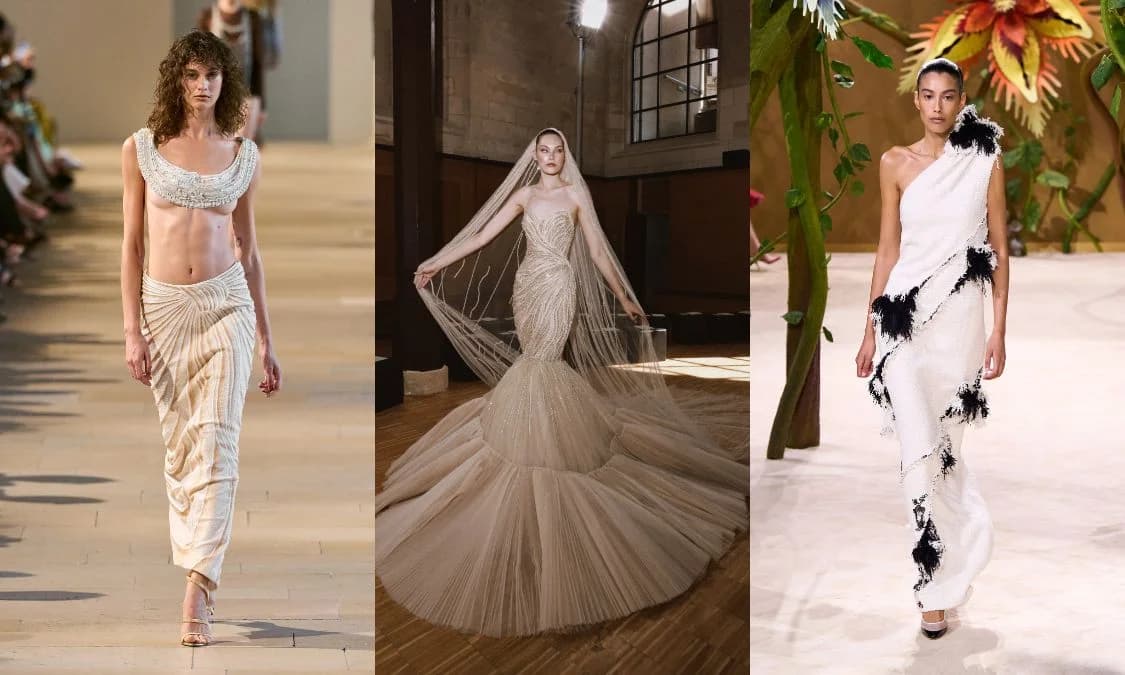
Across Schiaparelli, Chanel, Dior, Balenciaga, Georges Hobeika, Tony Ward, and Rahul Mishra, there was a noticeable move away from bridal maximalism. Instead of relying on bigger skirts, tighter corsets, or heavier embellishment, designers focused on proportion, texture, and construction. The result wasn't subtler. It was simply more considered.
If these collections are any indication, the next chapter of bridal fashion isn't about making a bigger statement. It's about making a better one.


The corset isn't disappearing. It's simply becoming less obvious.
For the better part of the last decade, exposed boning and sharply defined waists have dominated bridal fashion. At this couture season, structure remained, but it worked behind the scenes. Shape came from impeccable draping, sculptural tailoring, and precision cutting rather than visible construction.
Dior's softly gathered silhouettes created definition without rigidity, while Georges Hobeika's strapless gowns proved that clean lines can be just as impactful as intricate corsetry. Schiaparelli took the idea into more experimental territory with molded bodices that transformed the body into sculpture, showing that couture is finding new ways to celebrate form.
For brides, the takeaway is clear. The most modern silhouette isn't about looking tightly laced. It's about looking effortlessly sculpted.
Every bride wants a dress that photographs beautifully. Increasingly, designers are creating dresses that move beautifully first.


Volume appeared throughout couture week, but rarely in the traditional princess sense. Tony Ward's sweeping bridal look floated behind the model rather than standing away from her body. Balenciaga explored sculptural silhouettes that still carried surprising fluidity, while Dior relied on gathered fabric to create fullness without heaviness.
Movement has become part of the design language. A dress is no longer judged only by how it looks standing still, but by how it comes alive in motion.
There was no shortage of embellishment in Paris. It simply worked differently.


Instead of relying on crystal after crystal, designers built interest through surfaces. Lace layered over lace. Embroidery followed the shape of the body. Florals appeared as sculptural appliqués rather than predictable motifs. Schiaparelli experimented with unconventional materials, while Chanel and Georges Hobeika demonstrated that intricate handwork often has greater impact than obvious shine.
It feels like a natural evolution for bridal fashion, where luxury increasingly comes from craftsmanship rather than ornament alone.
If there was one place designers consistently drew the eye, it was upward.
Across the collections, necklines became an integral part of the silhouette. Strapless bodices were sculpted rather than simple. Halter necks felt refined instead of sporty. Off-the-shoulder draping framed the face with quiet elegance, while dramatic collars and veils extended the architecture of the gown itself.


Georges Hobeika embraced clean strapless lines, and Tony Ward elevated classic bridal silhouettes with elegant framing around the shoulder.
It's a shift that naturally complements today's bridal styling, where understated jewellery and polished beauty looks allow the dress to speak first.

Flowers remained a recurring motif, but they rarely appeared in the way bridal fashion has traditionally interpreted romance.

Instead of relying on classic floral lace, couture houses introduced petals through dimensional embroidery, botanical textures, sculpted embellishment, and organic forms. Romance felt less literal and far more expressive.
The effect was refreshing. It proved that bridal references don't need to be obvious to feel unmistakably romantic.


Perhaps the most defining luxury of the week wasn't a silhouette or a colour. It was time.
Time spent embroidering. Time spent draping. Time spent perfecting every seam until the construction became almost invisible.
Georges Hobeika's meticulous beadwork, Chanel's delicate ombre featherwork, and Tony Ward's layered craftsmanship all reflected a renewed appreciation for the artistry behind couture. Nothing felt rushed, and nothing relied on excess to make an impression.
It's a fitting direction for bridal fashion, where the most meaningful gowns are often the ones valued not only for how they look on the wedding day, but for the craftsmanship they carry long after the celebration ends.

Most brides won't walk down the aisle in a couture runway gown. That doesn't mean couture can't shape the way they dress.
The strongest bridal looks borrow ideas rather than duplicate them. A beautifully sculpted neckline. Softer draping instead of rigid corsetry. Hand-finished embroidery that feels personal rather than excessive. These are the details that elevate a wedding dress, regardless of the designer.
For couples looking to translate runway inspiration into their own celebration, Wedded Concierge offers access to trusted bridal professionals who can help curate every detail, from finding the right designer to refining the finishing touches. Because great bridal style isn't about recreating a runway moment. It's about creating one that's entirely your own.
Haute couture has never been about predicting exactly what brides will wear. It has always been about introducing ideas that eventually become part of the bridal conversation.
Paris Haute Couture Week Fall/Winter 2026 reminded us that bridal fashion doesn't have to choose between romance and modernity, softness and structure, or craftsmanship and ease.
The most exciting wedding dresses on the horizon may not be the biggest, the brightest, or the most embellished.
They will be the ones that feel beautifully resolved, where every seam, every fold, and every embroidered detail has a reason for being.
And if Paris is any indication, that's exactly where bridal fashion is headed.
For more runway reports, bridal fashion forecasts, celebrity wedding style, and the trends shaping luxury weddings around the world, follow Wedded Wonderland. Couples beginning their own wedding journey can also explore Wedded Concierge for thoughtful guidance and personalized planning support.
Search real weddings, venues and vendors from around the world.
Search Wedded Wonderland