Which Wedding Planning Websites and Tools Are Best?
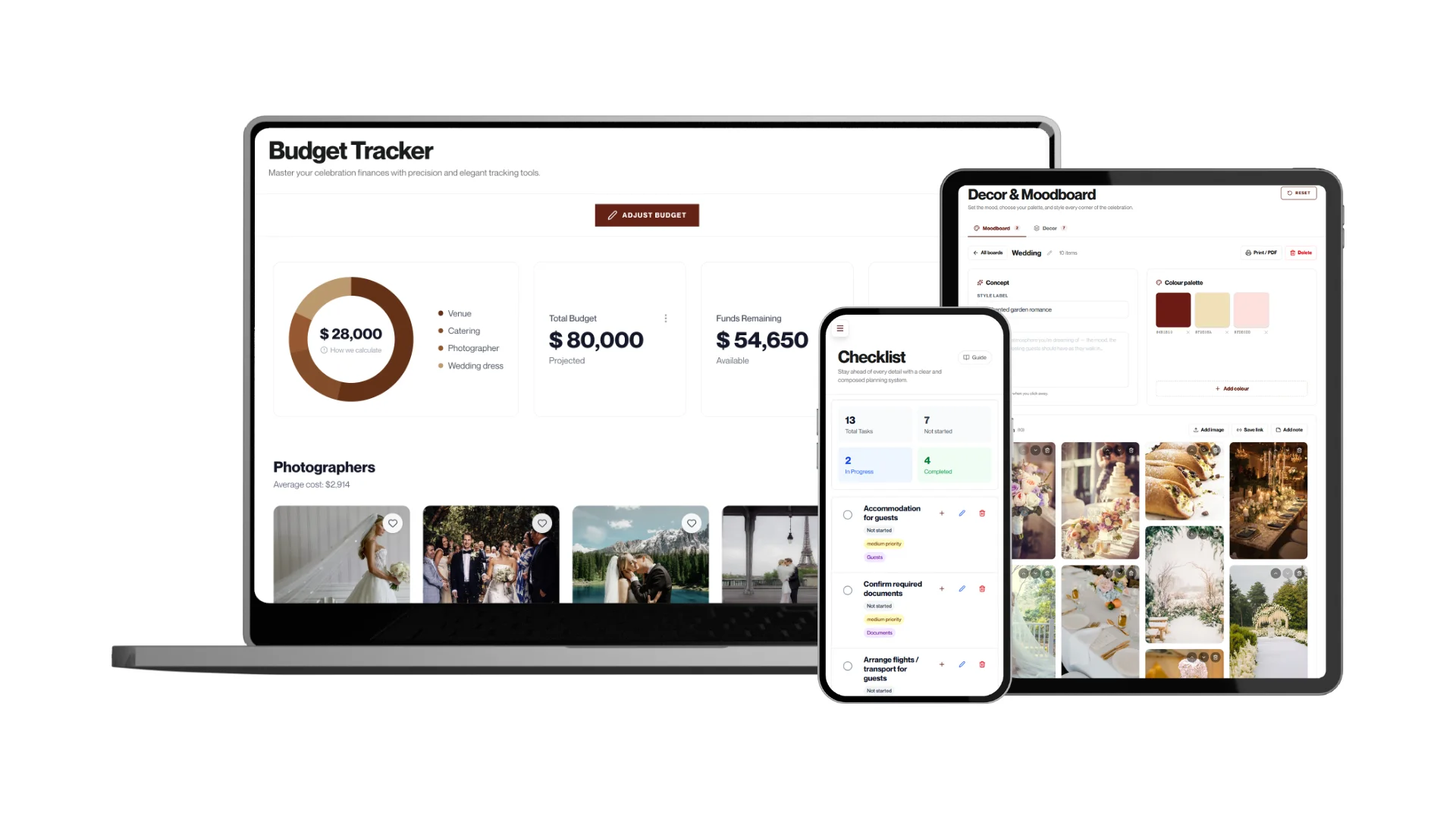
There is no single best wedding planning website. Zola suits couples who want registry, website and guest list in one login. The Knot suits couples booking US vendors. Joy suits multi-day weddings with travelling guests, and Squarespace suits couples who want full design control. Most couples end up using two tools.
Most wedding planning platforms do the same six things: a website, a guest list, RSVPs, a registry, a budget tracker and a vendor search. The reason to pick one over another is not the feature list, it is what the platform is actually built around. Zola is built around a registry. The Knot is built around a marketplace. Joy is built around design and travel. Here is which problem each one solves.
- Most wedding planning platforms do the same six things: a website, guest list, RSVPs, registry, budget tracker and vendor search.
- Choose by what a platform is built around, not by its feature list.
- Check what the free tier actually costs you before you commit.
- Match the platform to your planning style.
What should a wedding planning website give you?
Before comparing, know what you are comparing on:
A website builder with RSVPs and a guest list
A registry, or clean integration with one elsewhere
A budget tracker that you will actually open twice
Vendor search, useful only if it covers where you are marrying
A custom domain, included or priced clearly
Anything beyond that is a tiebreaker.

Which wedding planning platform is built for what you need?
Feature claims checked against each platform's own pages in August 2026. Pricing changes, so confirm on the platform before you pay.
Platform | Built around | Free to publish | Best for |
Zola | Its registry | Yes | Couples who want one account for everything |
The Knot | Its vendor marketplace | Yes, 100+ templates | Couples booking US vendors, and wanting budget tools |
Joy | Design and guest travel | Yes, 600+ templates, zero-fee cash registry | Multi-day weddings and travelling guests |
Minted | Stationery | Yes, $15 custom URL | Couples whose paper matters |
WeddingWire | Vendor reviews | Yes | Vendor research more than site building |
Loverly | Free all-in-one planner | Yes | Budgets, checklists, guest lists in one place |
Squarespace | Web design | From $16/mo billed annually | Couples who want a real website |
Why should you be careful with wedding vendor marketplaces?
The Knot and WeddingWire are advertising marketplaces. Vendors pay to be listed and to rank within the listings. That does not make the reviews worthless, but it does mean "top rated in your area" is not a neutral ranking, and you should read it as a shortlist to research rather than a verdict.
⚑ This matters much more for a destination wedding, where marketplace coverage outside the US thins out fast and the listings you do see are the ones that paid to be visible in a market they may not know well.
What do the free wedding planning tiers really cost you?
Every platform here except Squarespace publishes for free. What you give up on free is consistent:
Your own domain. Usually $15 to $40 a year.
The platform's branding in the footer of your site.
Registry fees on cash gifts, which Joy uniquely waives.
The one to price properly is the registry cut, because it is the only one that scales with your wedding rather than being a flat fee.
Which wedding planning tool suits your planning style best?

You want one login for everything: Zola.
You are booking US vendors and want a budget tracker: The Knot.
Your guests are travelling, or it is a weekend not a day: Joy.
You have already chosen your stationery: Minted.
You want the website to look like yours: Squarespace.
You are researching vendors before anything else: WeddingWire, read with the marketplace caveat above.
Is Zola or Joy better for your wedding planning?
It depends on what your wedding is built around. Zola is built around its registry, so it suits couples who want the website, guest list and gifts in one login. Joy is built around design and travel, so it suits weekend weddings and guests flying in, and it waives the registry fee on cash gifts, which matters more as your guest list grows.
If you are still deciding on a website builder alone, see our free wedding website builders compared.
Handle the bookings, the guests and the details, so the day feels like you.
What are the most asked questions about planning websites?
What is the best wedding planning website?
Are wedding planning websites free?
Do I need more than one?
Which is best for a destination wedding?
What is the best free website for wedding planning?

Where does Wonderland Studio fit for destination weddings?
Disclosure: Wedded Wonderland makes Wonderland Studio.
Everything above is built for a wedding where the guests drive there.
Studio is built for the other kind, and you can see it in the defaults rather than the feature list. The website templates are organised by tradition instead of by colour, so the South Asian one arrives with mehndi, sangeet, baraat and the pheras already structured, and the Arab one with the henna night, nikah and zaffe. The guest list requires the city and country each person is travelling from. The timeline and the checklist both ship a destination template covering travel logistics, guest accommodation and remote coordination. The budget's two starting points are a local wedding at around $150,000 and a destination one at around $185,000 for 60 to 100 travelling guests.
The other structural difference is the vendor tool. It autofills from Wedded Wonderland's own listings rather than a generic directory, tracks contract status, deposit and balance for each supplier, and attaches them to specific moments on the run sheet. That only works because the marketplace and the planner are the same company.


Two things it does not do: it has no gift registry, and it is not free. If either of those is decisive, one of the platforms above is your answer and we would rather tell you now.
See what is inside Wonderland Studio, or all eleven planning tools.
If you are comparing these on behalf of clients rather than for your own wedding, our trade membership holds the industry data and guides that sit behind recommendations like these.
Written by

Joseph Joshua Ngushual
Content and Creative Manager
Joseph Joshua is the SEO & Content Manager at Wedded Wonderland, bringing an editorial and search strategy perspective to the publication’s coverage of luxury weddings, destination celebrations and bridal lifestyle. His approach to content centres on helping readers move from inspiration to informed decisions, with attention to the design, craftsmanship and personal details that give a celebration its character.






Keep exploring
Search real weddings, venues and vendors from around the world.
Search Wedded Wonderland