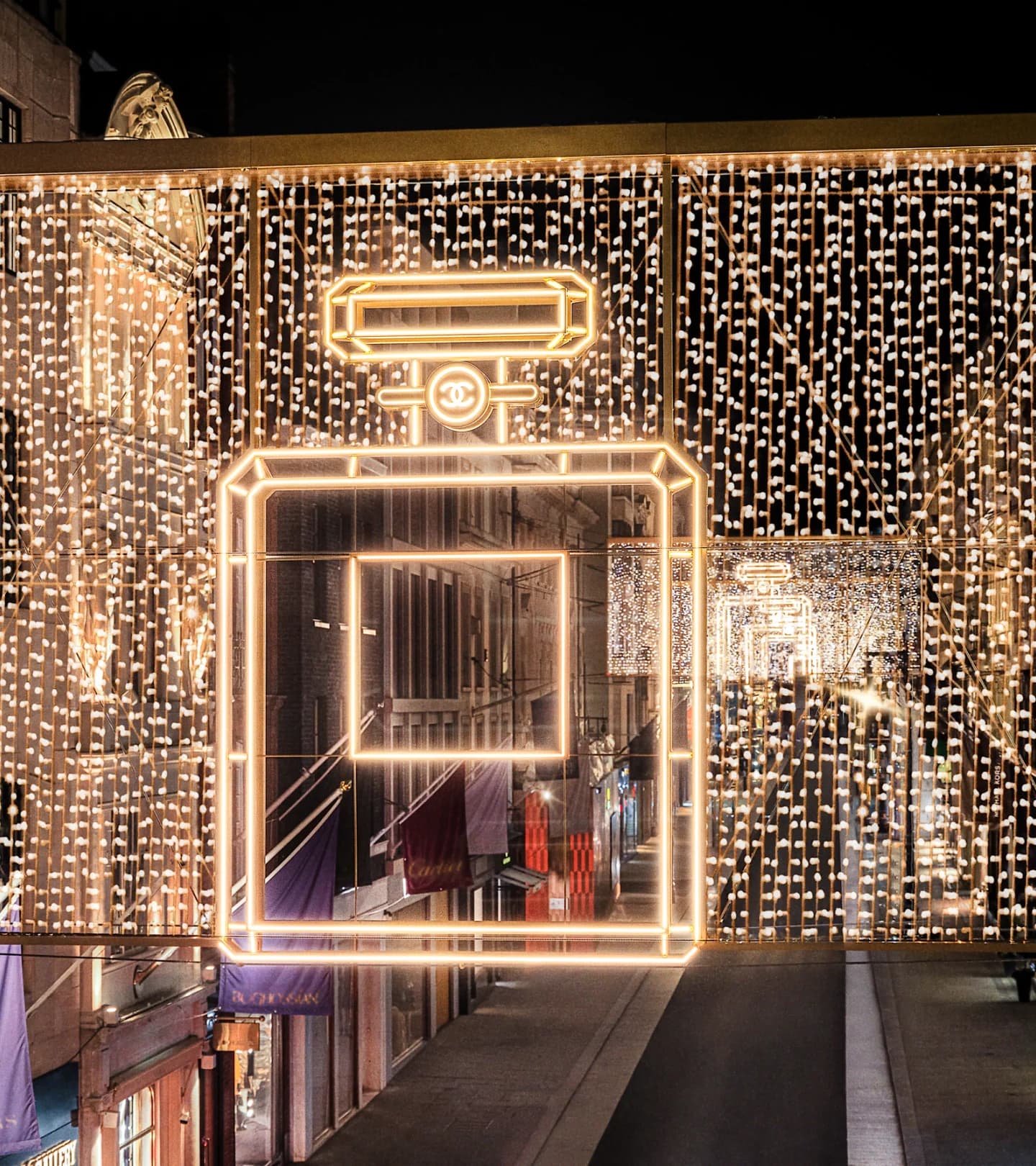
Every holiday season, luxury brands perform the same ritual. Facades light up. Windows turn theatrical. Entire city blocks slow down as crowds gather, phones raised, not to shop but to look. For an industry built on scarcity, this annual public display can seem counterintuitive, even wasteful.
It isn’t.
Holiday installations are not seasonal indulgences or aesthetic generosity. They are among luxury’s most deliberate brand investments, designed not to convert immediately, but to compound value over time. In an era where attention is fragmented, retail is under pressure, and luxury must justify its physical presence, these spectacles have become a strategic necessity.
To understand why, you have to look beyond Christmas, and beyond decoration, and examine how luxury actually grows.

Luxury depends on a paradox: it must remain exclusive while staying highly visible. The industry cannot afford to disappear from public life, yet overt selling erodes prestige. Holiday installations solve this tension elegantly.
They allow brands to occupy public space without transactional messaging. No price tags, no call-to-action, no urgency to buy. Instead, the brand becomes part of the city’s seasonal rhythm. It is seen without asking to be chosen.
This matters more than it appears. Brand salience, the likelihood a consumer thinks of a brand when a purchase moment eventually arrives, is built long before intent. Holiday spectacles quietly seed that familiarity, particularly among younger or aspirational audiences who may not yet be buyers but will be.
Luxury understands something mass retail often forgets: today’s non-customer is tomorrow’s high-value client.

Luxury brands activate throughout the year, but December holds a unique cultural advantage. Christmas is one of the few remaining moments where excess is not only accepted but expected. Emotional expression, nostalgia, fantasy, and ritual converge at scale. The season provides cultural permission for luxury to lean into theatricality without appearing self-indulgent.
At no other time of year do light, craft, and imagination feel so collectively meaningful. In December, consumers slow down, look up, and linger. That behavioral shift is critical. Luxury is not built on impulse; it thrives in moments of pause.
The holiday installation capitalizes on this mindset. It doesn’t interrupt the public, it meets them where they already are: reflective, sentimental, open to wonder.

Over the past two decades, luxury retail has been redefined. Stores are no longer primarily points of sale; they are brand environments. The rise of e-commerce has forced physical retail to justify itself not through convenience, but through meaning.
Holiday installations sit at the intersection of commerce, culture, and architecture. They are emotional infrastructure, built to be inhabited, photographed, remembered. They create memory before transaction, which is far more valuable in luxury than immediate conversion.
This is why the most successful installations rarely foreground product. The object is not the hero; the feeling is. Luxury brands are not selling coats or bags in December, they are reinforcing why those objects matter in the first place.

It is tempting to reduce holiday displays to “Instagram moments,” but that framing is too narrow. Social sharing is not the objective; it is the amplification layer.
What luxury brands are really buying is cultural embedding. When an installation becomes part of how a city experiences the season, when locals recommend it, tourists seek it out, and media documents it, the brand enters collective memory. People may forget the exact design, but they remember where they were, who they were with, and how it felt.
That emotional association is extraordinarily difficult to manufacture through traditional advertising. Holiday installations achieve it organically, year after year.
The reason this strategy belongs almost exclusively to luxury is simple: most industries cannot afford to invest without immediate return. Luxury can, because its margins, timelines, and customer lifetime values operate on a different scale.
Holiday spectacles are not measured by week-on-week sales uplift alone. Their value lies in brand equity, loyalty reinforcement, and perception management. They remind the public that luxury is not transactional, fast, or disposable. It is imaginative, patient, and rooted in ritual.
In a market increasingly driven by speed and screens, these physical moments of slowness become differentiators.
Luxury brands continue to invest in holiday installations not because the season demands it, but because the strategy works. It reinforces identity without explanation. It creates relevance without noise. It turns marketing into tradition.
Most importantly, it reminds consumers, buyers and non-buyers alike, that luxury is not just about owning something. It is about feeling something in a world that rarely slows down enough to allow it.
And that, ultimately, is the real business of holiday spectacle.
For more fashion and business insights, follow Wedded Wonderland. Join our complimentary Wedded Concierge service or explore our Wedded Partners Global Listing, and let’s get Wedded!
Elevate Your Brand With
Search real weddings, venues and vendors from around the world.
Search Wedded Wonderland